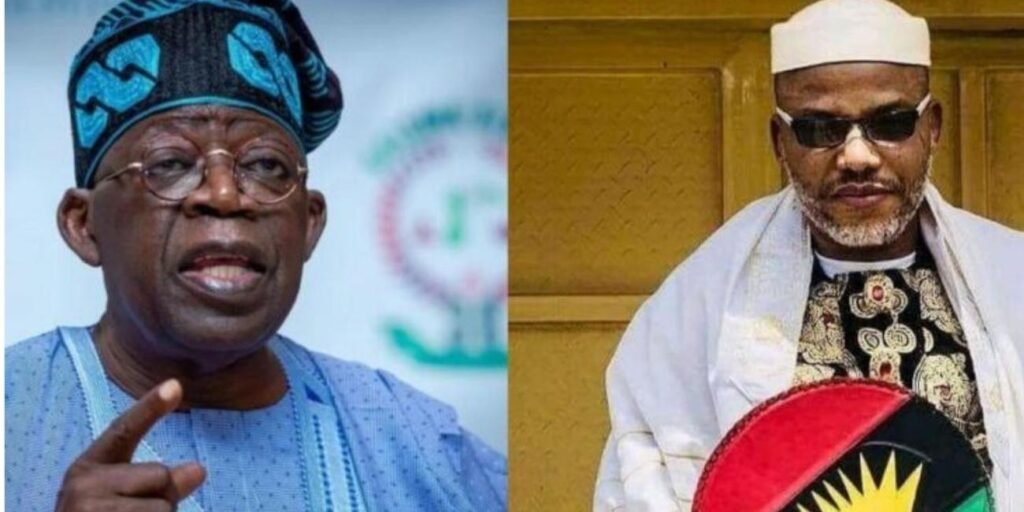
Fresh political pressure is mounting on President Bola Ahmed Tinubu as the apex Igbo socio-cultural organisation, Ohanaeze Ndigbo, has demanded that the Federal Government grant amnesty to detained Nnamdi Kanu on or before June 12, 2026, warning that continued detention risks deepening national divisions and prolonging unrest in the South-East.
In a strongly worded statement signed by factional Deputy President-General, Okechukwu Isiguzoro, and National Publicity Secretary, Chief Thompson Ohia, the group argued that aligning Kanu’s release with Democracy Day would serve as a powerful symbolic gesture capable of fostering national healing and political reconciliation.
The organisation described June 12 as a historic opportunity for the Tinubu administration to reset relations with the South-East, insisting that granting amnesty to the detained leader of the Indigenous People of Biafra would help calm long-standing tensions and rebuild trust between the region and the Federal Government.
According to Ohanaeze, Kanu’s agitation has been widely misunderstood, arguing that his ideological position aligns more closely with the “Biafra of the Mind” philosophy championed by late Igbo leader Chukwuemeka Odumegwu Ojukwu rather than a renewed secessionist campaign.
The group maintained that Kanu’s demands are rooted in dialogue, identity consciousness, and calls for equity within a restructured Nigerian federation, rather than violent separation. It further traced Kanu’s early activism to his association with Ralph Uwazuruike, founder of the Movement for the Actualisation of the Sovereign State of Biafra, noting that his initial posture was largely non-violent before tensions escalated.
Ohanaeze also dismissed concerns that Kanu’s release could destabilise the political landscape or complicate the 2027 elections, arguing instead that such a move could strengthen Tinubu’s political standing in the South-East and create a pathway for national reconciliation.
In a controversial twist, the group alleged that opposition figures, including former Vice President Atiku Abubakar, Labour Party presidential candidate Peter Obi, and Rabiu Musa Kwankwaso, may be benefiting politically from Kanu’s continued detention as preparations quietly begin ahead of the 2027 general elections.
The organisation also acknowledged ongoing infrastructure interventions in the South-East by the Tinubu administration, particularly road rehabilitation projects, but argued that such developments fall short of the political symbolism and national healing that Kanu’s release would represent.
Ohanaeze insisted that granting amnesty would open a new chapter of trust, unity, and cooperative nation-building, claiming that Kanu would embrace structured national dialogue rather than return to agitation if released.
As political calculations ahead of 2027 gradually intensify, the demand adds another layer to the already complex national debate surrounding Kanu’s detention, regional grievances, and the broader question of national unity.
For many observers, the call by Ohanaeze signals growing pressure on the Tinubu administration to take a decisive political step that could either reshape relations with the South-East or further deepen existing fault lines within Nigeria’s fragile political landscape.