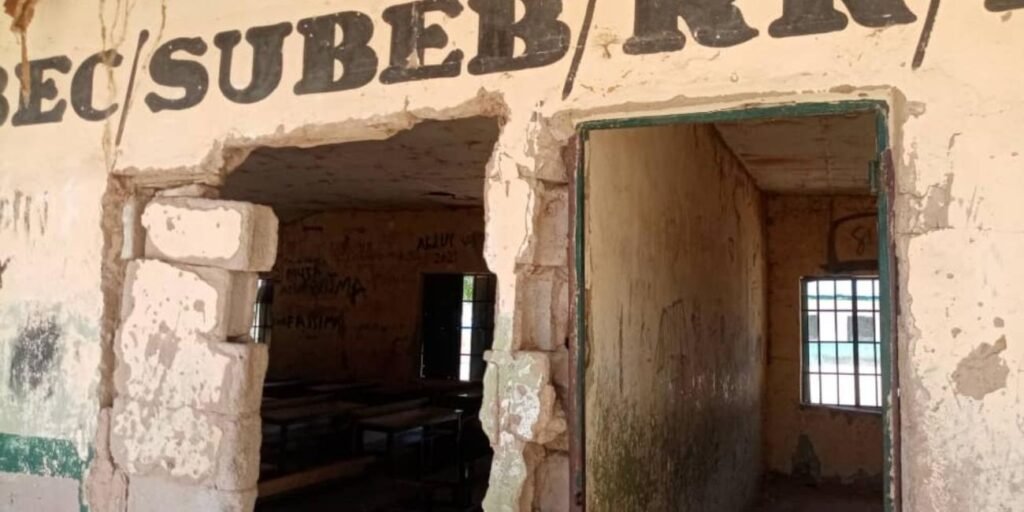
More than 300 pupils of Community Primary School in Ayama, Auyo Local Government Area, are currently learning inside dangerously dilapidated classrooms described as “death traps,” following years of alleged neglect under the administration of Umar Namadi.
The shocking revelation emerged after a field assessment conducted by Tracka, which exposed the harsh and unsafe learning conditions faced daily by children in the rural community.
According to findings obtained by Chronicles Reporters, the school, which serves as the only public primary institution for the Ayama community, has deteriorated into a hazardous environment where pupils are forced to pursue education under crumbling structures, cracked walls, damaged floors, and partially collapsed roofs.
The report described the situation as both shocking and heartbreaking, revealing that several classrooms have lost structural integrity and now pose serious risks to both pupils and teachers, particularly during harsh weather conditions.
Investigators observed that ventilation in many of the classrooms is extremely poor, while some buildings have deteriorated to the point where they could collapse at any moment. Despite these life-threatening conditions, children continue to gather daily inside the unsafe structures in pursuit of education.
Residents disclosed that the crisis has persisted for over three years, with repeated appeals to authorities yielding little or no intervention. Community members, desperate to keep the school operational, reportedly pooled scarce resources to carry out temporary repairs, patch leaking roofs, and reinforce weakened structures.
However, these local efforts have proven insufficient in addressing the scale of infrastructural decay that now defines the school environment.
Beyond the structural collapse, overcrowding has worsened the already dire learning conditions. With limited furniture available, many pupils are forced to sit directly on bare floors during lessons, further undermining their dignity and learning experience.
Education advocates warn that the unsafe learning environment not only threatens the physical safety of children but also weakens academic performance and increases dropout rates, particularly in rural communities already struggling with access to education.
Reacting to the findings, MonITNG expressed deep concern over the deteriorating condition of the school, linking the poor environment to declining school attendance and rising dropout rates among pupils in Jigawa State.
The organisation also questioned the disconnect between annual education budget allocations and the harsh realities faced by pupils in underserved communities.
According to MonITNG, the situation is particularly troubling given that billions of naira are reportedly allocated to the education sector annually, yet children in rural communities continue to learn under life-threatening conditions.
The organisation called for urgent intervention, urging authorities to reconstruct damaged classrooms, provide adequate furniture, and ensure access to clean water and sanitation facilities.
The group further warned that continued neglect could have long-term consequences for the future of the affected children, stressing that education should never become a gamble with the lives of young learners.
The crisis in Ayama reflects a broader pattern across rural Nigeria, where public schools remain trapped in cycles of neglect, dilapidation, and inadequate funding, despite repeated government promises to improve education infrastructure.
For the pupils of Ayama community, however, the crisis is no longer a policy debate but a daily struggle for survival, as hundreds of children continue to learn inside collapsing classrooms, hoping that help will arrive before tragedy strikes.