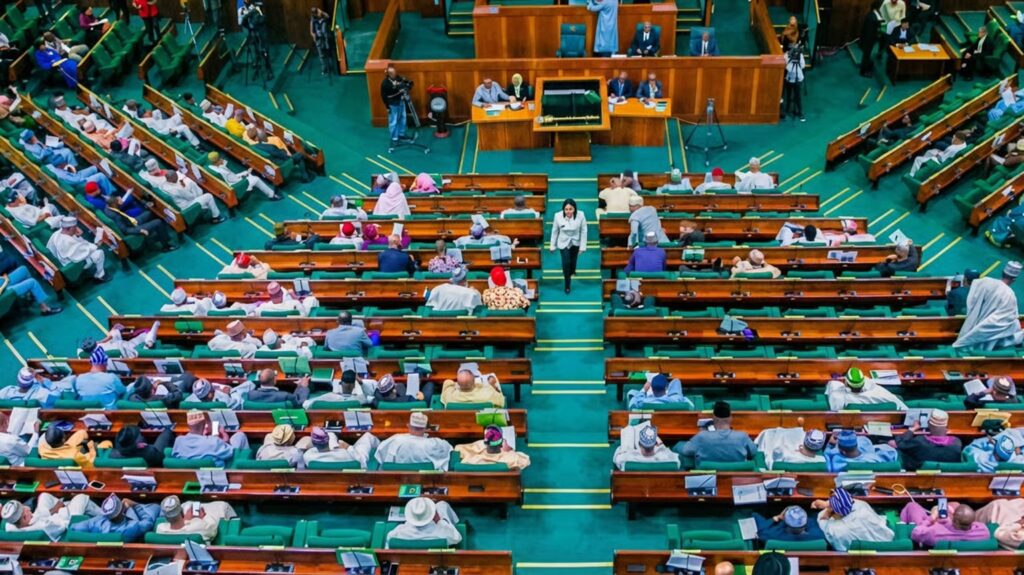
There was mild drama at the National Assembly on Wednesday as members of the House of Representatives openly demanded the resignation of the Minister of Finance and Coordinating Minister of the Economy, Wale Edun, alongside the Minister of Budget and Economic Planning, Atiku Bagudu, and the Chairman of the Nigeria Revenue Service (NRS), Zach Adedeji, over what lawmakers described as a total failure to implement the 2025 capital budget.
The heated confrontation occurred during a session of the House Committee on Appropriation, where legislators grilled the federal government’s economic team over the alleged zero release of funds for capital projects across ministries, departments and agencies (MDAs), despite claims of excess revenue recorded in the 2025 fiscal year.
Chairman of the Committee, Hon. Abubakar Bichi, said the session was convened to probe why capital projects in the 2025 Appropriation Act had not commenced, even as revenue performance exceeded projections.
“This interface is for us to study, consider and approve requests before us. We decided to engage the economic team of the President to discuss the performance of the 2025 budget as well as the proposed 2026 budget,” Bichi said.
“In 2025, we achieved about ₦28 trillion in revenue from a target of ₦25 trillion. Nigerians deserve to know why capital projects have not been funded.”
Lawmakers disclosed that the executive had earlier requested and obtained legislative approval for ₦1.15 trillion to support portions of the 2025 capital budget. Both chambers of the House of Representatives and the Senate approved the request.
However, committee members demanded explanations as to why capital project implementation remained at zero months after approval.
Responding, Finance Minister Wale Edun defended the administration’s fiscal posture, insisting that the government had abandoned what he described as “unsustainable practices” inherited from previous administrations.
“We stopped the unsustainable methodology of printing money—whether to pay contractors, service debts, or meet other obligations,” Edun said.
“We inherited a naira debt stock of about ₦152 trillion. Roughly ₦30 trillion was an accounting adjustment, while another ₦50 trillion resulted from exchange rate realignment following the move to a market-based foreign exchange system.”
He argued that fiscal stabilization and debt regularization took precedence over immediate capital releases.
In his submission, Budget and Economic Planning Minister Atiku Bagudu revealed that following consultations with the National Assembly, approval was granted to roll over 70 percent of the 2025 capital expenditure into the 2026 fiscal year.
According to Bagudu, the deferred capital allocations now form a major component of the 2026 budget proposal currently before the legislature.
He also distanced his ministry from responsibility for budget implementation data, stating:
“The Ministry of Budget and Economic Planning relies on the Office of the Accountant-General of the Federation and the Ministry of Finance for budget implementation figures.”
Defending his agency, NRS Chairman Zach Adedeji maintained that revenue generation was not responsible for the poor capital performance.
He disclosed that the service exceeded its 2025 revenue target, generating ₦28.23 trillion against a projected ₦25.2 trillion.
Unsatisfied with the explanations, several lawmakers descended into angry exchanges, shouting at Edun, Bagudu, and the Minister of State for Finance, Doris Uzoka-Anite, and openly calling on them to resign for incompetence and failure to deliver.
The tense session was eventually brought under control by Chairman Bichi, who appealed for calm and announced an adjournment pending the appearance of the Minister of State for Finance.
Proceedings were subsequently adjourned to Thursday at 1:00pm, when further clarifications are expected.
The controversy comes amid growing concerns over economic stagnation and stalled public infrastructure. Earlier in the week, the Minister of Health disclosed to lawmakers that his ministry received just ₦38 million out of a ₦286 billion capital allocation in the 2025 budget.
Lawmakers say nearly all ministers appearing for budget defence have reported zero capital releases, a situation they blame for worsening unemployment, abandoned projects, and what they describe as a near-collapse of the economy.
In January, the Association of Indigenous Contractors of Nigeria barricaded the Ministry of Finance, protesting the non-payment of over ₦4 trillion for certified and completed contracts executed under the 2024 budget.
The contractors accused the administration of abandoning duly executed projects despite budgetary provisions—deepening economic hardship and triggering job losses nationwide.
As pressure mounts on the economic team of President Bola Ahmed Tinubu, the National Assembly’s probe is expected to test the credibility of the government’s fiscal management and its commitment to capital development.