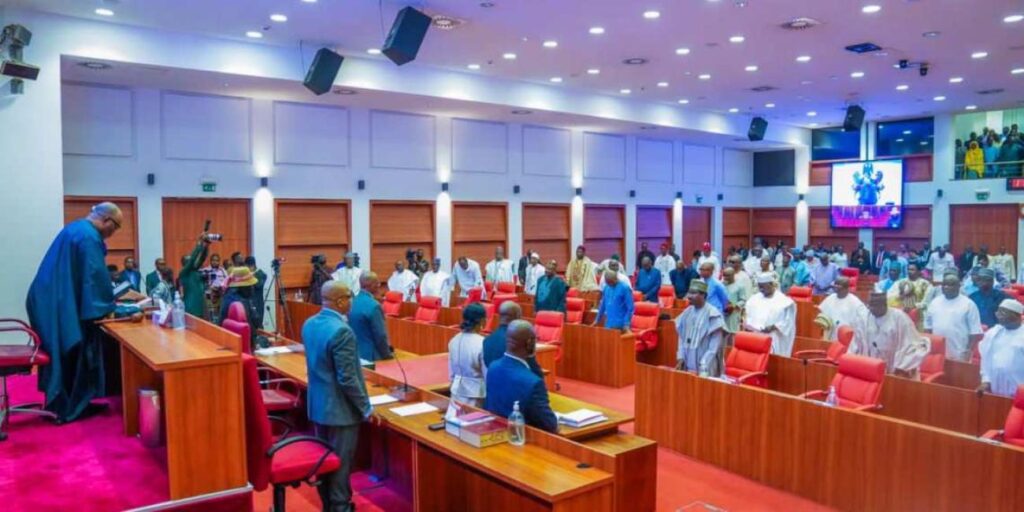
A coalition of civil society organisations has sharply criticised the Nigerian Senate over its recent vote on proposed amendments to the Electoral Act, warning that the decision poses serious risks to electoral integrity, transparency and public confidence ahead of the 2027 general elections.
In a statement made available on Saturday, the groups expressed deep concern over the Senate’s rejection of key reform proposals, including compulsory real-time electronic transmission of election results and measures to expand access to Permanent Voters’ Cards (PVCs).
The organisations said the Senate’s action undermines the gains achieved with the Electoral Act 2022 and weakens critical safeguards needed to ensure credible elections.
According to the statement dated February 5, 2026, senators voted against provisions that would have allowed voters to download missing or unissued PVCs and blocked electronic transmission of results reforms widely regarded as essential to curbing manipulation and restoring trust in the electoral process.
The groups also faulted the Senate for drastically shortening major electoral timelines, warning that the changes would weaken oversight and institutional readiness.
“The notice period for elections was reduced from 360 to 180 days, the deadline for political parties to submit candidate lists was cut from 180 to 90 days, and the timeframe for INEC to publish nominations was slashed from 150 to 60 days,” the statement said.
“These changes weaken public scrutiny, constrain institutional preparedness, and increase the risk of electoral manipulation,” it added.
While acknowledging the Senate’s decision to increase the fine for buying and selling PVCs to ₦5 million, the civil society organisations said the measure was insufficient and fell short of serving as a strong deterrent. They criticised the rejection of a proposed 10-year ban on offenders, arguing that without tougher sanctions such as electoral disqualification vote-buying and related abuses would persist.
“Strong sanctions are necessary to protect the integrity of the ballot and restore public confidence in democratic institutions,” the statement said.
The groups noted that the Senate’s position contrasts sharply with the more reform-oriented stance earlier adopted by the House of Representatives, particularly on electronic transmission of results, raising further concerns about the Senate’s commitment to credible elections.
They also referenced reports that 11 senators had distanced themselves from the vote, urging other lawmakers to follow suit by placing national interest above partisan considerations.
“We call on other Senators to insist that the Senate reverses its position, adopts real-time electronic transmission of results, and retains the existing timelines for key pre-election activities,” the groups said.
According to the coalition, electoral laws should strengthen the capacity of the Independent National Electoral Commission (INEC), enhance transparency and reassure citizens that the rules governing elections are not being shaped by political self-interest.
The organisations urged citizens, INEC and other stakeholders to challenge the Senate’s decision through the Conference Committee of the National Assembly, which is expected to harmonise differences between the Senate and the House of Representatives.
“At a time when public trust in elections remains fragile, Nigeria cannot afford legal provisions that narrow transparency, weaken oversight, or privilege political convenience over democratic integrity,” the statement warned.
As part of their demands, the groups called on the Conference Committee to adopt the House of Representatives’ position on compulsory real-time electronic transmission of results, retain existing statutory timelines for elections and party primaries, and conclude the harmonisation process swiftly so the final bill can be transmitted to the President within one week.
The statement was jointly signed by the Centre for Media and Society (CEMESO), Kukah Center, International Press Centre (IPC), Elect Her, Nigerian Women Trust Fund, TAF Africa and Yiaga Africa.
The organisations also urged Nigerians to hold their legislators accountable by demanding that provisions protecting electoral integrity and transparency are restored before the bill becomes law.