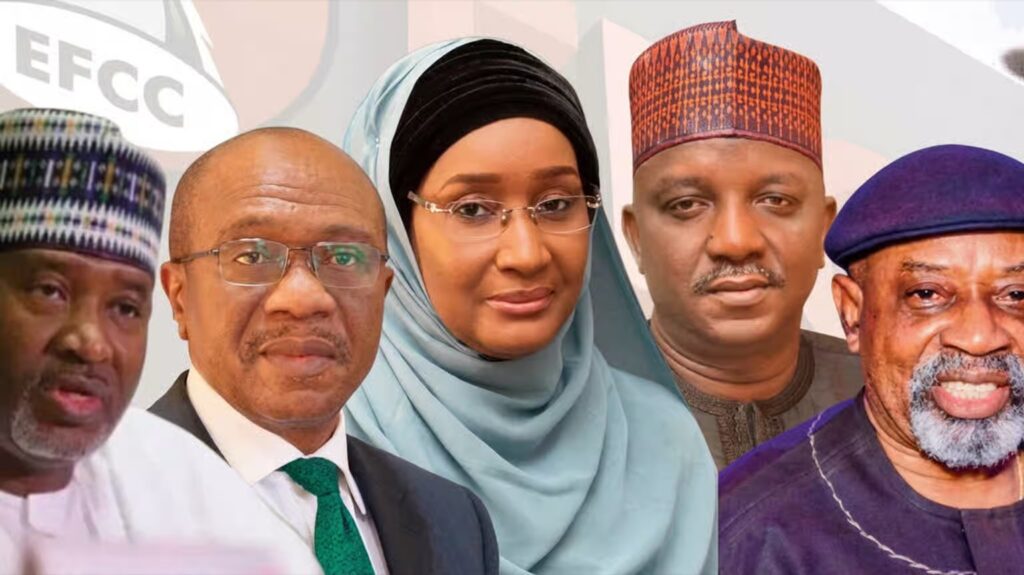
Several senior officials linked to the administration of former President Muhammadu Buhari are currently under investigation or prosecution over alleged corruption estimated at about N3.47 trillion, a development that has reignited national debate over accountability, selective justice and the real cost of Buhari’s eight years in office.
The unfolding cases come against the backdrop of Nigeria’s crippling debt burden, much of which was accumulated during the Buhari-led government. Critics argue that the scale of the alleged fraud exposes deep structural failures in public finance management, while supporters of the former administration insist the prosecutions are politically motivated and aimed at undermining Buhari’s anti-corruption legacy.
At the centre of the investigations are former ministers and top officials widely regarded as close allies of Buhari and key figures within the ruling All Progressives Congress (APC).
The Economic and Financial Crimes Commission (EFCC) is investigating Chris Ngige, former Minister of Labour, over an alleged N2.2 billion fraud. In November, the commission declared Timipre Sylva, former Minister of State for Petroleum Resources, wanted over an alleged N21.4 billion fraud. Sylva worked directly with Buhari, who served concurrently as President and substantive Minister of Petroleum Resources.
Also facing prosecution is former Minister of Aviation, Hadi Sirika, a close political associate of Buhari, over alleged fraud amounting to N2.7 billion linked to aviation projects.
However, the most far-reaching allegations surround Godwin Emefiele, former Governor of the Central Bank of Nigeria (CBN). According to the EFCC, Emefiele allegedly allocated N3 trillion worth of foreign exchange—equivalent to about $2 billion—without competitive bidding or due process, conferring undue advantages on associates.
Investigators further allege that Emefiele operated 593 bank accounts across multiple countries, unlawfully acquired a 753-unit housing estate in Abuja, and mismanaged over N16 billion in public funds.
Court filings also show that between 2019 and 2022, Emefiele allegedly warehoused funds in proxy accounts linked to Kelvito Integrated Services, with deposits of N167 million in 2019, N1.23 billion in 2020, N2.94 billion in 2021, and N1.98 billion in 2022, totalling over N6.3 billion. An additional N900 million was allegedly held in an account linked to Ifeadigo Integrated Services.
The EFCC has also accused the former CBN governor of forging a request for the payment of $6.2 million (about N8.8 billion) purportedly meant for foreign election observers.
Beyond the financial sector, the EFCC is prosecuting former Minister of Power, Saleh Mamman, who is facing a N33.8 billion money laundering trial. Similarly, the Ministry of Humanitarian Affairs, Disaster Management and Social Development, under former minister Sadiya Umar-Farouk, is accused of laundering N37 billion meant for social intervention programmes.
In direct naira terms, the allegations involving Buhari-era officials amount to about N471 billion. When the alleged $2 billion foreign exchange allocation is factored in, the total rises to an estimated N3.47 trillion, underscoring the staggering magnitude of the cases confronting anti-graft investigators.
The timing of the prosecutions has renewed scrutiny of Buhari’s stewardship, particularly Nigeria’s debt trajectory under his administration. As of December 2015, Nigeria’s total debt stood at $65.42 billion. After a brief dip in 2016, the figure rose steadily, reaching $84.57 billion in 2019, $87.24 billion in 2020, and $95.77 billion by June 2021, with domestic debt alone estimated at N35 trillion.
By the end of 2022, Nigeria’s total debt had climbed to N46.25 trillion, and estimates suggest that by May 29, 2023, Buhari handed over a debt burden of about N77 trillion, a figure that continues to strain fiscal sustainability.
Analysts argue that the corruption allegations cannot be divorced from the debt narrative. While the government borrowed aggressively to fund infrastructure and stabilise the economy, critics say weak oversight, opaque monetary interventions and politicised spending created fertile ground for abuse.
Supporters of the former administration, however, maintain that many of the EFCC’s actions are selective and politically driven, aimed at rewriting Buhari’s anti-corruption credentials.
As legal battles unfold, experts say the cases will test not only the credibility of Nigeria’s anti-graft agencies but also the country’s willingness to confront the systemic weaknesses that allow corruption to flourish alongside unprecedented borrowing.
A professor of economics at the University of Nigeria, Nsukka, Emmanuel Nwosu, said the sheer scale of the alleged fraud points to serious failures in Nigeria’s accounting and auditing systems.
“If people can be charged with corruption to the tune of N3 trillion, something is fundamentally wrong with public sector accounting and auditing. If these systems worked as they should, nobody could steal one kobo from the government,” Nwosu said.
He also questioned the fiscal narrative around fuel subsidy removal, asking Nigerians to demand accountability for the reported savings.
“If the subsidy was removed, where is the N16 billion daily subsidy money that Nigerians were told about?” he asked.
Governance and public finance expert Prof. Chiwuike Uba warned that allegations involving borrowed funds have direct consequences for ordinary Nigerians.
“Much of this money was borrowed, which means citizens are already paying through higher taxes, inflation and declining public services,” Uba said. “They will continue paying through debt repayments that crowd out spending on health, education and infrastructure.”
Uba noted that despite fiscal windfalls from subsidy removal, increased tax revenues and foreign exchange gains, borrowing at both federal and state levels continues to rise, translating into worsening roads, poorly equipped hospitals and overcrowded schools.
Former President of the Chartered Institute of Bankers of Nigeria (CIBN), Prof. Segun Ajibola, urged anti-corruption agencies to refocus on large-scale fraud.
“They should pay more attention to mega frauds rather than dissipating energy pursuing yahoo boys here and there,” Ajibola said, calling for tougher anti-corruption laws and citing China’s zero-tolerance approach as an example.
Similarly, Professor of Management and Accounting Godwin Oyedokun described the allegations as deeply troubling, warning that debts incurred today would be repaid by future generations without corresponding development.
Legal practitioner Ameh Madaki was more critical of the EFCC, accusing the agency of selective prosecution and conducting “media trials” that rarely lead to convictions.
“Nigerians are no longer excited by news of selective prosecutions. The perception is that such cases are meant to rattle suspects before quietly fading away,” he said.
Experts insist that Nigeria must move beyond post-administration probes to a preventive approach, anchored on strong public financial management systems, transparent procurement, real-time auditing of borrowed funds and genuine independence for oversight and anti-corruption institutions.