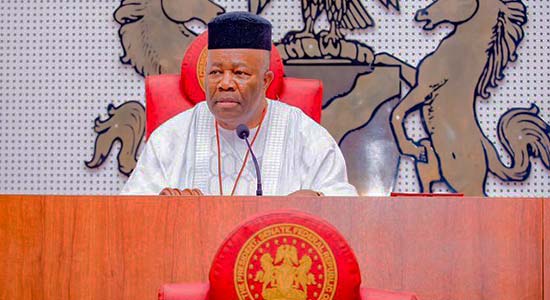
The Socio-Economic Rights and Accountability Project (SERAP) has filed a lawsuit against the Senate President, Godswill Akpabio, and Speaker of the House of Representatives, Tajudeen Abbas, over allegations that federal lawmakers pay between ₦1 million and ₦3 million to sponsor or present bills, motions, and petitions in the National Assembly.
The case, filed at the Federal High Court, Abuja, and marked FHC/L/CS/2214/2025, seeks an order of mandamus compelling Akpabio and Abbas—sued on behalf of all members of the National Assembly—to refer the alleged bribery scandal to appropriate anti-corruption agencies for investigation and possible prosecution.
The suit follows a viral video by Hon. Ibrahim Auyo, a member of the House of Representatives (APC, Jigawa), in which he alleged that lawmakers are required to pay millions of naira to get their legislative proposals entertained.
In a statement accompanying the suit, SERAP’s legal team—comprising Kolawole Oluwadare, Kehinde Oyewumi, and Andrew Nwankwo—argued that the allegations, if proven, represent a grave breach of public trust and a violation of lawmakers’ constitutional oaths of office.
“The allegations of ‘₦3m Bribe-for-Bills’ at the National Assembly are a grave violation of the public trust and constitutional oath of office by lawmakers,” SERAP stated. “Lawmakers should not have to pay bribes to present motions and bills at the National Assembly. Bribery should never influence the exercise of legislative duties or the operations of parliament.”
The organisation also asked the court to compel Akpabio and Abbas to take urgent measures to protect the whistleblower, Hon. Ibrahim Auyo, from possible retaliation or victimisation following his disclosure.
SERAP maintained that investigating and addressing the alleged bribery scheme is critical to restoring confidence in the legislature and ensuring accountability within Nigeria’s democratic system.
“The allegations that lawmakers are paying up to ₦3 million as bribes in exchange for presenting motions and bills make a mockery of lawmaking and legislative powers under Section 4 of the Nigerian Constitution 1999 (as amended),” the statement added.
According to SERAP, compelling the leadership of the National Assembly to act decisively would “build public trust in democratic institutions and strengthen the rule of law.”
As of press time, no date has been fixed for the hearing of the suit, and both Akpabio and Abbas have yet to issue official responses to the allegations.