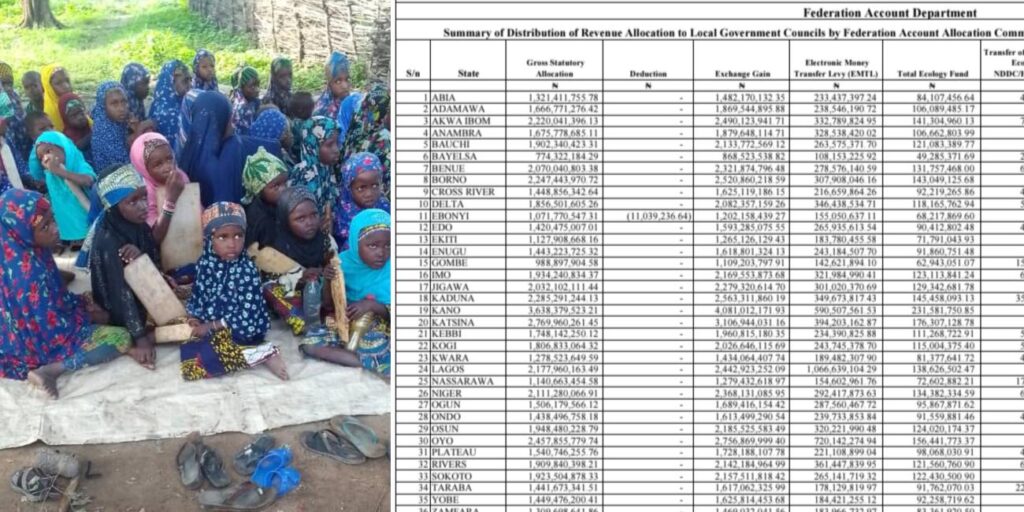
An investigation by Chronicles Reporters has revealed that, despite the disbursement of a staggering ₦66.7 billion in local government funds between January 2024 and February 2025, several public schools in rural parts of Nigeria’s Federal Capital Territory (FCT) remain in deplorable conditions, forcing children to learn in unsafe environments, including under trees and inside dilapidated buildings.
Data sourced from the Office of the Accountant General of the Federation confirms that the six Area Councils in the FCT received consistent monthly allocations throughout the 14-month period. Yet, the state of education infrastructure tells a grim story.
A monthly breakdown of the allocations shows the councils received ₦4.8 billion in January 2024, followed by ₦4.4 billion in February, ₦3.9 billion in March, and ₦5.2 billion in April. In May, they were allocated ₦3.7 billion, and ₦3.6 billion came in June. July saw another ₦3.7 billion, while ₦4.8 billion was disbursed in August. September and October saw ₦3.9 billion and ₦4.6 billion, respectively. A significant increase followed in the final months of 2024, with ₦7.0 billion and ₦7.1 billion released in November and December. The trend continued into the new year with ₦4.5 billion in January and ₦5.5 billion in February 2025.
However, the huge inflow of resources has done little to change the harsh learning conditions in several rural FCT communities. MonITng, a civil society organisation promoting transparency and accountability, has repeatedly raised concerns about the shameful state of basic education in the capital.
In various reports, the group described scenes of children being taught in uninhabitable classrooms or completely open spaces, some sitting on the bare floor without even basic learning materials.
In one of its disturbing findings, MonITng documented the poor state of LEA Primary School, Gyadna, located in Abuja Municipal Area Council (AMAC). According to the group, “The school is in a horrible state of decay—collapsed roofs, cracked walls, and broken floors. Children are forced to learn in dark, unventilated rooms with leaking ceilings and open rooftops.”
“Some of the buildings have become death traps and are no longer in use. It is a sad sight—young learners enduring such unfit conditions in the name of education,” the group added. “Community members have made countless appeals to AMAC authorities, but nothing has been done. Over 223 children have reportedly dropped out of school due to these inhumane conditions.”
Teachers, MonITng reported, are demoralised and stretched thin, doing their best to conduct classes in environments more comparable to ruins than schools.
Another heart-wrenching discovery was made in Gwagwalada Area Council, where children were seen learning under a tree at LEA Nomadic Primary School, Rugan Wakili Buba, Paiko Kore.
“Our team visited the school and found dozens of pupils gathered under the shade of a tree, sitting on the bare earth. There are no classrooms, no desks, no blackboards—nothing. Just children and their teachers making do with what nature has to offer,” MonITng stated.
According to the group, the situation persists despite huge financial allocations meant to support educational development across the FCT. “These children have been abandoned. The school doesn’t have a single building. During the rainy season, teaching halts entirely. Sometimes, kind-hearted locals offer their homes so lessons can continue.”
Data from January 2025 shows that AMAC received the highest allocation among the FCT’s local councils—₦1.1 billion. Gwagwalada received ₦691 million the same month. Yet, the sight of children schooling under trees tells a story of failed priorities.
The education crisis in the FCT is not limited to infrastructure alone. Human resources are also strained. Only recently, public school teachers in the territory ended a three-month strike prompted by the non-implementation of the ₦70,000 national minimum wage.
Chronicles Reporters had previously reported that the dispute stemmed from a Memorandum of Understanding signed on December 11, 2024, between the FCT Administration, Nigeria Union of Teachers (NUT), Nigeria Union of Local Government Employees (NULGE), and the Nigeria Labour Congress (NLC).
The agreement mapped out a phased rollout of the new wage structure starting from January 2025, along with a commitment to pay at least five months in salary arrears. It also included a promise by the Area Councils to allocate half of their Internally Generated Revenue (IGR) to meet the agreed terms.
Yet, the continued rot in the education sector raises concerns about how effectively these funds are being utilised and whether the right checks are in place to hold responsible parties accountable.
Read more via our WhatsApp channel: https://whatsapp.com/channel/0029VabITrvEAKW7DSkTfP0J