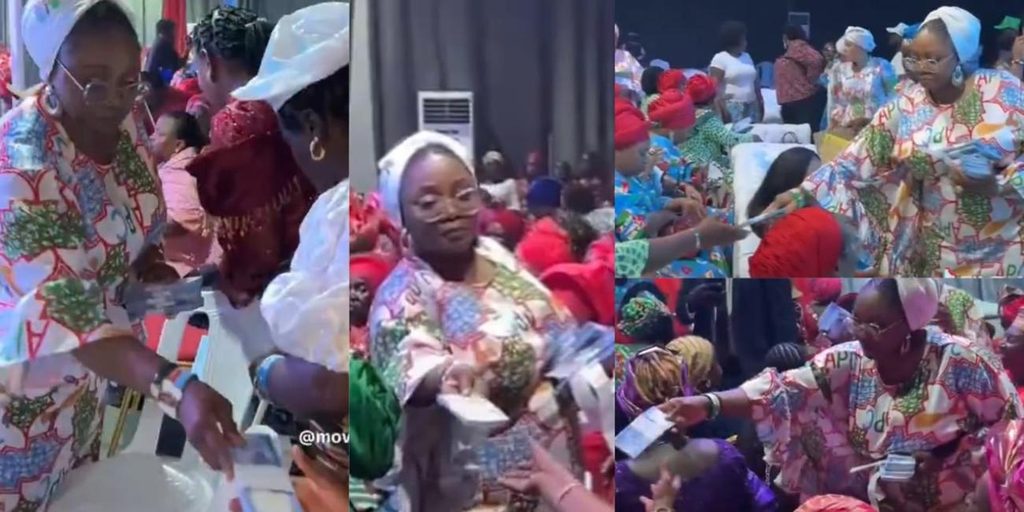
The Minister of Women Affairs, Imaan Sulaiman-Ibrahim, has sparked reactions on social media after a video emerged showing her distributing bundles of ₦100,000 cash to women beneficiaries during an empowerment programme in Lafia, Nasarawa State.
In the video circulating online, the minister is seen handing out bundles of cash to women seated inside a hall, while some attendees are spotted wearing outfits bearing the insignia of the All Progressives Congress (APC).
The cash distribution took place during a pre-rally empowerment programme organised under the initiative of Nigeria’s First Lady, Oluremi Tinubu. The programme also featured the distribution of refrigerators, sewing machines and grinding machines to selected beneficiaries.
Between 100 and 200 women reportedly received ₦100,000 each as additional capital to support their businesses. Some selected market traders also benefited from business kiosks as part of the empowerment exercise.
However, the cash distribution has generated questions about the source of the funds and the effectiveness of such empowerment programmes, particularly amid the economic hardship facing millions of Nigerians.
Reacting to the video, a social media user, Aliyu ATK, questioned whether the money being distributed was part of the funds saved from the removal of the fuel subsidy.
In a post on X on Tuesday, November 10, 2026, the user criticised the distribution, arguing that the resources could have been better utilised to address the widespread hardship in the country.
“Minister of Women Affairs, Hajiya Imaan Sulaiman Ibrahim. Sharing bundle of N100,000 to every person inside this hall. I believe this is our Subsidy money. It’s better to reverse it than allow these few number of clowns enjoying, while 200m Nigerians suffering,” he wrote.
The minister’s appearance at the programme, alongside the distribution of cash and other material items, has renewed conversations about the growing practice of politicians using cash handouts and household equipment as empowerment initiatives.
The development comes weeks after Senator Natasha Akpoti-Uduaghan, who represents Kogi Central Senatorial District, distributed cash grants ranging from ₦100,000 to ₦5 million to constituents during an empowerment programme held on November 2, 2026.
The programme was organised to mark her third anniversary in the 10th National Assembly, with videos of the cash distribution also circulating widely on social media.
The senator’s exercise attracted criticism from civic technology organisation MonITNG, which questioned whether distributing large sums of money to constituents should be celebrated as meaningful political representation and a sustainable approach to poverty alleviation.
In a statement issued on Tuesday, November 3, 2026, the organisation called on the senator to reconsider what it described as the growing practice of presenting cash distribution as an empowerment initiative.
“The display of millions of naira in cash as an empowerment initiative by Senator Natasha Akpoti-Uduaghan raises serious questions about our understanding of representation, leadership and poverty alleviation,” the organisation said.
MonITNG questioned what citizens were celebrating, arguing that leadership and effective representation should not be measured by the amount of physical cash politicians display and distribute to crowds.
The organisation maintained that genuine empowerment should focus on creating sustainable economic opportunities, supporting small businesses, investing in education, providing vocational training, improving access to healthcare and establishing economic structures that allow citizens to earn decent livelihoods without depending on politicians.
It further warned that when politicians turn poverty into an opportunity for public spectacle, they risk normalising a culture of dependency rather than addressing the underlying economic challenges confronting citizens.
The latest development involving the Minister of Women Affairs and the earlier cash distribution by Senator Akpoti-Uduaghan have brought renewed attention to the nature of political empowerment programmes in Nigeria.
While such initiatives are often presented as interventions aimed at supporting vulnerable citizens and small business owners, questions persist over their long-term impact, transparency, accountability and whether they provide lasting solutions to poverty or merely offer temporary financial relief.
The debate has also intensified over whether political officeholders should prioritise one-off cash distributions or invest more heavily in programmes capable of creating jobs, strengthening businesses and improving the economic conditions of ordinary Nigerians.