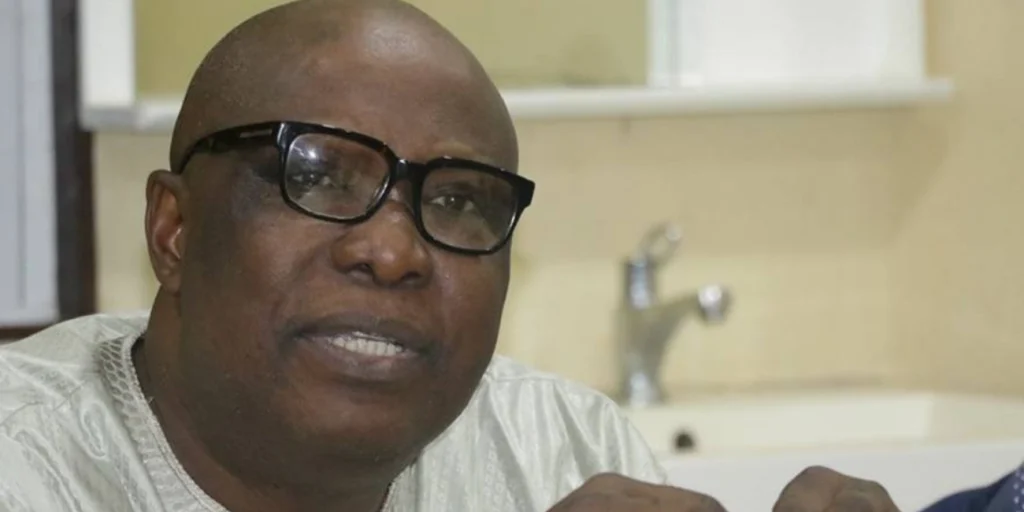
A former senator representing Ekiti Central and former Special Adviser to ex-President Muhammadu Buhari on Political Matters, Babafemi Ojudu, has condemned the attack on activist and African Action Congress (AAC) presidential candidate, Omoyele Sowore, in Ekiti State, declaring that political disagreements must never be used as an excuse for violence.
Ojudu, in a statement titled “Ekiti Must Be Safe For Dissent,” described the attack as incompatible with democratic values, insisting that every Nigerian must be free to express opinions, criticise government officials and promote political causes without fear of intimidation or physical assault.
The former presidential aide said his condemnation was not influenced by political affiliation, stressing that neither Sowore’s political beliefs nor his methods could justify the violence against him.
“Whatever anyone thinks of Sowore, his politics or his methods, disagreement cannot justify assault. No individual or group has the right to turn political displeasure into a licence to brutalise another citizen,” Ojudu said.
He maintained that freedom of expression should not depend on whether those in government agree with the opinions being expressed, warning that a society where citizens are only allowed to speak when they praise the government cannot claim to enjoy genuine freedom.
“The right to express an opinion cannot depend on whether those in power find it agreeable. A freedom available only to people who praise the government is no freedom at all,” he stated.
Ojudu further argued that criticising a government does not make anyone an enemy of the state, adding that Ekiti belongs equally to supporters of the ruling party, its critics and citizens who have yet to decide where their political allegiance lies.
Recalling his experiences of political intimidation during the administration of former Ekiti State Governor, Ayo Fayose, Ojudu warned that those who suffered political persecution in the past must not excuse similar conduct simply because their political party is now in power.
He cited several incidents of alleged political violence during Fayose’s administration, including attacks on opposition gatherings and an incident involving former Governor Segun Oni, who he said was beaten for organising a political meeting.
The former senator also recalled an attack on a political gathering at Omugbagba in Ado-Ekiti in 2006, where he alleged that political leaders were assaulted, more than 20 vehicles were destroyed and several party members were subsequently arrested and detained.
He further recounted an incident during Fayose’s administration when prominent opposition figures, including President Bola Tinubu, who was then a former Lagos State Governor, former Ekiti Governor Niyi Adebayo, former Ogun State Governor Olusegun Osoba and Bisi Akande, were allegedly held in Iyin-Ekiti for nearly 12 hours.
According to Ojudu, the politicians were travelling to attend the funeral of the mother of Senator Opeyemi Bamidele when they were subjected to political intimidation.
“Those of us who endured that indignity must never excuse its infliction on anyone else. The lesson of our suffering must be to protect freedom whenever it is threatened, regardless of whose freedom is at stake,” he said.
Ojudu also recalled violence during the campaign for Governor Kayode Fayemi’s second term, alleging that a young man from Ijero Local Government Area lost his life during an incident at Ijigbo.
He said such experiences should serve as a permanent reminder to political leaders that assuming power should not mean reproducing the same practices they once condemned when they were in opposition.
“Having condemned intimidation when we were its victims, we must condemn it with equal conviction now that our party is in government,” he stated.
The former senator, however, defended Governor Biodun Oyebanji’s record on political tolerance, saying he had consistently acknowledged the governor’s commitment to rejecting political violence and accommodating opposing views.
He disclosed that Oyebanji had distanced himself and his administration from the attack on Sowore, adding that he personally contacted the governor over the incident.
“It is good to know that Governor Oyebanji has dissociated himself and his government from this dastardly act. When I spoke to him about it yesternight I could feel his sincerity,” Ojudu stated.
Nevertheless, he insisted that the governor’s condemnation must be followed by a transparent investigation and accountability for everyone found responsible, irrespective of their political connections or affiliations.
“The clearest defence of that record will be a transparent investigation and accountability for everyone found responsible, whatever their connections or political affiliation,” he said.
Ojudu maintained that anyone visiting Ekiti to campaign, address political gatherings, grant interviews or promote a political cause peacefully must be allowed to exercise their rights without intimidation.
He said political disagreements should be settled through arguments, campaigns and elections rather than physical attacks, insisting that political opponents must not be beaten into silence.
“We are free to challenge their arguments, question their records and reject their proposals. We are free to campaign against them and defeat them at the polls. We are not free to beat them into silence,” he said.
He also argued that attacking a political speaker does not only violate the individual’s rights but also deprives members of the public of the opportunity to hear alternative opinions and make informed political decisions.
According to him, Sowore does not have to be right on every issue, polite, popular or politically convenient before his fundamental rights can be protected.
“Sowore does not have to be right on every issue for his rights to deserve protection. Neither does he have to be polite, popular or politically convenient,” Ojudu stated.
Invoking the Yoruba expression, “Èébú ò o,” which he explained means that insults do not stick, Ojudu urged politicians to develop the temperament to withstand criticism, ridicule and harsh comments without resorting to violence.
He said anyone who believes that a statement has crossed a lawful boundary should seek redress through the appropriate legal institutions rather than take the law into their own hands.
“Thugs cannot become our judges, and violence cannot become our answer,” he declared.
The former presidential aide also called on security agencies to protect citizens and guarantee peaceful political activities, warning against a situation where political affiliation determines whose complaints are taken seriously and whose rights receive protection.
With the 2027 general election approaching, Ojudu urged security agencies to put credible arrangements in place to protect political candidates, campaigners and members of the public during political activities.
He warned that the attack on Sowore could have resulted in more devastating consequences, saying the activist’s possible death would have amounted to an irreparable human tragedy and inflicted serious damage on Ekiti’s reputation, the standing of its government and public confidence in Nigeria’s electoral process.
While welcoming reports that arrests had been made in connection with the attack, Ojudu insisted that the authorities must not stop at arresting suspects but should conduct a thorough investigation and ensure that justice is served.
“I welcome the reported arrests. But arrest is only the beginning. There must be a thorough and impartial investigation, a fair prosecution where evidence warrants it, and appropriate punishment for anyone convicted,” he said.
He further demanded that anyone found to have organised, sponsored or facilitated the attack should also be identified and held accountable.
Ojudu concluded by cautioning members of the ruling party against assuming that political power would remain permanent, reminding them that the freedoms they protect for opposition figures today may become necessary for them when political circumstances change.
He insisted that Ekiti must remain a state where opposing political views can be expressed freely and citizens can participate in democratic activities without fear of intimidation.
“Ekiti must be a place where ideas contend freely and citizens participate without fear. Our history, our sacrifices and our reputation as a people of learning demand nothing less,” he said.
“Let Sowore speak. Let those who disagree with him answer him. Let the people decide.”