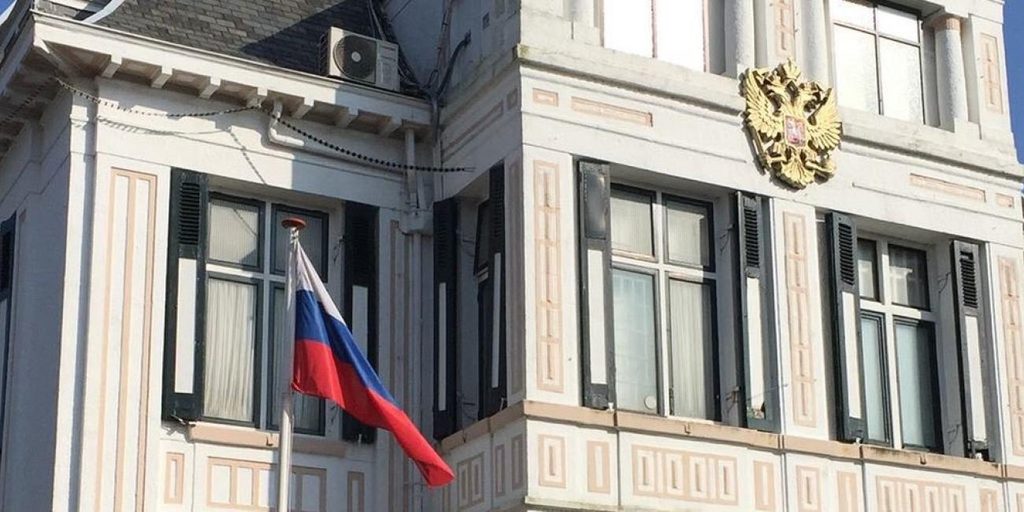
The Russian Embassy in the Netherlands has demanded clarification from the Dutch government after Defence Minister Dilan Yeşilgöz-Zegerius publicly declared that “Russia is our enemy”, questioning whether her remarks represented an official shift towards direct military confrontation with Moscow.
The embassy made the demand in a statement issued to Russia’s state-run TASS news agency on Thursday, October 8, 2026, and subsequently published on its Telegram channel.
Yeşilgöz-Zegerius made the remarks during a recent parliamentary budget debate, where she warned that the Netherlands could no longer afford to be “naive” in its approach to Russia.
“Russia is our enemy,” the minister said, according to Dutch media reports.
She also said Russia should no longer simply be described as an aggressor, describing the term as a euphemism she would no longer frequently use.
“Russia is no longer the aggressor. That is a euphemism you will not often hear from me again,” she said.
However, the minister clarified that her remarks did not mean the Netherlands was currently at war with Russia.
“This does not mean we are at war,” she said, while warning that “carefree peace is also very far away.”
Yeşilgöz-Zegerius cited intelligence assessments warning that Russia was testing Western societies and could be preparing for a potential conflict with the North Atlantic Treaty Organisation (NATO).
She argued that the Netherlands must remain vigilant, strengthen its resilience and continue investing in its military capabilities.
Reacting to the remarks, the Russian Embassy accused the Dutch defence minister of going beyond acceptable diplomatic rhetoric and demanded to know whether she was speaking on behalf of the entire Dutch government.
“The latest public outburst by the Dutch Defence Minister, who has never been known for diplomatic tact or restraint, has this time gone beyond all conceivable bounds of acceptability,” the embassy said.
The diplomatic mission questioned whether Yeşilgöz-Zegerius’s comments should be interpreted as an official declaration of a shift towards direct military confrontation with Russia.
“Legitimate questions arise: Is Ms Yeşilgöz-Zegerius speaking on behalf of the entire Dutch Government? Should her statements be considered as an official declaration of a shift towards direct military confrontation with Russia?” it said.
The embassy accused the Dutch government of pursuing what it described as a “destructive course of confrontation” with Moscow.
“By publicly branding Russia an ‘enemy’ of the Netherlands, Ms Yeşilgöz-Zegerius has once again demonstrated The Hague’s commitment to its destructive course of confrontation,” the embassy said.
“In fact, she has shamelessly revealed her desire to provoke an armed conflict with our country.”
The Russian mission nevertheless insisted that Moscow had no intention of attacking Europe or the Netherlands.
“We reiterate: Russia has no aggressive intentions towards Europe in general or the Kingdom of the Netherlands in particular,” it said.
The embassy warned, however, that Russia would respond to what it considers threats to its security and sovereignty.
“No one should be under any illusions: we will not tolerate attempts to address Russia in the language of threats and ultimatums,” it said.
“Any encroachment upon the security and sovereignty of the Russian Federation will be met with an immediate, swift and crushing response.”
The Russian Embassy called on Dutch authorities to issue an “official and unequivocal clarification” over what it described as the defence minister’s “belligerent and irresponsible rhetoric.”
In a separate post on X on Thursday, the embassy repeated its demand, saying: “Minister of Defence has openly called Russia an ENEMY. We demand that the Dutch Government either confirm her words or distance itself from them. Is this an official declaration of direct military confrontation?”
The exchange comes amid heightened tensions between Russia and NATO members, with European governments increasingly warning about Moscow’s military capabilities and potential hybrid activities.
Russia, for its part, has repeatedly rejected claims that it intends to attack European countries, while warning that it considers threats to its security and sovereignty a matter requiring a response.