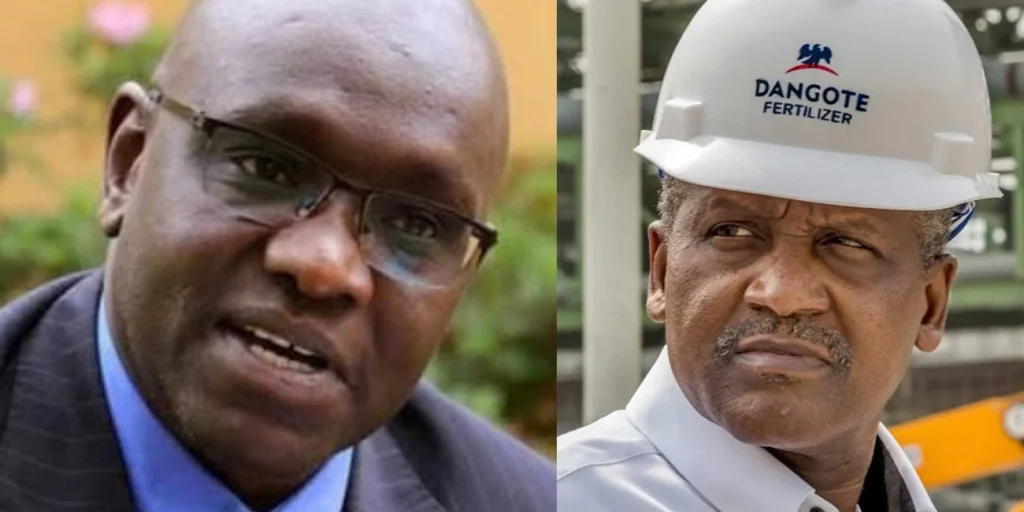
Kenya’s Thirdway Alliance Party has demanded the full disclosure of the contract between the Kenyan government and Dangote East Africa Petroleum Refinery and Petrochemicals SEZ over the proposed refinery and petrochemicals project in Lamu, while seeking detailed information on the ownership structure of the project.
The party made the demand in a letter dated October 2, 2026, addressed to Kenya’s Attorney-General, Dorcas Agik Oduor, requesting access to the agreement and related documents concerning the proposed Dangote project.
The letter, signed by Thirdway Alliance leader, Dr Ekuru Aukot, cited Article 35 of the Kenyan Constitution and Sections 4, 5 and 9 of the Access to Information Act, 2016, as the legal basis for the request.
Aukot also questioned why Nigerian billionaire and Africa’s richest man, Aliko Dangote, would seek to establish a refinery in Kenya while Nigeria continues to grapple with electricity supply challenges.
“Btw, Nigeria has serious power problem. Why can’t #Dangote fix his country first before coming to Kenya re oil refinery? We reject this deal,” Aukot wrote on his X account.
In its letter, Thirdway Alliance asked the Attorney-General to provide “full access to the agreement or contract executed between the Government of Kenya (or any associated public entity) and the Dangote Group or its project entity, Dangote Refineries Limited SEZ, regarding the Dangote East Africa Refinery and Petrochemicals SEZ located in Lamu.”
The party also demanded all execution copies, schedules, side letters and subsequent amendments to the agreement.
“Should a definitive agreement not yet be executed, kindly confirm its present status, provide any existing draft agreements, and supply any approvals currently on record with your office,” the party stated.
Thirdway Alliance said its demand followed what it described as recent public comments by Kenyan President William Ruto dismissing calls for information about the project.
The party accused Ruto of referring to citizens seeking information about the project as “matapeli”, a Swahili term commonly used to describe con artists or fraudsters, and of accusing them of attempting to extort the investor.
Thirdway Alliance rejected the characterization, insisting that Kenyan citizens have a constitutional right to scrutinise government contracts.
“Seeking access to public government contracts is an inalienable constitutional right under Article 35,” the party said.
“While foreign investment that advances Kenya’s interests is welcome, the public remains fully entitled to scrutinize any contractual commitments made on its behalf.”
The party further demanded information on whether the Dangote refinery project or any related agreement had been presented to, debated, approved or ratified by the Kenyan Parliament.
It requested the relevant dates, Hansard records, committee reports, parliamentary resolutions and approval documents, where applicable.
“If it was not, state whether the Government considers parliamentary approval necessary and the legal basis for its position, including whether the project is treated as a public-private partnership and creates any public financial liability,” the letter stated.
Thirdway Alliance also urged the Kenyan government to publish the agreement and all material government commitments relating to the project on an official public website.
“Article 35(3) and section 5 of the Act require publication of important public information,” it said.
The party said it acknowledged the potential economic benefits of the proposed refinery and petrochemicals project but opposed what it described as opaque government initiatives or arrangements that could impose an undue burden on Kenyan citizens.
“While we acknowledge the enormous economic benefits that would accrue from the project, we are opposed to any opaque initiatives, as well as initiatives that burden ‘mwananchi’ and go contrary to the spirit of ‘punguzamizigo’,” Thirdway Alliance said.
The political party also placed ownership of the Dangote project under scrutiny, demanding a list of all beneficial owners of Dangote East Africa Refinery and Petrochemicals SEZ.
It requested details of all current directors and official CR12 documents for locally incorporated corporate shareholders, as well as corresponding registry documents for foreign entity shareholders showing the project’s ownership structure.
The party further requested the Memorandum and Articles of Association, or their equivalents, for all local and foreign shareholders of corporate shareholders, alongside details of the beneficial owners of those shareholders.
Thirdway Alliance also invoked the constitutional responsibilities of the Attorney-General, arguing that the office has a duty to advise the President on the legal requirements surrounding access to public information.
“Kenya is a constitutional republic, not President Ruto’s personal or private company,” the party said.
“As the Government’s principal legal adviser under Article 156, you are requested to advise the President accordingly and ensure that this request is processed immediately.”
The party gave the Attorney-General 21 days to respond, relying on Section 9(1) of Kenya’s Access to Information Act.
It warned that a refusal or failure to respond within the stipulated period would be treated as a deemed rejection under Section 9(6) of the Act.
Thirdway Alliance further threatened legal action if its concerns over the project were substantiated.
“If the evidence establishes that President Ruto personally directed or maintained an unlawful refusal, Thirdway Alliance Kenya shall immediately commence proceedings against the state now and against him personally after he leaves office,” the party said.
The party requested that the government’s response be transmitted electronically to its designated email addresses.
The controversy comes amid Dangote Group’s expanding investments in Africa and its plans to increase its involvement in the power sector.
In May, Dangote said the group was moving into power generation, with a target of up to 20,000 megawatts. He made the disclosure during an interview with Makhtar Diop, managing director of the International Finance Corporation.
“We are now going into power – 20,000 megawatts,” Dangote said.
He listed the proposed power investment alongside other projects involving fertiliser production, liquefied natural gas and port development.
Nigeria currently generates about 4,000 to 4,500 megawatts of electricity, significantly below its installed generation capacity of more than 13,000 megawatts.
Dangote has also spoken about the challenges he encountered while developing his refinery in Nigeria, saying the project faced widespread scepticism before its completion.
“At the time when I started this refinery… I have never ever seen crude oil in my life,” he said. “People openly said this refinery will never happen.”
The Dangote refinery, valued at about $20 billion, is now producing fuel and has an estimated capacity of 650,000 barrels per day.
In September, Dangote told Al Jazeera that his conglomerate planned to invest more than $10 billion in Nigeria’s power sector as part of efforts to address the country’s electricity crisis and support industrialisation.
He identified inconsistent government policies and inadequate electricity supply as major obstacles discouraging investment across Africa and said the group was considering redirecting funds from some businesses, including steel, towards power.
“And I’m telling you in the next three to four years, there will be a major transformation in Africa, and that’s why we’re looking at power. We are going to invest in power. There are one or two businesses that we might cancel, like steel, and we will put the money in power. We want to invest over $10bn alone in power,” Dangote said.
He also said more than 600 million Africans still live without electricity.
“We Africans should not really allow over 600 million of our people to remain in darkness,” he said.
The demand by Thirdway Alliance has therefore placed the proposed Dangote refinery and petrochemicals project in Lamu under increased public scrutiny, particularly over the terms of the government agreement, ownership structure, parliamentary approval and any potential financial obligations that could arise for Kenyan taxpayers.