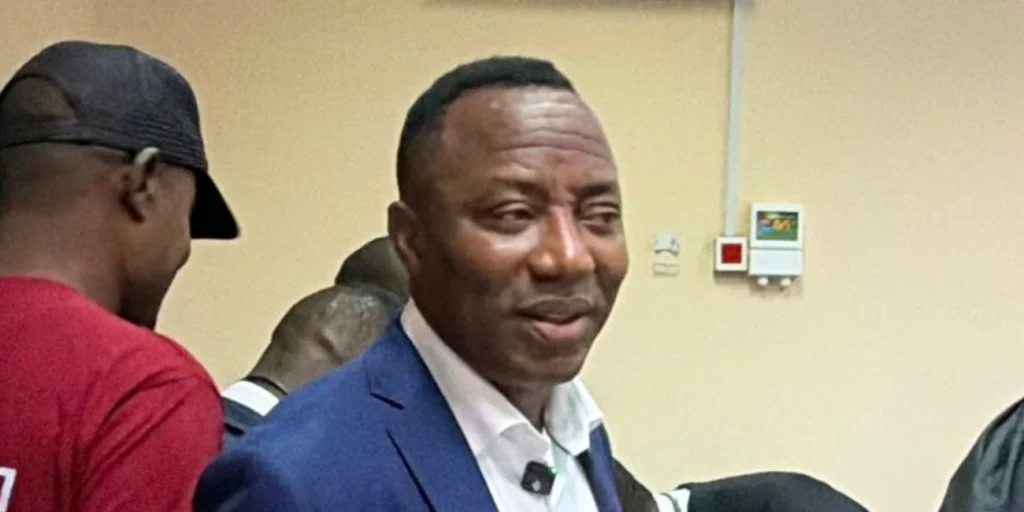
The ongoing cybercrime trial of African Action Congress (AAC) presidential candidate, Omoyele Sowore, took a dramatic turn on Friday as his defence team challenged the handling of an application by the Department of State Services (DSS) seeking to present another officer in place of the agency’s Director-General as a witness.
The development occurred at the Federal High Court in Abuja during the resumed hearing before Justice Mohammed Umar.
Sowore’s lead counsel, Adeyinka Olumide-Fusika, SAN, opposed the DSS application and insisted that the agency’s Director-General, Oluwatosin Ajayi, should personally appear before the court to testify.
Olumide-Fusika said any previous understanding that another DSS officer could appear on behalf of the Director-General had been repudiated by the prosecution itself.
According to him, the position became untenable after DSS counsel, Akinlolu Kehinde, SAN, told the court at an earlier proceeding that it was the responsibility of the defence to produce its witness.
The defence lawyer therefore maintained that Ajayi must personally appear before the court.
The disagreement between the prosecution and defence prompted Justice Umar to indicate that he was prepared to rule immediately on the prosecution’s application.
Olumide-Fusika opposed the move, arguing that the defence should first be given an opportunity to file a proper written counter-motion before the court determined the application.
The lawyer maintained that the defence could not be expected to adequately respond to the prosecution’s application without being allowed to put its position formally before the court.
Justice Umar, however, rejected the request and indicated that he would proceed to rule without waiting for the defence’s written response.
Olumide-Fusika then asked the court to ensure that his objection was firmly placed on record.
He maintained that the request for the DSS Director-General to personally appear before the court was fundamental to the defence and described it as sacrosanct.
The defence also challenged the relevance of the judicial authority cited by Kehinde in support of the prosecution’s position, arguing that the case relied upon did not apply to the circumstances surrounding Sowore’s trial.
According to the defence, an earlier DSS witness had repeatedly referred to the Director-General during his testimony.
The defence argued that it was precisely because of those references that Ajayi was required to appear personally and give evidence before the court.
The development also revived earlier concerns raised by Sowore’s legal team over the conduct of the proceedings.
Justice Umar had previously ordered one of Sowore’s lawyers to kneel before him during proceedings, an incident that generated controversy among supporters of the defendant and members of the legal community.
The judge subsequently adjourned the matter for a ruling on whether another DSS officer could be allowed to testify in place of the Director-General.
The dispute over the DSS Director-General’s appearance is not new.
Sowore’s defence had earlier obtained a subpoena seeking to compel Ajayi to testify in the case. Following interventions involving the Attorney-General of the Federation and Minister of Justice, Lateef Fagbemi, SAN, the defence agreed that another competent DSS official could appear and testify on behalf of the agency if Ajayi was unable to attend personally.
The latest disagreement centres on whether that previous understanding remains binding and whether the prosecution can now rely on another DSS officer despite the defence’s renewed insistence on the Director-General’s personal appearance.
The witness dispute comes amid a separate controversy over reports that the DSS had considered suspending Sowore’s trial until after the 2027 general election.
At a previous sitting, Olumide-Fusika raised reports that the DSS had directed its counsel to seek an adjournment of the trial to enable Sowore, an AAC presidential candidate, to participate fully in the 2027 electoral process.
Kehinde, however, told the court that he was unaware of any such directive and dismissed the reports as social media creations.
The position contrasted with earlier reports by several Nigerian media organisations that the DSS had directed its counsel to seek a suspension of the proceedings until after the 2027 elections.
Channels Television, TheCable, Punch and Vanguard had reported the alleged plan, while PREMIUM TIMES subsequently reported that Kehinde had spoken by telephone about the proposed suspension and its rationale.
Sowore’s defence expressed surprise at the prosecution’s position, while reports attributed to sources familiar with the matter said the DSS had initially considered suspending the trial before subsequently reversing its position and directing its counsel to continue the case.
The reports further claimed that the reversal followed dissatisfaction within the DSS over Sowore’s continued criticism of President Bola Ahmed Tinubu and his political activities.
The case against Sowore arose from social media posts in which he referred to Tinubu as a “criminal.”
He has pleaded not guilty to the charges, which are being prosecuted under the Cybercrimes (Prohibition, Prevention, Etc.) (Amendment) Act, 2024.
The case has attracted political and public attention because Sowore is not only the defendant in the cybercrime proceedings but also an AAC presidential candidate preparing for the 2027 general elections.
The latest courtroom confrontation has now left the question of who should testify for the DSS before Justice Umar, with the court expected to determine whether another officer can replace the agency’s Director-General as a witness.