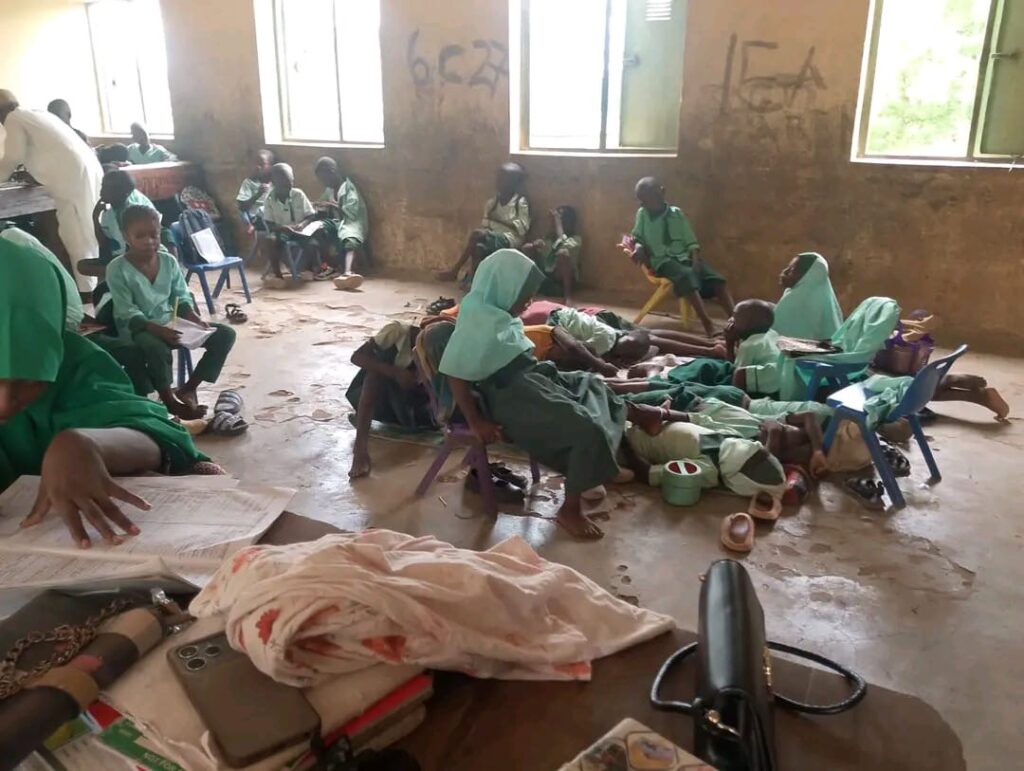
Pupils of Abaji South Primary School in Abaji Area Council of the Federal Capital Territory have reportedly been forced to sit on bare floors and use stones as makeshift seats, raising fresh concerns over the condition of basic education infrastructure in communities outside Abuja’s city centre.
The situation was brought to public attention by the Monitoring and Investigation Network (MonITNG), which shared photographs showing pupils inside the school and called for urgent intervention from the FCT Administration and other relevant authorities.
According to reports citing a resident who raised the alarm, some pupils were seen carrying stones from the surrounding community to the school, while others had no option but to sit directly on the classroom floor during lessons.
The resident reportedly told ChroniclesReporters that pupils were seen carrying stones on their heads to the school in the morning. Concerns were also raised about other conditions at the school, including inadequate desks and chairs, poor water supply, a dilapidated toilet facility and erosion around the school.
MonITNG described the situation as going beyond the absence of furniture, arguing that the condition of the school raises questions about the dignity, safety and quality of education available to children in underserved communities.
The civic monitoring platform called on FCT Minister Nyesom Wike, the FCT Universal Basic Education Board, Abaji Area Council and other relevant authorities to urgently visit the school, assess its condition and provide the necessary facilities, including decent classrooms, desks, chairs and other basic learning infrastructure.
The condition has also generated questions about the distribution of public investment across the Federal Capital Territory, particularly as Abaji remains part of the FCT despite being considerably removed from the major urban development projects concentrated around Abuja.
MonITNG referenced the FCT’s 2026 budget, which it said was approved at approximately ₦2.285 trillion, with ₦1.741 trillion allocated to capital projects. Other reports citing the organisation said ₦162 billion was provided for the education sector under the capital allocation.
The situation at Abaji South Primary School therefore presents a basic but important question for the authorities: how can children be expected to learn effectively when some reportedly have to search for stones simply to find somewhere to sit?
For parents and residents, the issue is not merely about chairs and desks. It concerns whether children in rural and underserved communities are receiving the minimum conditions necessary to learn safely and with dignity.
The Federal Capital Territory is widely associated with major roads, bridges, government buildings and large-scale infrastructure projects. However, the condition of schools such as Abaji South Primary School provides another measure of development — the state of the classrooms where children in less visible communities spend their formative years.
Chronicles Reporters understands that the appeal by MonITNG is for an urgent assessment rather than merely another public statement. Authorities responsible for basic education infrastructure are expected to establish the present condition of the school and determine what interventions are required.
A child going to school should be carrying books and learning materials — not searching the community for a stone to use as a chair.
The condition reported at Abaji South Primary School deserves prompt attention from the relevant authorities.