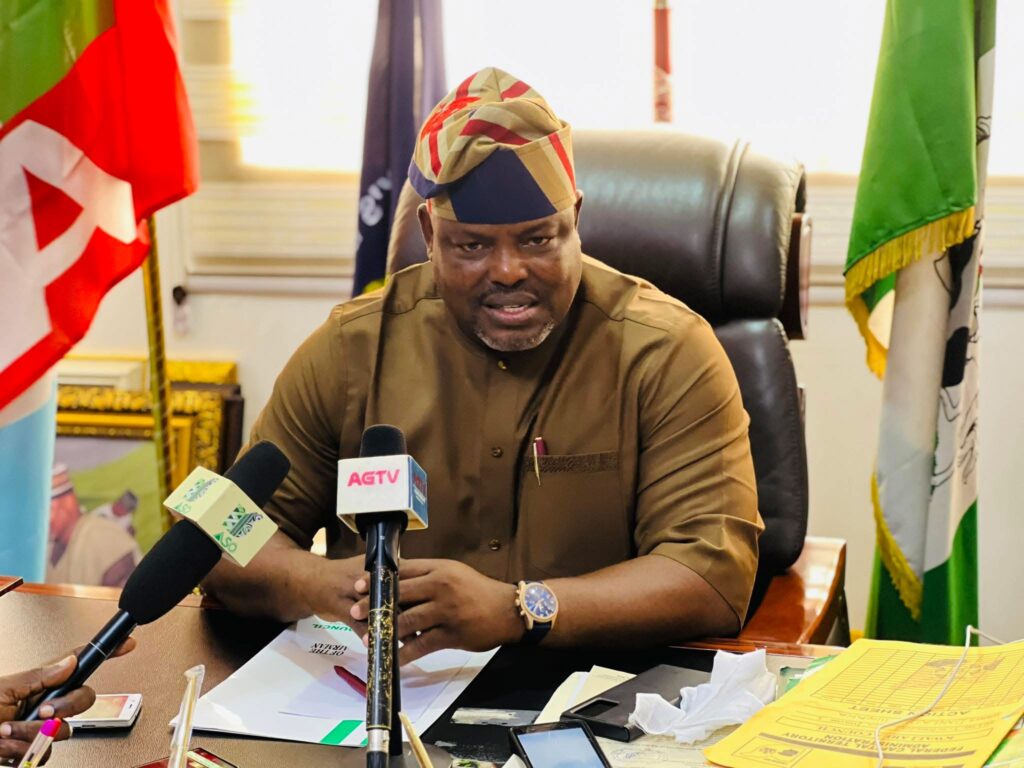
House of Representatives candidate for Abuja South under the All Progressives Congress (APC), Danladi Chiya, has described President Bola Ahmed Tinubu’s Independence Day address as a significant statement of direction for Nigeria, saying the country must now move from economic reforms to a period where ordinary Nigerians begin to feel the impact of those reforms in their daily lives.
Chiya, speaking on the occasion of Nigeria’s 66th Independence Anniversary, said President Tinubu’s message of moving from reform to prosperity should not remain a statement from Abuja but must translate into tangible development across communities, particularly in rural constituencies such as Abaji, Kwali, Gwagwalada and Kuje.
According to him, the next phase of Nigeria’s development must be centred on production, employment, agriculture, infrastructure, education, healthcare and economic opportunities for young Nigerians.
“Independence is not only about celebrating the day Nigeria became politically independent. Independence must also mean economic independence, productive communities and a country where the ordinary citizen can look into the future with confidence,” Chiya said.
He said President Tinubu inherited an economy facing serious structural challenges and that the administration’s reforms have been accompanied by difficult consequences for citizens, but argued that the next responsibility is to ensure that the gains being reported at the macroeconomic level translate into prosperity for ordinary Nigerians.
“President Tinubu has made it clear that Nigeria is moving from the period of reform into the period of prosperity. For me, that is where the real work begins.
“We cannot continue talking about GDP figures, inflation, foreign reserves and economic reforms without asking the simple question: what does the ordinary farmer in Kwali gain from these reforms? What does the young person in Gwagwalada gain? What does the trader in Kuje gain? What does the family in Abaji gain?
“That is the real meaning of governance.”
Chiya said his political philosophy is rooted in the belief that government must create conditions under which citizens can become productive rather than making them permanently dependent on political patronage.
He said his experience in grassroots administration, particularly during his time as chairman of Kwali Area Council, had given him a practical understanding of the challenges confronting rural communities.
“Having served at the grassroots, I understand that development is not theory. Development is the road connecting a farmer to the market. Development is water in a community. Development is electricity for a young person trying to run a business. Development is a functioning health centre. Development is a child having access to quality education.
“That is what politics should be about.”
Chiya recalled some of the interventions undertaken during his administration in Kwali, particularly in the areas of roads, water, rural infrastructure, agriculture and electrification, saying his experience convinced him that local development must be connected to broader federal economic policy.
He said Abuja South has enormous potential that can be unlocked through purposeful legislative representation.
“Look at Abuja South. We have Abaji, Kwali, Gwagwalada and Kuje. We have farmers, traders, artisans, students, young professionals and entrepreneurs.
“We have land, agricultural potential and a growing population. What we need is representation that understands how to convert these resources and human potential into economic opportunity.”
According to Chiya, if given the opportunity to represent Abuja South in the House of Representatives, his focus would include strengthening agricultural value chains, supporting rural infrastructure, improving access to education and skills acquisition, advocating for healthcare development, supporting youth enterprise and pursuing infrastructure capable of connecting communities to economic opportunities.
He said agriculture must become more than a campaign slogan.
“A farmer should not only be remembered during elections. We must talk about irrigation, mechanisation, storage, processing, farm-to-market roads and access to markets.
“If you produce food but cannot preserve it or move it to the market, you have not solved the agricultural problem.”
The APC aspirant also placed strong emphasis on young people, saying Abuja South must develop a political and economic framework capable of turning its youthful population into a productive force.
“Our young people are not the problem of Nigeria. The question is whether we are creating the conditions for them to use their talents.
“We need skills, technology, vocational education, entrepreneurship and access to opportunities. We cannot build the future by simply giving young people political handouts.”
Chiya also linked his political thinking to his interest in different schools of political and social thought, including Karl Marx’s The Communist Manifesto and Paulo Freire’s Pedagogy of the Oppressed.
He said his interest in such works was not about importing foreign political systems into Nigeria but about understanding power, inequality, economic structures and the relationship between government and ordinary citizens.
“I have studied different political and economic ideas because I want to understand society.
“I understand capitalism. I understand socialism. I understand communism. But beyond ideology, my concern is the Nigerian reality.
“What works for Nigeria must be determined by our own circumstances, our people and our development needs.”
He said political representation must therefore be judged by its ability to produce tangible improvements in people’s lives.
“Politics cannot simply be about who occupies an office. The question is what that office is used to achieve.
“If I am given the responsibility to represent Abuja South, I want people to be able to ask me what I have done on roads, agriculture, education, healthcare, employment, infrastructure and constituency development and receive clear answers.”
Chiya said he also believes that President Tinubu’s emphasis on prosperity creates an opportunity for lawmakers to strengthen the connection between federal policy and grassroots development.
“The President can make national policies, but representatives must take the needs of their constituencies into the national conversation.
“That is why Abuja South needs a representative who understands both the grassroots and the legislative process.”
He said Abaji, Kwali, Gwagwalada and Kuje should not be treated as separate political territories but as interconnected communities whose development requires a coordinated approach.
“We must stop looking at our communities only through the lens of elections.
“Abaji needs development. Kwali needs development. Gwagwalada needs development. Kuje needs development.
“The young people need opportunities everywhere. Farmers need support everywhere. Our schools need attention everywhere. Our roads need attention everywhere.
“This is why I am presenting myself for service.”
Chiya further said accountability must remain central to representation, insisting that elected officials should regularly explain what they promised, what they achieved and what remains outstanding.
“My politics is not about telling people what they want to hear. It is about telling them what can be done and then working to achieve it.
“I am not promising that one man will solve every problem in Abuja South. That would be dishonest.
“But I am saying that with serious representation, effective legislation, oversight, engagement with government agencies and proper constituency development, we can achieve far more than we have achieved.”
He called on Nigerians to reflect on the meaning of independence beyond political freedom, saying true independence must include economic opportunity and social development.
“As we celebrate Nigeria at 66, let us remember that independence is a responsibility.
“We inherited a country from those who fought for freedom. Our responsibility is to build a country where freedom has economic meaning.
“A Nigeria where the farmer can prosper.
“A Nigeria where the young person can work.
“A Nigeria where the child can receive quality education.
“A Nigeria where communities have roads, water and healthcare.
“That is the Nigeria we must build.”
Chiya concluded by saying his vision for Abuja South is anchored on representation, development and accountability.
“If Abuja South employs me to represent them, I will see the mandate as a contract with the people—not a personal achievement.
“I will go to the National Assembly with the understanding that Abaji, Kwali, Gwagwalada and Kuje are not merely names on an electoral map. They are communities filled with people whose hopes, struggles and aspirations must have a voice in Abuja.
“That is the representation I am offering.”