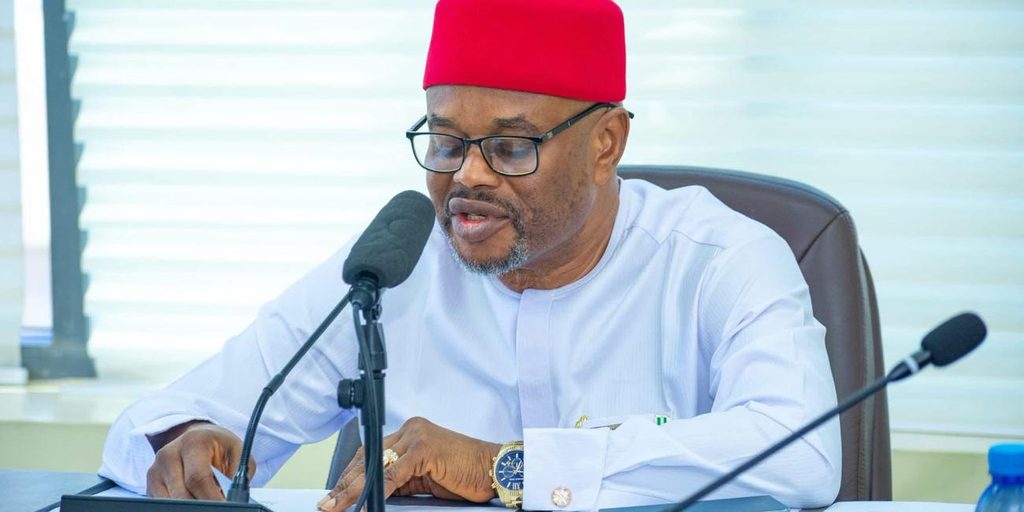
Chief Godfrey Uche Nnaji, the Peoples Democratic Party (PDP) governorship candidate in Enugu State, has accused the state government of what he described as an “attack on democracy” following the removal of campaign materials from his personal campaign office while a legal challenge to the state’s signage policy remains pending before the Federal High Court in Abuja.
Nnaji, a former Minister of Innovation, Science and Technology, made the allegation in a statement on Sunday after officials of the Enugu State Environmental Protection Agency (ENSEPA) allegedly entered his campaign office on Abakaliki Road in Enugu and removed posters, campaign livery and other decorations attached to the premises.
The PDP candidate said the action was unlawful because the state’s signage policy is already the subject of a court challenge, with a motion on notice served on the relevant parties and the matter awaiting hearing.
“My privacy has been invaded by the Enugu State government. My personal campaign office was attacked by the Enugu State Environmental Protection Agency (ENSEPA) and all my posters torn down in contravention of an ongoing court process,” Nnaji said.
He said the signage policy had been challenged at the Federal High Court in Abuja for about two months before the alleged enforcement action was carried out.
“A motion on notice was served on them and we are waiting for the hearing of the matter when they embarked on their ‘Destroy Enugu First Campaign’. The Signage policy of Enugu State government was being challenged at the Federal High Court, Abuja since about two months now,” he said.
Nnaji also described the alleged entry into his campaign premises as an “unwarranted invasion” and an unacceptable interference with his campaign activities.
“I wish to express my deep concern and condemnation over what I consider to be an unwarranted invasion of my privacy and an unacceptable attack on my personal campaign office at Abakaliki Road in Enugu State,” he added.
The dispute centres on the Enugu State Government’s regulations governing the display and placement of political posters, billboards and other campaign materials as political activities ahead of the 2027 general elections intensify.
The Enugu State Structures for Signage and Advertisement Agency (ENSSAA) has previously reiterated restrictions on the display and pasting of posters across the state under the Enugu State Structures for Signage and Advertisement Agency Law No. 12 of 2016.
Nnaji, however, argued that the existence of a regulatory framework does not remove the obligation of government agencies to respect due process, ongoing court proceedings and citizens’ fundamental rights.
The PDP candidate also raised concerns over the financial implications of the state’s signage requirements, particularly the reported ₦150 million fine for political parties that erect signage or posters for the 2027 elections without the required approval.
Critics of the policy have argued that such financial requirements could disproportionately affect opposition parties and candidates seeking to campaign across the state, while the state government and its supporters have maintained that signage regulations are intended to regulate outdoor advertising and maintain order.
Nnaji questioned the size of the proposed financial requirement in relation to the statutory limit on election expenditure for governorship candidates.
“If the Electoral Act limits total spend of a governorship candidate to N1 billion, then any state government that imposes such a fee for permit to post posters and erect signage, is either being unrealistic or is demonstrating that it does not want the opposition to campaign,” he said.
He further questioned why enforcement was allegedly carried out while the matter was already before the court.
“Why the haste? Why destroy first when the court is already seized of the matter?” Nnaji asked.
He maintained that the appropriate course was for the authorities to allow the judiciary to determine the legality of the disputed policy rather than taking enforcement steps while the case remained pending.
“Where a policy or governmental action is before a competent court, the proper course is to allow the judiciary to determine the legality of the disputed policy rather than resorting to actions that might appear to prejudge the matter,” he said.
The former minister said the alleged removal of the campaign materials was particularly concerning because it occurred at his personal campaign office rather than simply involving public advertising spaces.
He described the development as “politically sad and unethical” and accused the authorities of showing political intolerance and disregard for the judicial process.
According to Nnaji, political disagreements and regulatory disputes should be resolved within the framework of the law, particularly when a competent court has already been approached over the disputed policy.
The allegations come as political activities begin to gather momentum ahead of the 2027 general elections, with parties and candidates increasingly turning attention to campaign structures, publicity and mobilisation across the country.
The Federal High Court in Abuja is expected to consider the legal challenge to the Enugu State signage policy, while the disagreement between Nnaji and the state authorities over the removal of his campaign materials has added another layer to the wider dispute over political advertising and campaign regulation in Enugu State.