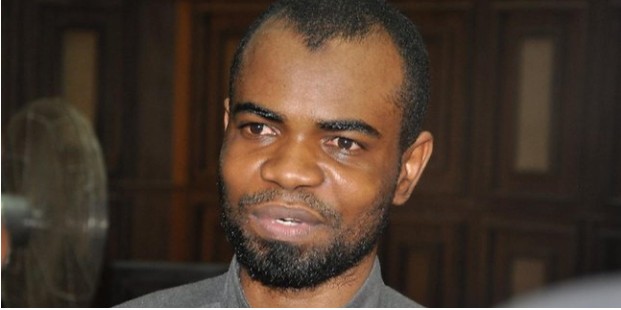
Twelve years after the Federal High Court in Abuja convicted and sentenced Kabiru Umar, popularly known as Kabiru Sokoto, to life imprisonment, the Court of Appeal has granted him a fresh 21-day window to formally challenge the 2013 judgment.
The Abuja Judicial Division of the Court of Appeal granted Umar’s application for an extension of time to appeal the judgment delivered by the Federal High Court on December 20, 2013.
The decision was contained in an enrolled order dated August 20, 2026, in Appeal No. CA/ABJ/PRE/ROA/CR/619M1/2026, a copy of which was seen by SaharaReporters.
A three-member panel comprising Justices Muhammed Danjuma, Ntong F. Ntong and Ele Ojo Enenche granted the application filed by Umar on May 13, 2026, while two other prayers were struck out after they were withdrawn.
The order was signed by Josephine J. Ekperobe, Deputy Chief Registrar of the Court of Appeal, Abuja Judicial Division.
The appellate court specifically extended the time within which Umar could appeal against the judgment of the Federal High Court sitting in Abuja in Suit No. FHC/ABJ/CR/38/2013.
It also directed that he be given 21 days to file his Notice and Grounds of Appeal.
The order stated: “The application filed on 13/05/2026 is hereby granted in terms of prayers 1 and 3. Prayers 2 and 4 having been withdrawn are struck out.”
The court further ordered: “Time is hereby extended to the Appellant/Applicant to appeal against the judgment of the Federal High Court sitting in Abuja, delivered on 20th December, 2013 in Suit No. FHC/ABJ/CR/38/2013.”
It added: “The Appellant/Applicant is granted 21 days to file his Notice and Grounds of Appeal in terms of exhibit A attached to this application alongside the Order of this Court at the registry of the Lower Court.”
The ruling, however, does not overturn Umar’s conviction or declare him innocent of the offences for which he was convicted.
It is a procedural decision dealing with the time within which he can initiate the appeal. The appellate court has not yet considered or determined the substantive grounds on which he intends to challenge the Federal High Court judgment.
Umar was sentenced to life imprisonment by Justice Adeniyi Ademola of the Federal High Court in Abuja on December 20, 2013, in connection with terrorism-related offences arising from the broader investigation into the December 2011 bombing of St. Theresa’s Catholic Church in Madalla, Niger State.
The Christmas Day bombing killed at least 37 people and was widely associated with Boko Haram. It was one of the deadliest terrorist attacks in Nigeria at the time.
However, Umar’s legal team has maintained that the specific charge upon which he was tried and convicted did not allege that he physically carried out or masterminded the bombing.
In a statement issued by his lawyer, Don C. Akaegbu, and reported in May 2026, the defence disclosed that Umar had formally initiated an appeal against the Federal High Court judgment following a review of the proceedings and judgment.
The lawyer attributed the delay in commencing the appellate process to circumstances beyond his client’s control.
“We act as Counsel to Mr. Kabiru Umar (also known as Kabiru Sokoto), who was convicted and sentenced by the Federal High Court, Abuja Judicial Division, on the 20th day of December, 2013,” the statement said.
“We wish to respectfully inform the public that our client has now formally initiated an appeal against the said judgment before the Court of Appeal, the delay in so doing occasioned by circumstances beyond his control, notwithstanding.”
The defence also said an application for extension of time had been filed because of the delay in commencing the appeal.
In his application, Umar attributed the delay to his prolonged incarceration, repeated transfers between custodial facilities and the deaths of two lawyers who had previously handled his case.
His lawyers have also sought to distinguish between direct participation in the Madalla church bombing and the allegation contained in the charge on which Umar was convicted.
“It is important, in the interest of accuracy and fairness, to clarify that: The charges upon which our client was tried and convicted did not allege that he carried out or masterminded the bombing of St. Theresa’s Catholic Church, Madalla,” the defence said.
“Rather, the relevant count alleged that he had information about the incident and failed to disclose the same to law enforcement authorities.”
According to the legal team, the distinction between direct participation and alleged prior knowledge is central to the proposed appeal.
“The distinction between direct participation and alleged prior knowledge is significant in law and forms a central issue in the pending appeal,” the lawyers said.
The defence further indicated that the appeal would challenge the evidence relied upon by the trial court in reaching its decision and the manner in which Umar’s defence was evaluated during the proceedings.
The latest application before the Court of Appeal followed Umar’s Motion on Notice seeking four principal orders.
The first prayer sought an extension of time within which he could seek leave to appeal against the Federal High Court judgment delivered on December 20, 2013.
The second sought an order granting him leave to appeal against the judgment.
The third sought an extension of time within which to file his Notice of Appeal.
The fourth asked the appellate court to deem the Notice of Appeal already filed as properly filed and served.
Following consideration of the application and the affidavit deposed to by Lawal Suleiman, the court granted the first and third prayers.
The second and fourth prayers were withdrawn by the applicant and subsequently struck out.
The ruling therefore clears the procedural hurdle that had stood in the way of Umar’s attempt to challenge the 2013 judgment at the appellate level.
His legal team must now comply with the order by filing the required Notice and Grounds of Appeal within the 21-day period granted by the court.
Umar was represented during the proceedings by E.O. Bamidele, who held the brief of Don C. Akaegbu.
The Federal Republic of Nigeria, the respondent, was represented by D.E. Kasuwe, Assistant Director at the Federal Ministry of Justice, with M.U. Ossi, Esq.
The significance of the Court of Appeal’s decision lies in the fact that Umar has now been given an opportunity to formally pursue an appeal against a judgment delivered more than a decade ago.
Ordinarily, appeals are subject to prescribed statutory timelines. Where the applicable period has expired, an intending appellant must obtain the necessary extension from the court before proceeding.
That was the immediate procedural issue before the Court of Appeal.
By granting the extension of time, the appellate court has allowed Umar to take the next step in challenging the Federal High Court judgment.
However, the court has not ruled on whether his conviction was right or wrong, nor has it determined any of the arguments contained in his proposed appeal.
If the appeal is properly filed and subsequently heard, the appellate court could be called upon to examine the evidence relied upon by the Federal High Court, the interpretation of the charges against Umar and the manner in which his defence was evaluated during the original trial.
For now, the 21-day period granted by the Court of Appeal represents the next stage in the long-running legal battle over Umar’s 2013 conviction arising from the Madalla church bombing case.