
A leadership crisis has deepened within the Petroleum and Natural Gas Senior Staff Association of Nigeria (PENGASSAN) branch covering NNPC Trading Limited (NTL) and NNPC Shipping and Logistics Limited (NSL), as concerned members have approached the National Industrial Court in Abuja seeking the nullification of a July 2026 branch election.
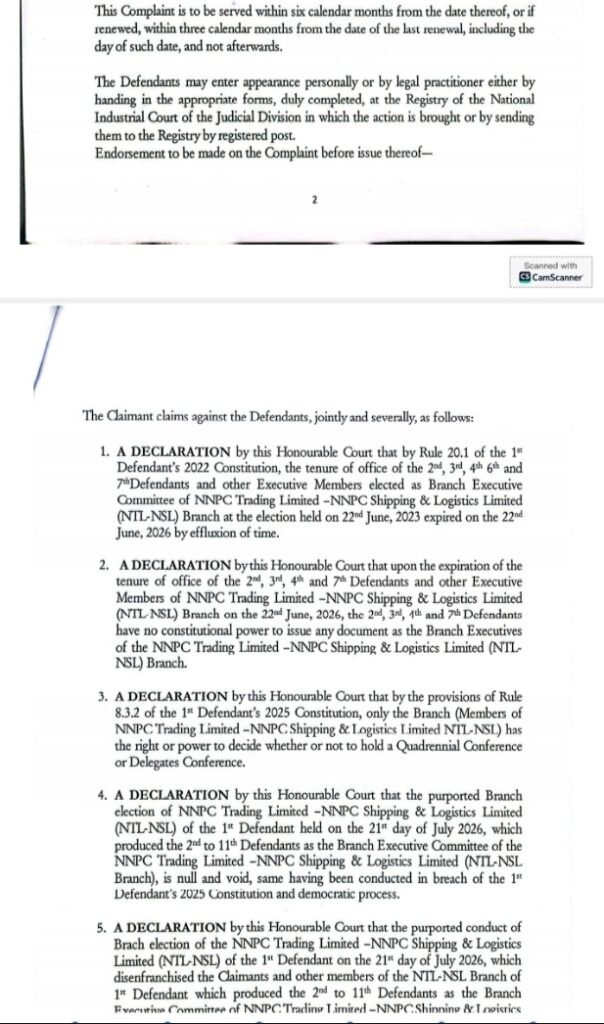
The claimants, who instituted the suit on behalf of concerned members of the NTL-NSL branch, are challenging the legality of the process that produced a new branch executive committee, alleging that the election was conducted after the tenure of the previous executive had expired and in breach of provisions of the union’s constitution.
They are also asking the court to restrain the officials declared winners from parading themselves as duly elected executives and direct PENGASSAN to constitute a caretaker committee to organise a fresh election in accordance with the union’s constitution.
At the centre of the dispute is the tenure of the branch executive elected on June 22, 2023, and the circumstances surrounding the election conducted on July 21, 2026.
According to the claimants, the 2023 executive, led by Amaoge Chukwudi as chairman, was elected for a three-year tenure which expired on June 22, 2026.
They relied on Rule 20.1 of the PENGASSAN 2022 Constitution as well as documents relating to the 2023 election to support their position that the tenure had formally come to an end before the disputed election was conducted.
The claimants said members of the branch had raised concerns about the approaching expiration of the executive’s tenure several weeks before June 22, 2026, and called on the leadership to begin the transition process and provide members with a clear roadmap for the election.
They said the issue was also raised during an emergency congress held on May 7, 2026, under Any Other Business.
According to the claimants, when the matter was raised, the chairman responded that “plans were underway.”
They alleged, however, that the assurance was not followed by a concrete or transparent electoral process.
The members claimed that they were not formally informed of an election timetable, offices to be contested, screening requirements, nomination procedures, delegate accreditation arrangements or electoral guidelines, which they said were required under the union’s 2025 Constitution.
The disagreement intensified after the expiration of the outgoing executive’s tenure.
On July 20, concerned members submitted an urgent petition to PENGASSAN’s Central Working Committee through the General Secretary, raising objections to the proposed electoral process.
The petition, titled “Urgent Petition Against Unconstitutional Electoral Conduct And Disenfranchisement Of Members – NNPC Trading Limited & NNPC Shipping & Logistics Limited Branch,” accused the outgoing leadership of allegedly undermining internal democracy within the branch.
The petitioners described the situation as one involving “grave constitutional urgency” and alleged “deliberate and systematic subversion of internal democracy.”
They further alleged that officials whose tenure had expired were still exercising authority over the electoral process and were effectively using powers they no longer lawfully possessed “to determine the conditions of their own succession.”
A major point of contention was the decision to conduct the election through a Delegates’ Conference instead of a congress involving the wider membership of the branch.
The petitioners relied on Rule 8.3.2 of the PENGASSAN 2025 Constitution, which provides that the “Branch” may choose either a Quadrennial Conference of all members or a Delegates’ Conference.
They argued that the constitutional power to determine the mode of election belonged to the branch collectively and could not simply be exercised by the Branch Executive Council or Branch Executive Committee without a decision by the membership.
The claimants also alleged that critical decisions concerning the electoral process were taken after June 22, 2026, when they maintained that the tenure of the outgoing executive had already expired.
Another major issue raised was the selection of additional delegates to participate in the election.
The petitioners relied on Section 8.3.3 of the 2025 Constitution, which they said required delegates to be nominated and accredited in accordance with applicable by-laws and guidelines approved by the National Secretariat.
They alleged that no such framework was properly presented to or communicated to branch members before the delegates were selected.
Among their demands to the Central Working Committee were recognition of the expiration of the outgoing executive’s tenure, nullification of the purported appointment of additional delegates, suspension of the planned election, appointment of an independent Returning Officer and publication of a formal election timetable.
They also called for an investigation into the conduct of the outgoing officials, particularly over alleged failure to commence the electoral process within their tenure, actions allegedly taken after the expiration of their tenure and the manner in which delegates were selected.
“This petition is not about who wins an election. It is about whether the Constitution will govern our Union or whether expediency will,” the petitioners stated.
They added: “In PENGASSAN, no individual is greater than the Constitution, no office is greater than the membership, and no electoral process can be considered legitimate unless members can clearly see that it is fair.”
Despite the complaints, the disputed electoral process proceeded, culminating in the July 21 Delegates’ Conference, where new branch officials were declared elected.
The claimants have now taken the dispute before the National Industrial Court, asking it to determine whether the election was validly conducted and whether the outgoing executive had the constitutional authority to take steps towards the election after its tenure had expired.
One of the documents specifically challenged in the suit is a July 13 letter signed by Chukwudi and titled “REQUEST FOR APPROVAL OF THE 1ST QUADRENNIAL BRANCH DELEGATES’ ELECTION.”
The letter was addressed to the PENGASSAN General Secretary.
The claimants argue that Chukwudi’s tenure had already expired by the time the request was made and that he therefore lacked constitutional authority to take decisions relating to the branch’s electoral process.
They further contend that members of the NTL-NSL branch had not met and collectively decided whether the election should be conducted through a Quadrennial Conference of all members or a Delegates’ Conference before the July 13 request was submitted.
The controversy was further complicated by another petition filed on August 5 by four members of the former branch executive.
The four members alleged what they described as the “unconstitutional, discriminatory and arbitrary exclusion” of duly elected NTL/NSL Branch Executive Council members from the Delegates’ Conference.
According to them, they had neither been suspended nor removed from office and had not been subjected to any disciplinary sanction that could have lawfully prevented them from participating in the conference.
They alleged that they were the only members of the Branch Executive Council who supported conducting the election through Congress rather than a Delegates’ Conference.
The four claimed that after expressing that position, they were allegedly excluded from the electioneering process and prevented from participating in the election.
They alleged that they travelled to the PENGASSAN Head Office Annex in Jahi, Abuja, on July 21 for the Delegates’ Conference but were denied entry.
According to their petition, the entrance gate was locked and security personnel refused to allow them into the premises.
They further alleged that they were not given any written explanation or constitutional provision justifying their exclusion.
The petitioners also alleged that while the four members remained outside the venue, another BEC member, Bwaltam Musa, was permitted to enter and participate in the proceedings.
The four members relied on Section 8.3.3 of the PENGASSAN Constitution, which they quoted as providing that the conference “shall be composed of…all members of the Branch Executive Council (BEC).”
They argued that the provision did not authorise organisers to selectively exclude duly elected BEC members from a Delegates’ Conference.
They described their alleged exclusion as “abuse of administrative authority” and “suppression of dissent.”
The claimants are consequently asking the National Industrial Court to determine a number of constitutional questions arising from the dispute.
Among them is whether the tenure of the branch executive elected on June 22, 2023, expired on June 22, 2026, and whether the affected officials retained constitutional authority to act on behalf of the branch after that date.
They are also asking the court to determine whether the branch itself, rather than the outgoing BEC or BECOM, was responsible for determining the mode of election under Rule 8.3.2 of the PENGASSAN 2025 Constitution.
Another question before the court is whether the July 21, 2026 election was validly conducted in accordance with the union’s constitution and whether the process unlawfully excluded eligible members from participating in the choice of their leaders.
Among the reliefs being sought is a declaration that the July 21 election is null and void on the grounds that it allegedly violated PENGASSAN’s constitutional provisions and established democratic procedures.
The claimants are also seeking an injunction restraining the newly declared executives from presenting or parading themselves as duly elected officials of the NTL-NSL branch.
They want the court to restrain PENGASSAN from taking disciplinary action against them or other concerned members on account of their petitions, complaints or efforts to challenge the disputed electoral process.
They are further asking the court to direct the PENGASSAN National Secretariat to constitute a caretaker committee that will oversee the affairs of the branch and organise a fresh election conducted in accordance with the applicable constitutional provisions.
The dispute comes against the backdrop of an earlier position reportedly taken by PENGASSAN’s Central Working Committee, which described the initial petition as frivolous and maintained that there was no constitutional infraction.
The claimants, however, have rejected that position by placing the issues before the National Industrial Court for judicial determination.
The case has therefore moved beyond an internal disagreement over who should occupy branch offices and into a wider legal contest over the interpretation of PENGASSAN’s constitutional provisions, the duration and limits of union officials’ tenure, the authority to determine the method of conducting branch elections, the composition of delegates’ conferences and the rights of ordinary members and elected representatives to participate in the process of choosing their leaders.
At the heart of the case is the claimants’ contention that the legitimacy of any union election must flow from strict compliance with the constitution governing the organisation.
The court’s eventual determination could therefore have implications not only for the disputed NTL-NSL election but also for how questions of tenure, transition and electoral authority are handled within the union’s branches.