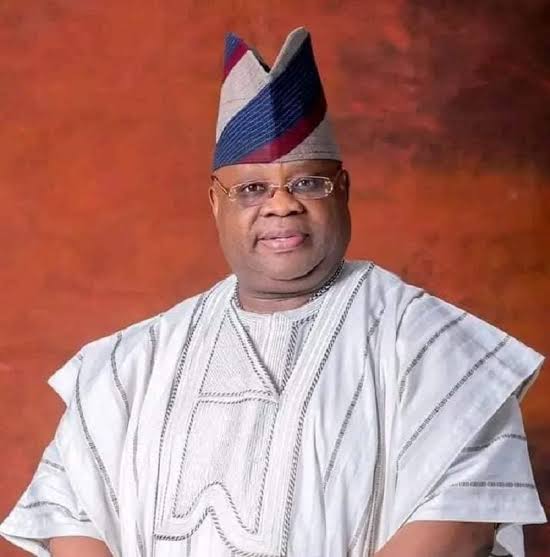
The Osun State Governor, Ademola Adeleke, has come under criticism over his decision to approve a two-year extension for the Vice-Chancellor of Osun State University (UNIOSUN), Professor Clement Adebooye, whose initial five-year tenure is due to expire in January 2027.
The extension, which will keep Adebooye in office until January 2029, has triggered controversy within the university community, with critics alleging that the governor’s decision amounts to an abuse of the law establishing the institution.
Adebooye assumed office as Vice-Chancellor in January 2022 and, under the existing provisions governing the university, is expected to complete his first and only five-year term in January 2027.
The controversy centres on the Osun State University (Establishment) Law, 2006, which provides specific provisions concerning the appointment and tenure of the institution’s Vice-Chancellor.
The law, in the First Schedule, provides that the Vice-Chancellor “shall be appointed or be removed by the Visitor upon consultation with the Council.”
It further states that “The tenure of the Vice-Chancellor shall be one term of five years.”
Critics of the extension argue that the provision is clear and limits the tenure of a Vice-Chancellor to a single five-year term, raising questions over the legal basis upon which Governor Adeleke approved an additional two years for Adebooye.
The development has reportedly generated anger among some members of the university community, particularly following the recent dissolution and reconstitution of the institution’s Governing Council by the governor.
“There is anger on campus regarding the extension of tenure of the Vice Chancellor while other council members were sacked,” a source within the university told SaharaReporters.
A former UNIOSUN Alumni executive, who spoke on condition of anonymity, also criticised the decision, saying it had created tension within the university’s alumni body.
“There is a law that established the University, any action that ought to be taken should be taken in cognizance of the law but this is not the case in the instance of the extension,” the former alumni executive said.
Another major concern raised by critics is the procedure for appointing a substantive Vice-Chancellor when the office becomes vacant.
Under Paragraph 5 of the First Schedule to the 2006 law, when a vacancy occurs in the office of the Vice-Chancellor, the Governing Council is required to advertise the position in a reputable journal or widely read newspaper in Nigeria.
The advertisement is expected to state the qualifications and qualities required of prospective candidates, as well as the terms and conditions of service attached to the position.
The Council is subsequently required to draw up a shortlist of suitable candidates for consideration.
However, sources within the university questioned why the process of selecting a successor to Adebooye was allegedly not commenced before the expiration of his tenure in January 2027.
One UNIOSUN staff member accused the administration of using the extension as a reward for loyalty rather than following the procedure established by law.
“They are using the extension as compensation for loyalty but that’s not what the law says,” the staff member alleged.
The controversy emerged shortly after Governor Adeleke dissolved the university’s existing Governing Council and constituted a new one.
On Friday, August 28, 2026, Adeleke dissolved the then-existing council and immediately reconstituted it, saying the decision was aimed at strengthening the governance structure of the institution.
The development was announced in Osogbo in a statement issued by the governor’s spokesperson, Mallam Olawale Rasheed.
According to the statement, the council was dissolved “in a bid to strengthen the institution’s governance structures.”
The governor said the reconstitution was also necessary to ensure continuity in the administration of the university and prevent disruption to its operations.
The statement said the move was carried out “to avoid gaps in the operation of the globally rated university.”
Professor Adewale Abiodun Oladipo was appointed Pro-Chancellor and Chairman of the reconstituted Governing Council.
Oladipo had previously served as chairman of the dissolved governing board and was retained by the governor to lead the new council.
Other members of the reconstituted council are Alhaji Gbadegesin Lawal, Otunba Titi Laoye-Ponnle, Mr Akinola Franklin Omoniyi, Chief Funminiyi Awotide, Mr Orija Samuel Adebayo and Mrs Adewale Adetayo Bola.
Following the reconstitution of the council, Governor Adeleke approved the two-year extension of Adebooye’s tenure.
A statement signed by the university’s Public Relations Officer, Ademola Adesoji, said the governor announced the extension on Monday while inaugurating the reconstituted Governing Council at the Osun State Government House in Osogbo.
According to the statement, the governor’s decision to retain Adebooye was based on the need to maintain stability and prevent an administrative vacuum at the university.
Adeleke also retained Oladipo as Pro-Chancellor and Chairman of Council, citing his experience and familiarity with the university system.
The governor’s position has, however, failed to settle the controversy, as critics insist that administrative continuity cannot automatically supersede the provisions of the law establishing the university.
At the centre of the dispute is the interpretation of the Visitor’s powers under the 2006 law.
While the law gives the Visitor the authority to appoint or remove the Vice-Chancellor after consultation with the Council, critics are questioning whether that power also extends to unilaterally or administratively extending a Vice-Chancellor’s tenure beyond the stipulated five-year term.
Adebooye’s case has become particularly contentious because his initial appointment in January 2022 means that his five-year tenure is scheduled to end in January 2027.
The newly approved extension would effectively give him seven years in office, taking his tenure to January 2029.
Those opposed to the decision are therefore demanding that the Osun State Government explain the legal basis for the additional two years.
They are also questioning why the statutory process for advertising the position and selecting a new substantive Vice-Chancellor was not allowed to proceed ahead of the expiration of Adebooye’s tenure.
The controversy has consequently shifted from a question of administrative continuity to a broader legal and governance issue: whether Governor Adeleke’s powers as Visitor to UNIOSUN permit him to extend the tenure of a Vice-Chancellor beyond the five-year period expressly provided under the Osun State University (Establishment) Law, 2006.
Unless the legal basis for the extension is clarified, the decision is likely to remain a source of tension within the university community, particularly among staff, alumni and other stakeholders who insist that every decision concerning the institution must be made in accordance with its establishing law.