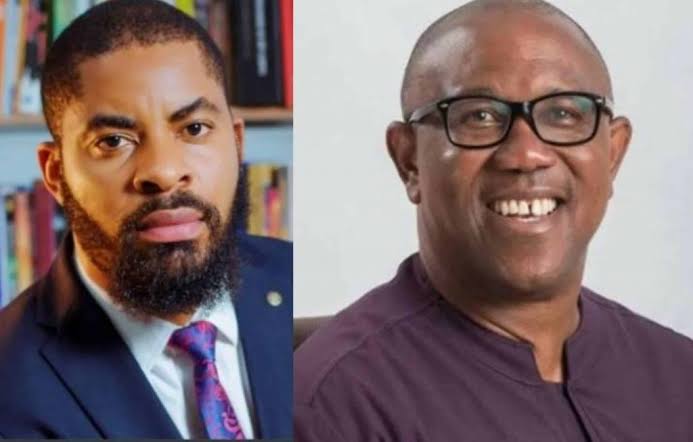
Human rights lawyer and activist, Deji Adeyanju, has criticised the presidential candidate of the Nigeria Democratic Congress (NDC), Peter Obi, over his renewed appearances at Christian gatherings ahead of the 2027 general elections, warning against a return to what he described as the religious politics that divided Nigerians during the 2023 presidential election.
Adeyanju, in a statement on Tuesday, argued that elections should be based on ideas, policies and competing visions for the country rather than religious mobilisation, accusing politicians and religious leaders of creating a dangerous environment when faith is used as an electoral tool.
His criticism followed Obi’s recent appearance at a Koinonia Global service in Abuja on Sunday, where the founder of the church, Apostle Joshua Selman, publicly acknowledged the former Anambra State governor before the congregation.
A video of the moment showed worshippers cheering as Selman introduced Obi. The footage was subsequently shared by Obi’s official 2027 campaign photographer.
Obi, who is seeking the presidency in 2027 under the NDC, has in recent weeks appeared at several Christian gatherings across the country as he steps up his political activities ahead of the election.
On August 5, he attended the 50th/15th Biennial Conference of the Methodist Church Nigeria in Ibadan, Oyo State, where he spoke about governance, insecurity and the economic challenges confronting the country.
In July, Obi also spoke to journalists at St Fintan’s Catholic Church in Ebonyi State after attending a burial ceremony. He used the occasion to criticise the administration of President Bola Tinubu over economic hardship, insecurity and what he described as the harassment of opposition supporters.
Obi was also in Edo State in August for the funeral rites of the late Archbishop Augustine Akubeze at the Holy Cross Cathedral in Benin City.
But Adeyanju said the renewed visibility of Obi in churches was troubling, particularly in view of the controversy surrounding the role of religion in the former Labour Party presidential candidate’s 2023 campaign.
“Elections should be about ideas, policies and competing visions for Nigeria. Religion and politics should never be allowed to become instruments of division,” Adeyanju said.
“The church is not a place for political campaigns or political gimmicks, and politicians are not pastors. Pastors and religious leaders should stop giving politicians platforms to campaign or seek endorsements in church.”
Obi’s relationship with Christian leaders and churches became a major issue during the 2023 presidential election, when his campaign attracted significant support among sections of Nigeria’s Christian population.
During the campaign, Obi made appearances at several churches and Christian gatherings.
At an Anglican Church event in Abuja in September 2022, he urged Christian leaders to “take back your country”, a statement that subsequently became part of the wider controversy over the role of religion in his campaign.
The controversy intensified after an audio recording of a telephone conversation between Obi and Bishop David Oyedepo of the Living Faith Church emerged during the 2023 election period.
In the recording, Obi was heard asking Oyedepo to speak to Christians in parts of the country while describing the election as a “religious war”.
Obi initially disowned the recording but later acknowledged that he had spoken with Oyedepo, while denying that he described the election as a religious war.
The controversy unfolded amid heightened tensions over the All Progressives Congress’ Muslim-Muslim presidential ticket of Bola Tinubu and Kashim Shettima.
Obi, a Christian from the South-East, had selected a Muslim, Yusuf Datti Baba-Ahmed, as his running mate.
Adeyanju said Nigeria must avoid returning to the religious mobilisation that characterised parts of the 2023 election, warning that politicians should not exploit religious sentiments for electoral advantage.
He also cited the Electoral Act 2026, which prohibits campaigning or broadcasting based on religious, tribal or sectional considerations for the purpose of promoting or opposing a political party or candidate.
Section 101 of the Act provides that anyone convicted of campaigning on such grounds could face a fine of between N3 million and N5 million, imprisonment for up to 12 months, or both.
Political parties convicted of the offence could also face fines ranging from N30 million to N50 million.
Adeyanju further condemned the use of religious leaders for political endorsements, maintaining that the practice was dangerous regardless of the politician involved.
“The gathering of religious clerics by a governor last week to endorse Tinubu is also condemnable, just as it is troubling to see Peter Obi appearing to return to the same politics of religious mobilisation that divided Nigerians in 2023,” he said.
“At what cost will it be when we continue to divide ourselves along religious lines using the weapon of politics? At what cost?”
He urged politicians across political parties to focus on governance, policies and national development rather than exploiting religious sentiments to secure votes.
“The bad precedent set in 2023 should not be repeated, let alone worsened. Pastors must desist from platforming politicians if they are to retain their respect and keep the house of God sacred,” Adeyanju said.
“All is not fair in politics. All is not fair in politics like President Tinubu wrongly said.”
Adeyanju’s criticism comes as Obi intensifies his political activities ahead of the 2027 presidential election and seeks to consolidate his political support following his third-place finish in the 2023 presidential election.
Obi has repeatedly presented the 2027 contest as an election about leadership, governance and the future of Nigeria. In June, he also warned young Nigerians against being manipulated through ethnic and religious sentiments.
The former Anambra governor has maintained that he would not base his 2027 campaign on religion or ethnicity, despite the controversies that followed his 2023 campaign strategy and the leaked conversation with Oyedepo.
The renewed scrutiny of his church appearances is therefore likely to keep the role of religion in Nigerian politics at the centre of public debate as political parties and presidential hopefuls position themselves for the 2027 presidential election.
For Adeyanju, however, the warning is not limited to Obi. His criticism also extends to politicians supporting President Tinubu and religious leaders who allow their platforms to be used for political endorsements.
His position is that the standard should apply across political parties and religious divides: politicians should campaign on their records, policies and plans for Nigeria, while religious institutions should remain spaces for worship rather than becoming extensions of political campaigns.