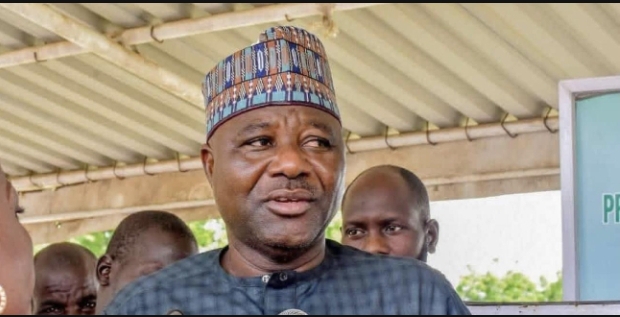
Borno State Commissioner for Youth and Sports Development, Sainna Buba, has come under intense criticism after threatening political opponents with punishment if they refuse to support the ruling All Progressives Congress (APC).
Buba, a known ally of Borno State Governor Babagana Umara Zulum, made the controversial remarks at a campaign inauguration organised by the Tinubu City Boy Movement, a political support group focused on promoting the policies of President Bola Ahmed Tinubu and mobilising support for his re-election.
The phrase “City Boy” is a popular political moniker associated with Tinubu, dating back to his years as governor of Lagos State.
Speaking at the event, Buba issued a series of threats against individuals perceived to be opposed to the government.
“Whoever shows us a finger, we are ready to cut off his fingers,” the commissioner said.
He went further, warning political opponents that the government would respond aggressively to those who challenged it.
“We are now playing politics. Whoever shows us a finger, we will show him a finger. Whoever dares to show us a finger again, we will break his finger,” Buba said.
“The government is our government. Those who follow us will enjoy the honey; if you refuse, then you will be flogged.”
The comments have triggered concerns over the language being used by a serving government official, particularly in a state where questions about political freedom, security, youth rights and the treatment of dissent have continued to generate public debate.
Critics say the commissioner’s remarks could be interpreted as a threat against citizens who choose to oppose the ruling party or exercise their constitutional right to political disagreement.
They argue that statements threatening to “break” the fingers of opponents go beyond ordinary campaign rhetoric and risk creating an atmosphere in which political loyalty is presented as a requirement for favourable treatment by those in power.
The controversy has also revived allegations surrounding the treatment of some young people in Borno State, including claims that youths in Tandari were subjected to intimidation and prolonged detention through the justice system.
Other allegations have claimed that executive powers were used against young people, with some reportedly fleeing the state and seeking refuge in Algeria.
Those allegations have not been independently established and require proper investigation by the relevant authorities.
However, Buba’s latest comments have renewed questions about whether political dissent is being tolerated in the state and whether government officials should be using language that could be perceived as threatening citizens who disagree with them.
Critics say the issue is particularly sensitive in Nigeria, where political violence, intimidation and inflammatory rhetoric have repeatedly featured around election periods.
The concerns have been reinforced by previous controversies involving politicians across the country.
During the build-up to the Osun State Governorship Election, Senator Francis Fadahunsi, an APC lawmaker representing Osun East, came under fire after a video circulated in which he appeared to instruct APC supporters to “kill” members of the rival Accord Party while addressing a campaign rally in Ilesa.
Fadahunsi also reportedly referred to the violent political crisis of 1983 in the former Western Region, including the burning of an opposition candidate’s family home.
His comments generated widespread outrage and prompted the Osun State Police Command to summon him for questioning.
In a letter signed by Samuel Erale, the Commissioner of Police for election duties, the police described the senator’s remarks as “threatening, inciting, and intimidating in nature.”
Fadahunsi honoured the invitation and appeared before the State Criminal Investigation Department in Osogbo.
The senator, however, denied calling for physical violence. He argued that his words had been manipulated and that their meaning had been distorted because he spoke in Yoruba.
Fadahunsi maintained that when he said supporters should “kill Accord,” he meant defeating the political party at the ballot box rather than physically attacking its members.
Despite the controversy and police questioning, there was no reported prosecution or other punitive action against the senator beyond the invitation.
Civil society organisations, including ActionAid Nigeria, subsequently condemned what they described as the normalisation of impunity surrounding inflammatory electoral rhetoric.
The Fadahunsi controversy is only one example of a wider pattern in which politically charged threats and inflammatory statements have accompanied Nigerian election campaigns, with critics often questioning whether those responsible face meaningful consequences.
Ahead of the 2023 Lagos State governorship election, APC chieftain Musiliu ‘MC Oluomo’ Akinsanya was also widely criticised after a video circulated in which he warned Igbo voters: “If you know you won’t vote for us, stay at home.”
The statement attracted condemnation amid concerns that it could intimidate voters and discourage citizens from participating freely in the electoral process. However, it did not result in significant reported legal action.
Similarly, ahead of the 2019 general elections, then-Kaduna State Governor Nasir El-Rufai warned foreign election observers on live television that anyone who came to interfere in Nigeria’s electoral process would “go back in body bags.”
El-Rufai later defended the statement as a warning against interference in Nigeria’s sovereignty.
But, like several other politically inflammatory remarks, the statement did not result in reported prosecution.
Against this backdrop, Buba’s comments have raised fresh questions about the limits of political rhetoric, particularly when such statements come from serving government officials.
For critics, the central concern is not simply whether the commissioner’s words were intended literally, but the message they could send to citizens, opposition supporters and young people in a politically sensitive environment.
They argue that democracy allows citizens to support the ruling party, oppose it, criticise government policies or choose not to participate in partisan politics without fear of retaliation.
The controversy has therefore placed renewed attention on the responsibility of political leaders and government officials to avoid language that could encourage intimidation, threats or violence during political mobilisation.
With Nigeria already facing concerns over electoral violence and political intolerance, critics say statements suggesting that supporters of the government will “enjoy the honey” while those who refuse to support it will be “flogged” risk reinforcing perceptions that access to government protection, opportunities or rights could be tied to political loyalty.
The controversy is likely to intensify calls for political actors and security agencies to ensure that campaign activities remain peaceful and that citizens are allowed to freely exercise their political rights without intimidation or threats.