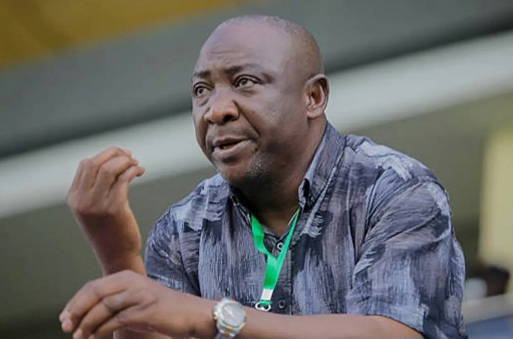
Nigeria Football Federation (NFF) President Ibrahim Gusau and members of the federation’s Executive Committee have reportedly resigned amid mounting pressure over the state of Nigerian football, in a development that could trigger a major shake-up of the country’s football administration.
Former Super Eagles media officer Obong Colin reported on Thursday that Gusau and other members of the NFF board had stepped down, following weeks of growing criticism over the federation’s leadership, national-team performances, financial management and wider football development.
Earlier reports had indicated that eight of the 13 members of the NFF board had already resigned. NFF General Secretary Mohammed Sanusi was also linked to the leadership crisis, although there was no immediate official statement from the federation confirming all the reported resignations at the time of filing this report.
The reported departures came days after an alleged 24-hour demand for the NFF board to resign. The National Sports Commission subsequently clarified that the Federal Government had not ordered the NFF leadership to step down, even as discussions continued around the possibility of establishing a normalisation committee to oversee the federation.
Pressure on Gusau’s administration intensified following Nigeria’s failure to qualify for the 2027 FIFA Women’s World Cup in Brazil.
The Super Falcons had participated in every edition of the Women’s World Cup since the inaugural tournament in 1991. Their hopes of maintaining that record ended after a 1-0 quarter-final defeat to Cameroon at the 2026 Women’s Africa Cup of Nations, followed by a 2-1 loss to South Africa in the subsequent World Cup play-off.
The NFF later dismissed Super Falcons head coach Justin Madugu.
The crisis has not been limited to the women’s national team. The Super Eagles also failed to qualify for the 2026 FIFA World Cup after losing to the Democratic Republic of Congo on penalties in the African play-off.
Nigeria’s youth football programme suffered another setback, with the Golden Eaglets failing to qualify for the 2026 FIFA U-17 World Cup.
Financial concerns have further deepened scrutiny of the federation. The Economic and Financial Crimes Commission (EFCC) and the Independent Corrupt Practices and Other Related Offences Commission (ICPC) are investigating the utilisation of a ₦12 billion Federal Government intervention fund released in 2024 to settle outstanding wages, bonuses and allowances.
The NFF has maintained that the relevant records are currently with the anti-graft agencies.
The latest leadership crisis followed the work of a fact-finding committee constituted by the NFF to investigate the Super Falcons’ disappointing 2026 WAFCON campaign and the subsequent failure to qualify for the 2027 FIFA Women’s World Cup.
The committee, chaired by Ambassador Fanny I. Amun, examined the problems surrounding the national team while also investigating wider issues affecting Nigerian football, including governance, finances, player selection, national-team camp management, league development and technical preparation.
Its report, dated August 21, 2026, contained a series of serious allegations against officials within the football administration. However, the committee expressly cautioned that not every allegation presented before it had been established as proven fact.
Among the allegations examined were claims that some coaches and officials invited players to national-team camps for financial gain, while some NFF board members were accused of interfering in player selection.
The committee also considered allegations that officials had infiltrated the Super Falcons’ camp in Morocco and raised concerns over reported disparities in payments made to players, coaches and federation officials.
Financial controls also came under scrutiny following an incident involving allegedly missing money during the Falcons’ stay in Morocco.
The committee recommended stronger financial accountability and tighter controls, as well as a clearer separation between administrative and technical responsibilities within Nigerian football.
It further called for objective and transparent criteria for selecting players for national teams, improved remuneration for players and officials, and greater accountability across the football administration.
But the committee’s concerns went beyond the immediate failures of the Super Falcons and pointed to what it described as deeper structural weaknesses in Nigerian football.
It recommended reforms to the NFF statutes and Congress, improved management and funding of domestic leagues, stronger coaching education, better player-development and scouting systems, and increased deployment of technology in player registration and football administration.
The committee argued that Nigeria’s recurring international football setbacks could not be solved simply by changing coaches or focusing on individual national teams.
Instead, it stressed that fundamental reforms were required across the country’s football administration and domestic league structure if Nigeria was to restore its position as a major force in African football.
Despite the mounting criticism, Gusau’s tenure was not without achievements.
Under his administration, Nigeria reached the final of the 2023 Africa Cup of Nations, while the Super Falcons returned to the Olympic Games at Paris 2024 after a 16-year absence.
The federation also supported the development of new training and accommodation facilities at the Moshood Abiola National Stadium in Abuja.
The reported resignations nevertheless represent the most significant challenge yet to the current NFF leadership and could have far-reaching consequences for the administration of Nigerian football.
The NFF had scheduled its next elective Congress for September 27 in Lafia, Nasarawa State. The sudden leadership shake-up could now alter that timetable and raise fresh questions over who will steer the federation through the next phase.
With the national teams struggling for major tournament qualification, financial investigations ongoing and the federation facing allegations of administrative and technical interference, the reported resignation of Gusau and other board members marks a potentially decisive moment for Nigerian football.
The central question now is whether the crisis will result in a genuine restructuring of the NFF or simply lead to another change of personalities at the top of an institution facing much deeper governance and development problems.