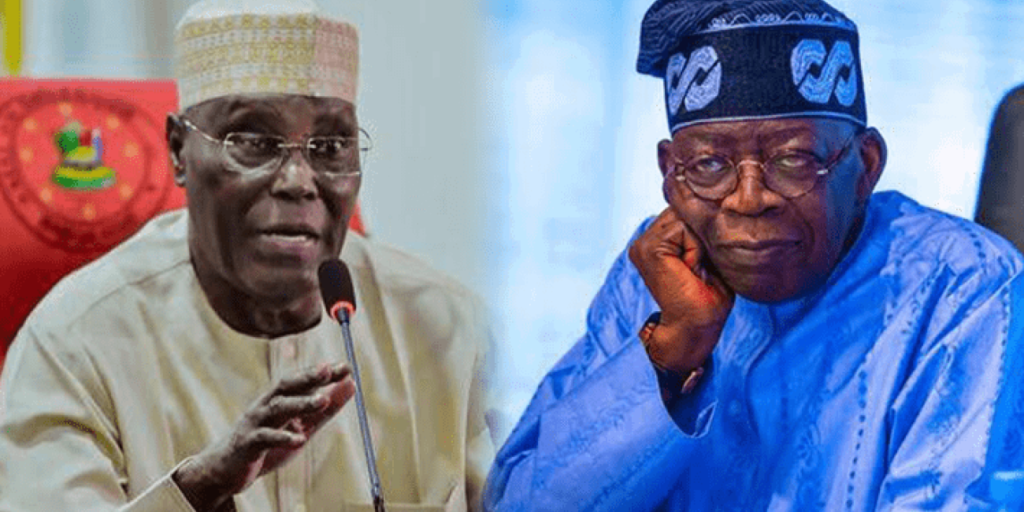
Former Vice President and presidential candidate of the African Democratic Congress (ADC), Atiku Abubakar, has launched a fresh attack on the administration of President Bola Tinubu over Nigeria’s rising debt profile, demanding full transparency on loans contracted by the Federal Government.
Atiku warned that continued borrowing without adequate disclosure and demonstrable economic benefits could saddle present and future generations of Nigerians with an unsustainable debt burden.
The former Vice President made the demand in a statement issued by his Media Office in Abuja on Sunday, accusing the Tinubu administration of incompetence and financial impropriety, particularly over what he described as a lack of transparency surrounding recent loan agreements.
Atiku specifically questioned the Federal Government’s handling of a $5 billion financing facility obtained from First Abu Dhabi Bank, insisting that Nigerians, as taxpayers and the ultimate beneficiaries and debtors of government borrowing, deserve to know exactly how the money will be utilised.
According to him, the government has an obligation to explain every loan contracted on behalf of the Nigerian people, especially at a time when the country’s debt stock continues to rise.
Atiku, citing figures from the Debt Management Office (DMO), said the Tinubu administration had added about N72 trillion to Nigeria’s fresh debt stock since assuming office on May 29, 2023, bringing the country’s total indebtedness to N159.35 trillion as of early 2026.
He questioned the justification for the increasing borrowing, arguing that Nigerians have not witnessed corresponding improvements in their living conditions, economic security or general wellbeing despite the additional financial obligations.
The ADC presidential candidate further claimed that poverty had increased from 56 per cent in 2023 to between 61 per cent and 63 per cent under the Tinubu administration, leaving more than 140 million Nigerians trapped in multidimensional poverty.
Atiku also criticised the Minister of Finance and Coordinating Minister of the Economy, Taiwo Oyedele, over his response to questions surrounding the Abu Dhabi facility.
Oyedele had stated that the facility was approved by the National Assembly and was intended to refinance more expensive debt.
However, Atiku argued that Nigerians still deserve detailed information about the transaction, insisting that parliamentary approval should not prevent the government from explaining the financial implications of the deal to citizens.
“The government is obliged to explain every loan taken on behalf of Nigerians,” Atiku said.
“Every kobo borrowed matters because citizens — both living and unborn — will bear the burden of repayment. Yet these loans have failed to improve their material wellbeing.”
The former Vice President argued that transparency was particularly important because of the financial commitments attached to the Abu Dhabi facility.
He noted that the Federal Government is required to pledge securities worth about 133 per cent of the loan amount as collateral, arguing that the scale of the commitment makes public disclosure and accountability even more critical.
Atiku further referenced concerns reportedly raised by the International Monetary Fund (IMF) and Fitch Ratings over aspects of Nigeria’s financing structure, particularly transparency and the sustainability of the country’s sovereign debt.
He maintained that Nigerians should not be expected to accept additional financial obligations without knowing the purpose of the borrowing, the terms attached to the facility, the collateral being pledged and the expected economic benefits.
The former Vice President warned that borrowing without clear and measurable results could undermine public trust and expose Nigeria to deeper economic difficulties.
He urged Nigerians to hold the Tinubu administration accountable for its borrowing decisions and demand evidence that borrowed funds are being deployed in ways capable of stimulating economic growth and improving the standard of living.
Atiku stressed that the loans contracted by the government would ultimately have to be repaid by Nigerian citizens, making the issue not merely a political dispute but a matter with long-term consequences for the country.
According to him, every additional borrowing decision places a responsibility on both the present generation and Nigerians yet unborn.
The former Vice President therefore called for greater transparency in the management of Nigeria’s finances, particularly regarding loans contracted by the Federal Government.
The controversy over the $5 billion Abu Dhabi facility comes against the backdrop of the National Assembly’s approval of fresh external borrowing requests by the Tinubu administration.
In March, SaharaReporters reported that the Senate swiftly approved President Tinubu’s request to obtain external loans totalling $6 billion, barely three and a half hours after the request was formally presented before the upper chamber.
The approval followed the reading of the President’s request by Senate President Godswill Akpabio during plenary and the immediate consideration of a report by the Senate Committee on Local and Foreign Debts.
The committee, chaired by Senator Aliyu Wamakko of the All Progressives Congress (APC), Sokoto North, recommended approval of the borrowing plan after reviewing the details contained in the President’s communication.
Earlier during plenary, Akpabio had read two separate letters from President Tinubu requesting the National Assembly’s approval for external financing facilities.
In the first letter, President Tinubu sought approval for a structured Total Return Swap (TRS) external financing programme of up to $5 billion with First Abu Dhabi Bank of the United Arab Emirates.
According to the President’s request, the facility would be provided to Nigeria in tranches and would serve as a financing mechanism to support government obligations.
Atiku’s latest intervention has therefore placed the Federal Government’s borrowing strategy under renewed political and public scrutiny, with the former Vice President demanding that Nigerians be given clear answers on how the country’s growing debt is being managed.
He warned that if borrowed funds do not produce measurable economic benefits, the country could be left with a massive repayment burden while ordinary Nigerians continue to struggle with rising economic pressures.
Atiku ultimately urged Nigerians to demand accountability and insist that every loan contracted in their name must be accompanied by transparency, clear objectives and evidence of tangible results.
He maintained that the question Nigerians should be asking is not simply how much the government is borrowing, but who is benefiting from the borrowing and whether the people who will ultimately repay the loans are receiving any meaningful value in return.