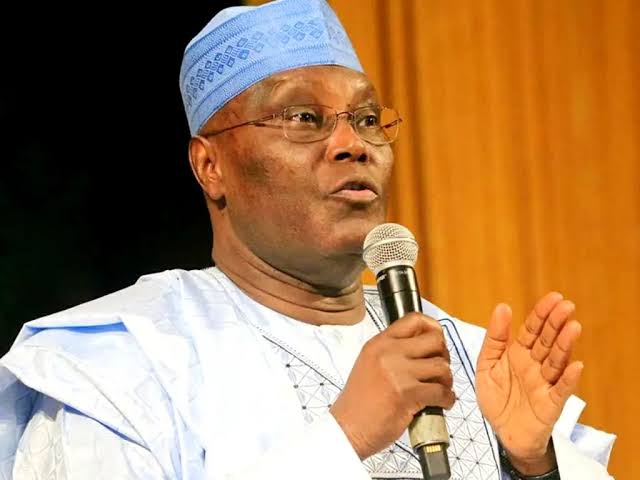
Former Vice President and presidential candidate of the African Democratic Congress (ADC), Atiku Abubakar, has challenged the United States Federal Bureau of Investigation (FBI) over its invocation of “danger to lives” as justification for withholding potentially disclosable records concerning President Bola Tinubu.
Atiku argued that Nigerians could not be expected to accept a blanket invocation of “danger to lives” when millions of citizens were already grappling with insecurity, hunger and severe economic hardship.
In a statement issued by his Senior Special Assistant on Public Communication, Phrank Shaibu, Atiku questioned the basis of the FBI’s position, arguing that the reality confronting Nigerians makes the argument particularly difficult to accept.
“The FBI says disclosure could endanger lives. Which lives? Nigerians are already dying,” Atiku said.
He accused the Tinubu administration of pursuing economic policies that have placed additional pressure on the survival of ordinary Nigerians since the President assumed office.
“In the past three and a half years since Tinubu became Nigeria’s President, he has pursued economic policies that have made his government a threat to the daily survival of ordinary Nigerians,” he said.
Atiku said Nigerians were being killed by terrorists and bandits, while many others were suffering the consequences of hunger, unaffordable healthcare and the mounting financial and emotional pressure of providing basic necessities for their families.
“Many have been killed by terrorists and bandits. Many more have died amid hunger, inability to pay medical bills and the crushing emotional and economic pressure of being unable to provide food, shelter and basic necessities for their families,” he said.
The former vice president said the economic hardship had made it increasingly difficult for families to afford food, medical care and shelter.
“Families that once managed three meals now struggle for one. Parents cannot afford medicines for sick children. Breadwinners are buckling under debt and unbearable economic pressure,” he said.
Atiku linked the hardship to the Federal Government’s removal of fuel subsidy, describing the policy as having been implemented without what he considered a credible mechanism to shield ordinary Nigerians from its consequences.
“This is the human cost of Tinubu’s senseless removal of fuel subsidy without a credible plan to protect ordinary Nigerians,” he said.
He maintained that “danger to life” should not be treated as an abstract legal expression when Nigerians were experiencing insecurity and economic hardship in their homes and communities.
“Danger to life is therefore not a legal abstraction to Nigerians. It is a daily reality in our homes, hospitals, farms, highways and communities,” Atiku said.
He also questioned the Tinubu administration’s celebration of the fuel subsidy removal, asking whether Nigerians were genuinely better off following the policy.
“So when Tinubu boasts that subsidy is gone, Nigerians should ask him what exactly he is celebrating: the empty cooking pots, abandoned medical prescriptions, unaffordable transport fares or businesses struggling to survive?” he asked.
Atiku declared that his alternative vision for Nigeria would not measure economic success by the level of hardship citizens could withstand.
“Atiku’s Nigeria will not measure economic success by how much suffering citizens can endure,” he said.
However, Atiku clarified that his demand for disclosure did not extend to information capable of compromising legitimate American law-enforcement operations.
He said undercover agents, confidential sources and investigative methods should remain protected, while information that could legally be released should not be unnecessarily withheld.
“Protect your agents. Protect your sources. Protect legitimate investigative methods. Redact whatever American law genuinely requires you to redact,” he said.
“But do not stretch those protections until they become a bulletproof vest for Tinubu.”
Atiku said his demand was not an attempt to interfere in Nigeria’s political affairs, but a call for transparency and democratic accountability.
“Our demand of American law enforcement is not a call to interfere in Nigeria’s politics. It is a humanitarian and democratic appeal rooted in the principle that people have a right to information legitimately available about those who exercise enormous power over their lives,” he said.
He maintained that Nigerians had a democratic right to know the history and character of the individual occupying the country’s highest political office, particularly where relevant information is held by American law enforcement and can legally be disclosed.
“Nigerians have a democratic right to know the history and character of the man who occupies their country’s highest office,” Atiku said.
He argued that where information is legitimately in the public interest and can be released without compromising investigations, transparency should prevail.
“Where information relevant to that legitimate public interest rests with American law enforcement and can lawfully be disclosed, the principles of openness and democratic accountability demand that it should not be unnecessarily hidden,” he said.
Atiku therefore called on the FBI to release any information that could legally be made public while protecting material genuinely covered by American law.
“If information can lawfully be released without endangering investigators, confidential sources or legitimate law-enforcement operations, release it,” he said.
He further stressed that Nigerians were not asking the United States to determine the country’s political direction or interfere in its democratic process.
“Nigerians are not asking America to conduct our democracy for us,” he said.
Rather, he argued that American secrecy laws should not inadvertently become a shield against legitimate scrutiny of powerful Nigerian public officials.
“We are saying that American secrecy laws must not inadvertently become a sanctuary from accountability in Nigeria,” Atiku said.
He ended with a direct message to the FBI, urging the agency to protect legitimate law-enforcement interests without concealing information that can lawfully be disclosed to Nigerians.
“So, to the FBI, our message is simple: Protect your investigators. Protect your sources. Protect your methods. But do not protect the truth from Nigerians. Our people are already paying for bad governance with their lives,” he said.