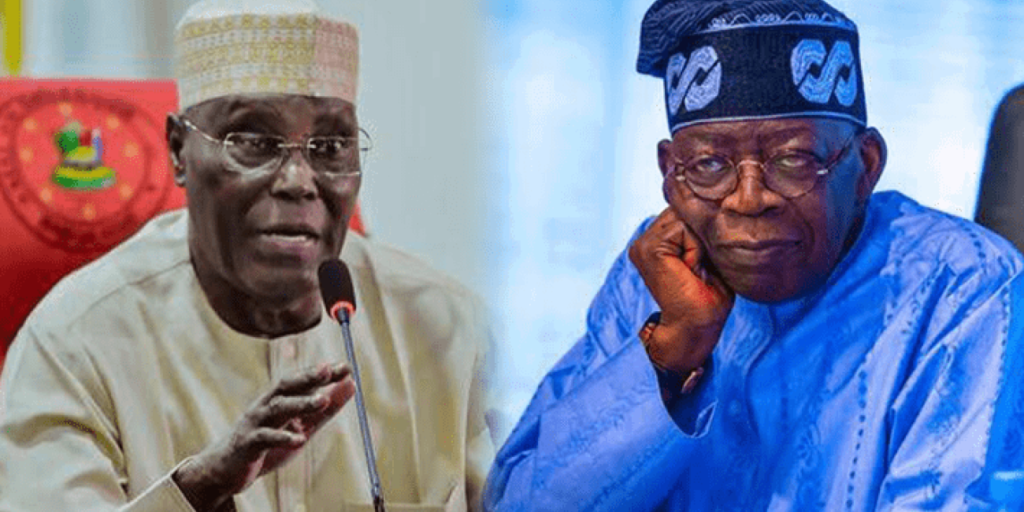
Former Vice President and presidential candidate of the African Democratic Congress (ADC), Atiku Abubakar, has launched a fierce attack on President Bola Tinubu over the ongoing debate surrounding fuel subsidy, accusing the president of economic ignorance and describing his administration’s subsidy policy as “economic vandalism.”
Atiku’s latest criticism came after Tinubu dismissed his proposal to restore a form of fuel subsidy if elected president in 2027, describing the proposal as evidence of “serious ignorance” about governance and economics.
Tinubu made the statement on Thursday while hosting Osun State Governor Ademola Adeleke.
“I saw one of my opponents now say he will go back to subsidy. I read it. That is a demonstration of serious ignorance on governance and the economy,” Tinubu said.
But Atiku, through his Senior Special Assistant on Public Communication, Phrank Shaibu, fired back, accusing Tinubu of attempting to lecture Nigerians on economic management despite what he described as the devastating consequences of the administration’s policies.
Shaibu described Tinubu’s remarks as “the insolent sermon of a failed economic experimenter,” arguing that the president had mistaken Nigerians’ ability to endure hardship for evidence that his economic policies were working.
“If economic ignorance had a presidential seal, Tinubu and his family would be its official logo,” Shaibu said.
He accused the Tinubu administration of triggering simultaneous fuel-price, exchange-rate and cost-of-living shocks in an already fragile economy, leaving millions of Nigerians poorer while the government celebrates increased revenues and Federation Account allocations.
“That is not reform. It is economic arson followed by propaganda about the ashes,” he said.
According to Atiku’s spokesman, the increased allocations received by state governments cannot be treated as evidence of economic success when households and businesses are struggling with rising costs.
“Tinubu’s courtiers may clap because FAAC allocations have increased, but hungry Nigerians cannot boil FAAC figures for dinner. Businesses cannot power factories with presidential speeches, workers cannot pay transport fares with macroeconomic grammar, and parents cannot settle school fees with statistics manufactured for State House applause,” he said.
Shaibu further accused the government of creating an economic situation in which government revenues have increased while ordinary Nigerians face declining purchasing power.
“A government that grows richer while its citizens grow poorer is not reforming an economy. It is extracting from its people,” he said.
Atiku’s camp also took direct aim at Tinubu’s decision to end the petrol subsidy shortly after assuming office, arguing that the policy was announced without adequate measures to cushion the impact on Nigerians.
“Tinubu should therefore spare Nigerians the economics lecture. A man who set the house on fire cannot ridicule another man for redesigning the fire extinguisher,” Shaibu said.
He went further, telling the president and his supporters to return to what he described as the basics of economic reasoning.
“Tinubu and his gang of jesters should acquaint themselves with elementary economics before accusing anyone of ignorance,” Shaibu said.
He cited the economic principle of ceteris paribus, meaning “other things being equal,” arguing that the conditions surrounding economic policy had changed dramatically since Tinubu took office.
“Economic prescriptions respond to prevailing conditions. Even a first-year economics student understands ceteris paribus — other things being equal,” he said.
“But other things are no longer equal in Tinubu’s Nigeria.”
Shaibu recalled Tinubu’s declaration at Eagle Square that “subsidy is gone,” arguing that the decision represented a major economic shock because it was not accompanied by what he described as a credible transition plan or adequate protection for vulnerable Nigerians.
According to him, petrol prices subsequently surged, transportation and production costs increased, the naira depreciated sharply, food prices rose and household purchasing power was severely weakened.
“Those three words were not economic policy. They were economic vandalism by presidential fiat,” Shaibu said.
He accused the administration of subsequently blaming Nigerians for questioning policies that, according to him, had fundamentally changed the economic environment.
“Having destroyed the economic assumptions upon which previous prescriptions rested, Tinubu’s propagandists now accuse Atiku of inconsistency for responding to the disaster they created,” he said.
“That is not inconsistency. That is economics. Only incompetence insists on yesterday’s prescription after today’s conditions have changed.”
Atiku also sought to clarify his position on fuel subsidy, insisting that his proposal does not amount to a return to the controversial system that existed before Tinubu’s administration.
According to his camp, Atiku is proposing a targeted, capped, budgeted and time-bound production-support mechanism that would be independently audited and tied to domestic production.
“Atiku is not proposing the resurrection of the corrupt, open-ended subsidy bazaar. He proposes a targeted, capped, budgeted, time-bound and independently audited production-support mechanism tied to domestic production and protected against arbitrage,” Shaibu said.
He argued that the difference between the two approaches was that Tinubu removed the subsidy before addressing the consequences, while Atiku’s proposal was based on the economic realities Nigerians currently face.
“The difference is simple: Tinubu pronounced first and searched for a plan afterwards. Atiku studied the consequences and produced a solution,” he said.
The former vice president’s camp also questioned the claim that fuel subsidy had been completely eliminated, citing figures it said were contained in the audited accounts of the Nigerian National Petroleum Company Limited.
Shaibu claimed that the accounts reportedly contained approximately ₦17.5 trillion in energy-security costs and petroleum under-recoveries, including about ₦7.13 trillion classified as Energy Security and ₦8.67 trillion in under-recoveries.
“So what exactly did Tinubu remove?” he asked.
“If subsidy is dead, why are under-recoveries alive? If corruption was eliminated, why has opacity survived?”
According to him, Nigerians are now experiencing the worst of both systems — losing the protection previously provided by lower petrol prices while the government continues to incur costs associated with petroleum under-recoveries and energy security.
“Tinubu has given Nigerians the worst of both worlds: he removed the relief but retained the opaque costs. Nigerians got the pain; government kept the bill,” Shaibu said.
Atiku also rejected Tinubu’s argument that the removal of fuel subsidy has strengthened state governments by increasing the amount of money distributed through the Federation Account.
Tinubu has repeatedly argued that the end of subsidy has freed more resources for distribution to the three tiers of government, enabling states that previously struggled to pay salaries to receive larger allocations.
But Atiku’s camp said government revenue should not be considered a success if the additional money comes at the expense of ordinary Nigerians.
“You do not build a federation by impoverishing citizens so that Abuja can send bigger cheques to governors. That is robbing households to subsidise governments,” Atiku said.
He argued that the economic burden being transferred to Nigerians was too severe to justify the government’s claims of increased fiscal capacity.
“If the price Nigerians must pay for governors to meet their basic obligations is crushing transport costs, diminished purchasing power, food inflation and deepening poverty, then Tinubu has merely transferred solvency from the kitchen tables of ordinary families to government treasuries,” he said.
The latest exchange adds another explosive dimension to the political battle between Tinubu and Atiku as both figures position themselves ahead of the 2027 presidential election.
The fuel subsidy question is expected to remain a major political and economic issue as the election approaches, with the Tinubu administration defending subsidy removal as a necessary step towards restructuring Nigeria’s economy and improving government finances, while Atiku’s camp argues that the policy has imposed unbearable costs on citizens and requires a fundamentally different approach.
The increasingly bitter rhetoric between both camps also signals that Nigeria’s economic record under Tinubu is likely to become one of the central battlegrounds of the 2027 presidential contest, with the opposition expected to make fuel prices, inflation, poverty, the naira’s performance and declining purchasing power key issues in its campaign against the administration.