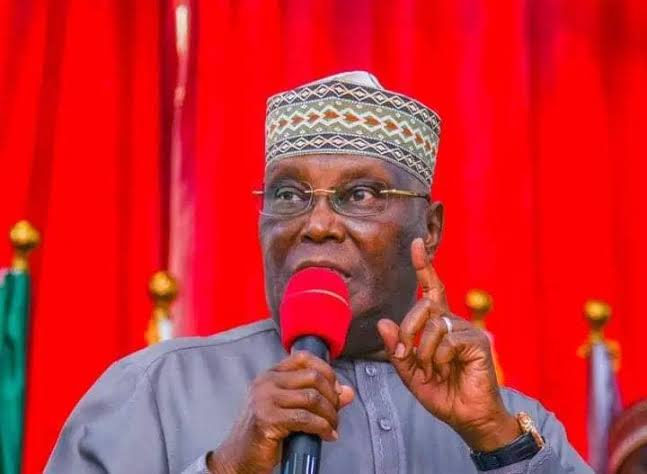
President Bola Tinubu has accused former Vice President Atiku Abubakar of demonstrating “serious ignorance” of governance and economics after proposing a return to a form of petrol subsidy if elected president in 2027.
Tinubu made the comment while receiving Osun State Governor-elect, Ademola Adeleke, during a meeting captured in a video seen by Chronicles Reporters.
The president appeared to be responding to Atiku’s recent criticism of the administration’s removal of petrol subsidy and his proposal for government intervention to reduce the burden of high fuel prices on Nigerians.
While urging political actors not to stigmatise their opponents, Tinubu said Atiku’s position on subsidy reflected what he described as a lack of understanding of Nigeria’s economic realities.
“Don’t stigmatize any of your opponents. Okay, let’s look at the trajectory of the history. I saw one of my opponents now say he will go back to subsidy,” Tinubu said.
“I read it. That is demonstration of a serious ignorance on governance and economy.”
Tinubu defended his administration’s decision to remove the petrol subsidy, arguing that Nigeria inherited a deeply troubled financial situation.
According to the president, 27 states were unable to meet their salary obligations before his administration came into office, while pensioners and workers were also affected by the financial difficulties confronting state governments.
“Before I came here, 27 states were unable to pay salaries,” Tinubu said.
“Not to even talk of pensioners, salary of workers.”
The president also referred specifically to the situation in Osun State, recalling a man whose nickname, according to him, became “half salary” because workers were allegedly unable to receive their full wages.
“In your state, I know a man that I raised whose nickname is half salary,” Tinubu said.
“They come to the federal, cap in hand, unable to do anything.”
Tinubu’s remarks come amid an increasingly heated political argument over the future of petrol pricing and whether subsidy should be restored ahead of the 2027 presidential election.
Atiku, a former presidential candidate of the Peoples Democratic Party, has repeatedly criticised the Tinubu administration’s handling of the subsidy removal and the economic hardship Nigerians have experienced since the policy was implemented.
The former vice president has argued that government intervention may be necessary to cushion the effects of high petrol prices on households, businesses and the wider economy.
The Tinubu administration, however, has maintained that the former subsidy system was financially unsustainable and created opportunities for corruption and abuse.
The Presidency has insisted that any proposal to restore subsidy must answer the fundamental question of who would finance it and what effect it would have on government finances.
Tinubu’s Special Adviser on Information and Strategy, Bayo Onanuga, recently challenged Atiku to explain how his proposed subsidy would be funded.
“If the subsidy is restored, who pays for it? What will the new pump price be? N200 or N500?” Onanuga asked.
He argued that petrol had previously been sold below its actual economic cost, with the government effectively paying the difference.
According to the Presidency, the former subsidy arrangement placed enormous financial pressure on the Nigerian National Petroleum Company Limited, with crude oil reportedly pledged against loans used to finance subsidy payments.
Onanuga further claimed that the NNPCL had reached a critical financial position by 2024 and owed suppliers billions of dollars.
The Presidency has therefore argued that restoring subsidy could put additional pressure on the finances of the Federal Government, state governments and local governments.
Government officials maintain that resources used to finance fuel subsidies could instead be channelled into infrastructure, social services and other development programmes.
The Presidency has also warned that borrowing to fund another subsidy regime could increase Nigeria’s public debt and further strain the economy.
Despite its defence of subsidy removal, the Tinubu administration has acknowledged that the policy has imposed significant hardship on Nigerians.
Onanuga admitted that higher petrol prices had increased transportation costs, household expenses and the operating costs of businesses.
“There is no disagreement that the cost of petrol places enormous pressure on Nigerian households and businesses. The hardship created by higher energy and transportation costs is real,” he said.
Rather than returning to the old subsidy system, the Federal Government has promoted alternatives such as Compressed Natural Gas, arguing that cheaper energy sources can reduce transportation and production costs.
The Presidency has pointed to companies such as Dangote and BUA that have introduced CNG-powered trucks into their operations, while urging commercial transport operators to adopt similar alternatives.
The government has also continued to highlight increased domestic refining capacity as part of its strategy to improve fuel supply and achieve greater stability in the petroleum market.
The subsidy debate remains one of the most politically sensitive economic issues in Nigeria because changes in petrol prices have a direct effect on transportation, food prices, household expenses and the cost of doing business.
With political activities ahead of the 2027 general elections gathering momentum, the disagreement between Tinubu and Atiku has further intensified the debate over whether Nigeria’s economic reforms should be sustained, modified or reversed.
Atiku is expected to remain a major opposition figure in the 2027 political contest, while Tinubu continues to defend his administration’s economic policies, including petrol subsidy removal and foreign exchange reforms.
The former vice president has presented his proposals as measures designed to reduce hardship and improve the welfare of Nigerians.
The Presidency, however, maintains that any plan to restore petrol subsidy must first pass what it describes as the test of “fiscal arithmetic,” warning that promises of cheaper fuel must be matched with a clear explanation of who will pay the bill.