A fresh controversy has emerged over Nigeria’s 2026 federal budget following the discovery of N5.971 billion worth of police infrastructure, cholera medical interventions and solar-powered water supply projects embedded in the capital expenditure of the Federal Co-operative College, Oji River, Enugu State.
The unusual allocations have raised questions about possible budget padding, transparency in the appropriation process and the use of federal academic institutions to accommodate constituency-style projects that appear unrelated to their statutory responsibilities.
A review of the 2,790-page 2026 Appropriation Act showed that the projects are spread across several states and communities, despite being captured under an institution whose core mandate is cooperative education, training, research and professional development.
The allocations are contained in pages 731 to 761 of the budget document obtained from the Budget Office of the Federation.
The Federal Co-operative College, Oji River, received a total allocation of N226.774 billion in the 2026 budget, with N225.632 billion earmarked for capital expenditure.
Of that capital provision, N5.971 billion is assigned to dozens of projects involving police stations, police area commands, police quarters, renovation of police facilities, human rights advocacy training, cholera interventions and solar-powered water supply projects.
The geographical spread of the projects is particularly striking.
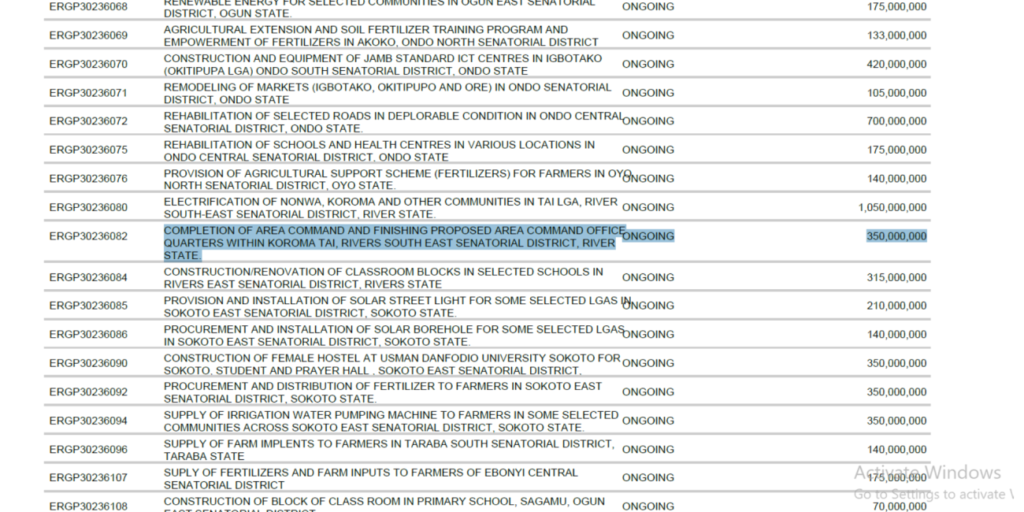
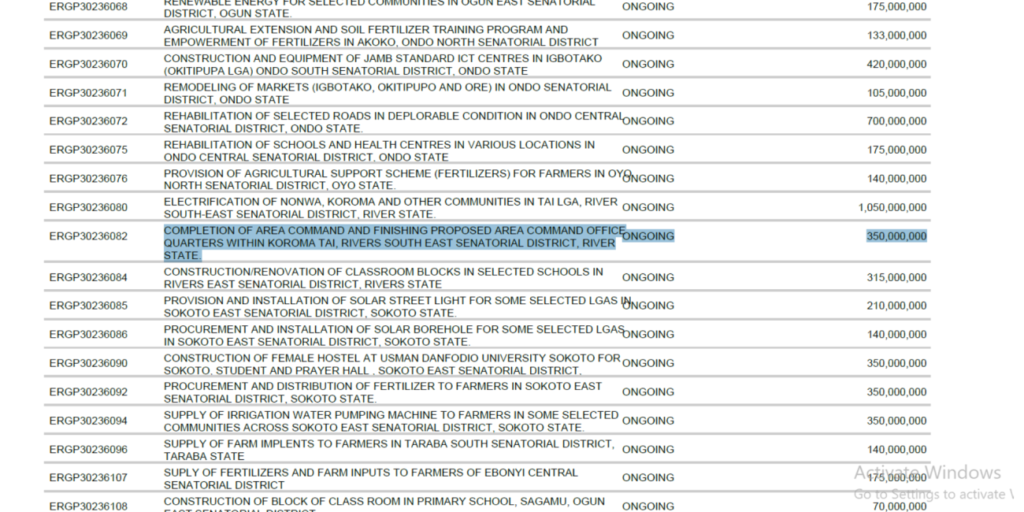
The largest individual allocation identified is N350 million for the “Completion of Area Command and Finishing Proposed Area Command Office Quarters Within Koroma Tai, Rivers South East Senatorial District, Rivers State.”
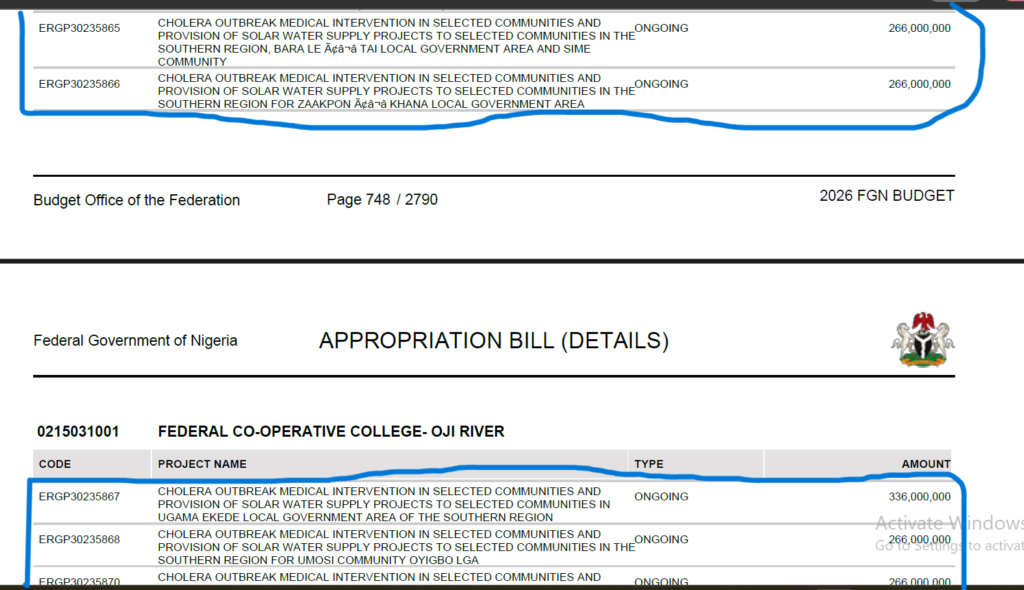
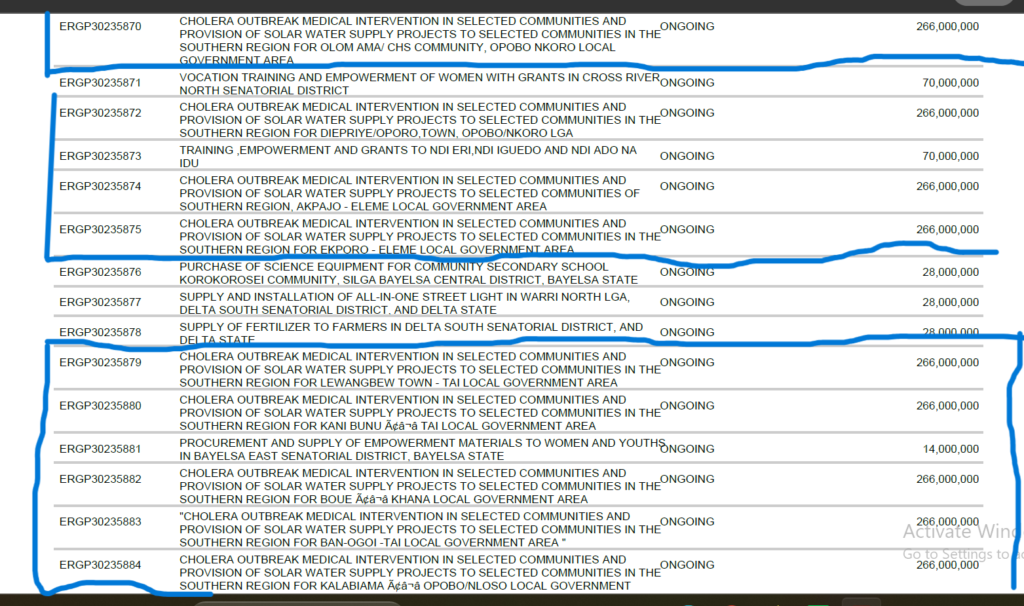
Another N336 million is allocated for “Cholera Outbreak Medical Intervention in Selected Communities and Provision of Solar Water Supply Projects to Selected Communities in the Southern Region for Ugama Ekede Local Government Area of the Southern Region.”
Several other communities receive N266 million each for similar cholera medical intervention and solar water supply projects.
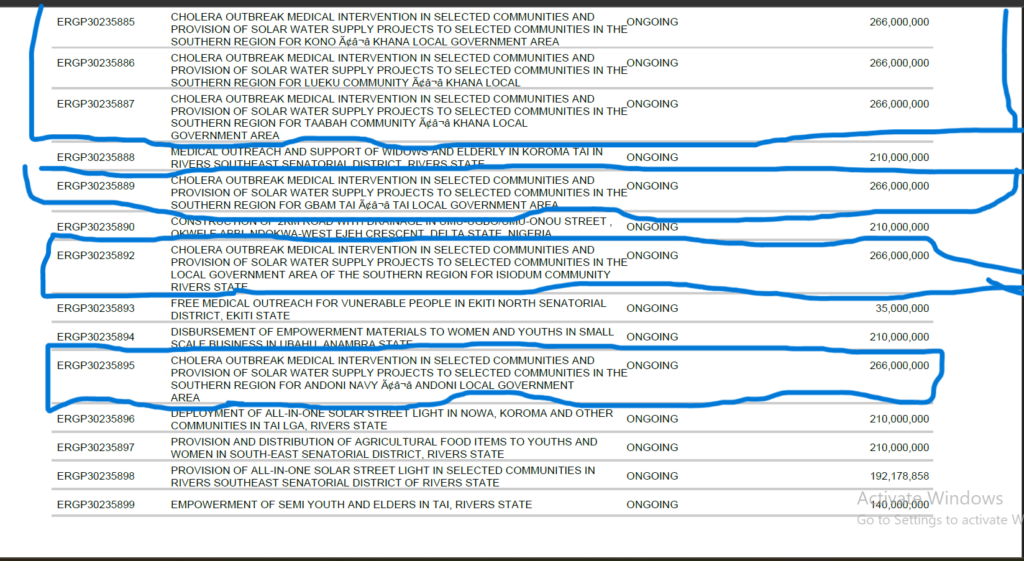
The beneficiaries listed include Bara-Ale Tai and Sime Community, Zaakpon in Khana Local Government Area, Umosi Community in Oyigbo, Olom Ama/CHS Community in Opobo-Nkoro, Diepriye/Oporo Town, Akpajo and Ekporo in Eleme, Lewangbew Town and Kani Bunu in Tai, Boue in Khana and Ban-Ogoi in Tai Local Government Area.
The same N266 million allocation is provided for Kalabiama in Opobo/Nkoro, Kono and Lueku in Khana, Taabah Community in Khana, Gbam Tai in Tai, Isiodum Community and Andoni Navy in Andoni Local Government Area.
The repeated allocation of exactly N266 million for numerous projects described in substantially similar terms raises questions about how the cost estimates were determined and whether the projects underwent independent assessment before being included in the national budget.
The budget also contains several police-related projects under the capital expenditure of the Federal Co-operative College.
N140 million is allocated for the construction of a Police Area Command in Ndiagu Amagu, while another N140 million is earmarked for the completion of Police Secondary School, Ugbo.
N70 million is allocated for the construction and furnishing of a police station in Burutu Local Government Area of Delta State.
Another N42 million is provided for the construction and furnishing of a police station in the Akamkpa/Biase Federal Constituency of Cross River State.
In Zamfara State, N35 million is allocated for the renovation of a police station in Zurmi Local Government Area under the Shinkafi/Zumi Federal Constituency.
The budget further provides N70 million for capacity building for law enforcement agents and community leaders on human rights advocacy in the Okigwe/Onuimo/Isiala Mbano Federal Constituency.
The projects cut across sectors ordinarily handled by different government ministries, departments and agencies.
Police infrastructure would normally fall within the security sector, while cholera response, medical interventions and community water supply would ordinarily involve health and water-related government agencies.
The placement of such projects under a federal cooperative college therefore raises fundamental questions about institutional responsibility, procurement and accountability.
The Federal Co-operative College, Oji River, is principally focused on cooperative education, training, research and professional development.
Its stated mandate does not appear to include the construction of police stations across the country, execution of nationwide cholera interventions or provision of solar-powered water systems in communities spread across different states.
The central question is why an academic institution was selected to house and potentially implement billions of naira worth of projects that have little apparent connection with its statutory mandate.
There are also concerns over whether the college possesses the technical and administrative capacity required to procure, supervise and monitor police construction, medical interventions and solar water projects across multiple states.
The arrangement could make it difficult to establish which government agency is responsible for procurement, project supervision, payment, certification and monitoring.
The projects also bear the characteristics of constituency-style interventions because of their highly specific locations and concentration in particular local government areas and federal constituencies.
Such projects are traditionally associated with lawmakers identifying development projects for their constituencies. However, the budget document reviewed does not clearly identify the lawmakers who may have sponsored the projects or explain why the Federal Co-operative College was selected as the implementing agency.
The lack of clarity could make it difficult for Nigerians to trace the origin, ownership and implementation responsibilities attached to the projects.
If the projects were sponsored as constituency interventions, questions arise as to why they were placed under the capital budget of a federal academic institution.
If they were initiated by the executive, the government would need to explain why the projects were assigned to the Federal Co-operative College instead of ministries, departments or agencies whose mandates correspond directly with the projects.
The development comes amid longstanding concerns over budget padding, opaque constituency projects and the insertion of projects into the budgets of government institutions without a clear connection to their statutory functions.
Critics have argued that such practices can obscure who proposed a project, who is responsible for implementing it and who should be held accountable if the project is abandoned, poorly executed or never delivered.
In this case, the N5.971 billion allocation is particularly striking because of the sharp mismatch between the projects and the institution carrying them in the national budget.
The controversy is therefore not only about the amount involved but also about why billions of naira meant for police infrastructure, public health interventions and community water supply are sitting inside the capital budget of a cooperative education institution.
It also remains unclear whether the Federal Co-operative College was consulted before the allocations were made, whether it accepted responsibility for implementing the projects and which government agency will ultimately certify their completion.
The budget document reviewed does not provide sufficient answers to these questions.
The discovery is likely to intensify calls for greater transparency in Nigeria’s budget process, particularly concerning constituency-style projects, their sponsors, implementing agencies, procurement arrangements and monitoring mechanisms.
For Nigerians demanding greater accountability in public spending, the N5.971 billion allocation raises a broader question about the 2026 budget process and the extent to which projects are being placed under agencies with little or no direct connection to their execution.
Until the Federal Government, the Federal Co-operative College and other relevant authorities provide clear explanations on the origin, sponsorship, implementation and oversight of the projects, the allocations will continue to fuel concerns about possible budget padding and the transparency of Nigeria’s appropriation process.