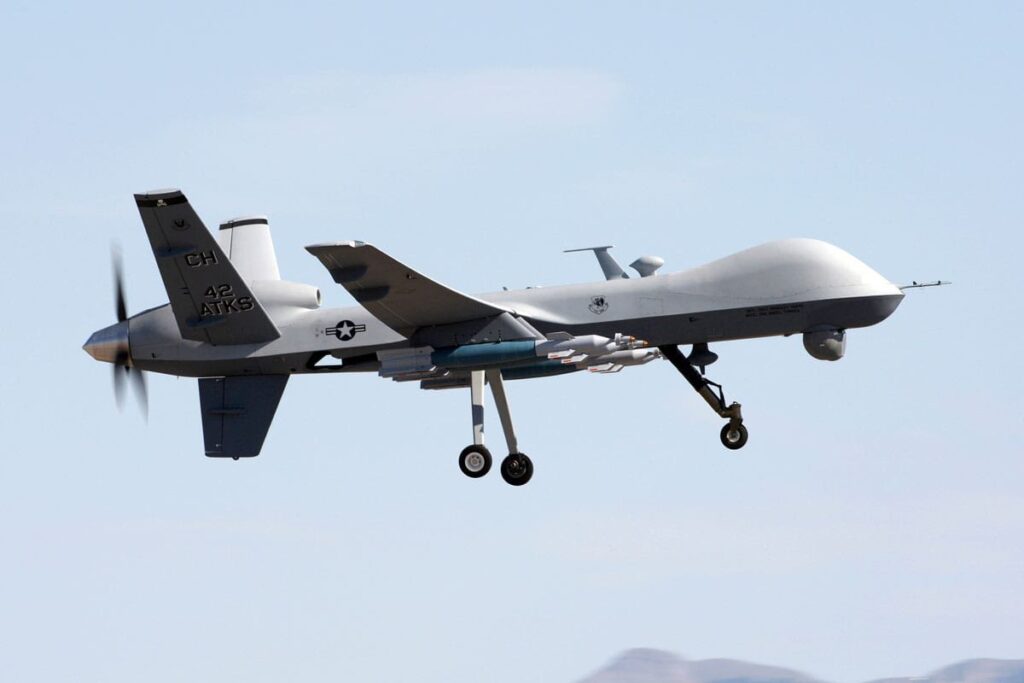
The United States is facing a major depletion of one of its most important unmanned military assets after losing at least 45 MQ-9 Reaper drones during the war with Iran, a figure that represents roughly one-quarter of the Reaper fleet the U.S. had at the beginning of the conflict.
The staggering losses, reported by The Washington Post based on information from three U.S. officials, have potentially put the value of the lost aircraft at more than $1.3 billion, based on estimated unit costs of between $30 million and $50 million, depending on the aircraft’s configuration and sensors.
The figures expose an increasingly expensive dimension of the Iran war and raise fresh questions about the ability of the United States to sustain high-value unmanned operations in heavily contested airspace.
At the start of the war, the U.S. military reportedly had about 185 MQ-9 Reapers, including approximately 165 operated by the Air Force and 20 by the Marine Corps. The reported loss of 45 aircraft therefore represents close to 25 per cent of that initial inventory.
The Reaper is far more than a conventional surveillance drone. It is a long-endurance unmanned aircraft capable of intelligence, surveillance and reconnaissance missions as well as precision strikes. Its ability to remain airborne for long periods has made it a critical tool for monitoring hostile territory and supporting American military operations.
But the Iran conflict is putting that capability under extraordinary pressure.
The reported losses have occurred amid intense American operations around the region, including activity near the strategically vital Strait of Hormuz, where the U.S. has been operating drones in an environment where aircraft can face air-defence threats, electronic interference and other hazards.
Importantly, American officials have indicated that not all 45 Reapers were shot down by Iranian forces.
One U.S. official told The Washington Post that an unspecified number of the drones crashed after operators lost communications links with the aircraft. That means the reported figure combines combat losses with aircraft lost through operational or technical failures, rather than representing 45 confirmed Iranian shoot-downs.
Nevertheless, the scale of the attrition remains significant.
For Washington, the problem is not simply the cost of replacing 45 aircraft. Every Reaper represents an integrated military system involving sophisticated sensors, communications equipment, weapons capability, trained operators, maintenance crews and logistical support.
Replacing the aircraft is therefore a question of industrial capacity as much as money.
The losses also strike at a central assumption behind modern American warfare: that advanced technology can provide persistent surveillance and strike capability while keeping U.S. personnel away from some of the most dangerous parts of the battlefield.
The Iran war is demonstrating that even highly sophisticated unmanned aircraft can suffer heavy attrition when repeatedly exposed to a capable and determined adversary.
The financial calculation makes the situation even more striking.
At the upper end of the reported $30 million-to-$50 million range, 45 Reapers could represent as much as $2.25 billion in replacement value. The widely reported estimate of more than $1.3 billion reflects the lower and varying costs of the aircraft and their configurations.
Either way, the losses amount to an extraordinary bill for a single category of military aircraft.
The depletion comes at a time when the United States is already confronting broader concerns over weapons and equipment consumed during the Iran conflict. Reports have pointed to mounting pressure on American defence production and military stockpiles as Washington attempts to maintain its operations while also replenishing weapons and equipment.
For Iran, the Reaper losses offer an opportunity to challenge America’s technological dominance and demonstrate that U.S. military hardware can be subjected to significant attrition.
For the United States, however, the central concern is sustainability.
A military can absorb individual aircraft losses during a major war. The more difficult question is what happens when losses accumulate faster than sophisticated systems can be manufactured, delivered and deployed.
The Reaper fleet’s depletion therefore carries implications beyond the drones themselves.
It raises questions about the cost of maintaining persistent surveillance, the vulnerability of expensive unmanned platforms, the capacity of American defence manufacturers to replace losses and whether future conflicts will push the Pentagon toward larger numbers of cheaper, more expendable drones rather than relying as heavily on smaller fleets of expensive systems.
The irony is difficult to ignore.
The MQ-9 Reaper was developed partly to give the United States a persistent and comparatively lower-risk means of projecting military power. Yet the Iran war has turned the aircraft into one of the clearest indicators of the price of sustained warfare in contested skies.
Forty-five Reapers lost. Nearly a quarter of the pre-war fleet gone. More than $1.3 billion in reported aircraft losses.
And the war is not necessarily over.
For American commanders, the battle is therefore no longer only about what the Reaper can see or strike from the sky. It is also about how many Reapers Washington can afford to lose — and how quickly it can replace them.
The answer could become one of the defining measures of the United States’ ability to sustain its air campaign against Iran.