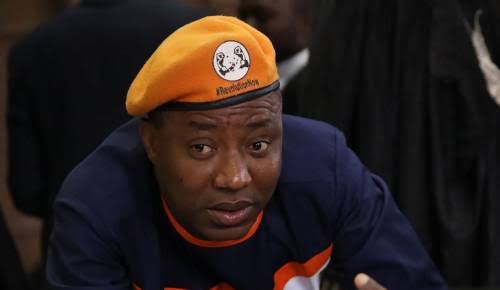
Presidential candidate of the African Action Congress (AAC), Omoyele Sowore, has accused the administration of President Bola Ahmed Tinubu of hiding what he described as worsening economic failures behind government revenue figures, GDP growth and other macroeconomic indicators.
Sowore argued that the economic figures being celebrated by the Federal Government have not translated into better living conditions for ordinary Nigerians, accusing the administration of creating an impression of economic progress while Nigerians struggle with hunger, rising living costs, unemployment and the difficulties facing businesses.
He made the remarks on Tuesday while appearing as a guest on Arise News TV, where he was asked to comment on claims about the economic performance of the Tinubu administration, including increased government revenue, improved fiscal collections and a rising tax-to-GDP ratio.
Sowore dismissed the figures as insufficient evidence that the Nigerian economy was improving, arguing that economic statistics have little meaning if they do not result in improved living standards for citizens.
“I’ve been around for long enough to know that you just need to change the dates on this analysis,” Sowore said.
He compared the economic policies of the Tinubu administration with those implemented during the administration of former military ruler Ibrahim Babangida, arguing that Nigerians had been presented with similar promises of prosperity in the past.
“Because we’re doing the same thing in 1988 when Babangida was in power. You know, structural adjustment program was going to bring about prosperity,” he said.
Sowore also referred to the Goodluck Jonathan administration, recalling how the rebasing of Nigeria’s economy produced impressive economic statistics but, in his view, failed to significantly improve the lives of ordinary Nigerians.
“We did it under Jonathan. We rebased our economy. It’s now bigger than that of South Africa. Now South Africa is bigger than our own,” he said.
“All of this has not translated to the poor person or an average Nigerian, not even the poor person. Businesses are pretty much gone.”
He accused the Tinubu administration’s economic policies of contributing to the closure of industries and worsening the financial pressure on Nigerians.
“You’ve closed down industries. Your people are poorer,” he said.
Sowore further argued that Nigeria’s poverty crisis extends beyond conventional poverty measurements, claiming that millions of Nigerians are experiencing multiple forms of deprivation.
“We’re talking about people who are multidimensionally poor. Out of about 200 million people, over 140 million people are recognized as multidimensionally poor. Your currency is in tatters,” he said.
He also challenged the significance of increased tax collections, arguing that higher nominal revenue should not automatically be interpreted as evidence of a stronger economy, particularly when the purchasing power of the naira has weakened.
According to Sowore, the government should focus on demonstrating how its policies have improved infrastructure, strengthened businesses, created employment and improved household welfare.
“But what we’re asking them to produce are the wealthier people in society, the schools that have been built, the roads that you have constructed after you removed subsidy, and how your people are; how your businesses are faring,” he said.
“Since they love to talk about private sector a lot, we want to see the development in the private sector that has brought about employment, that has brought about a new fresh lease of life for people.”
Sowore said Nigerians should not be persuaded that they are better off simply because certain economic ratios have improved.
“They say, you know, you are feeling better because our GDP ratio is higher. We’re talking about GDP to tax, but what about GDP to standard of living? Nobody is talking about that,” he said.
He described the government’s economic explanation as a repetition of what he called past failures.
“That’s why I said it’s a repetition of the same old explanation of their own economic failures,” Sowore said.
The AAC presidential candidate also criticised the Tinubu administration’s decision to remove the petrol subsidy, arguing that the government had not completely eliminated subsidies but had merely changed the form in which they were being provided.
Asked whether he would restore the petrol subsidy, Sowore responded: “I’ll bring back subsidy, yes.”
He argued that government was still subsidising parts of the economy, including the naira.
“In the first place, they are still paying subsidy. They just changed the name of what they call it,” he said.
“They are subsidizing not only petrol, because they don’t have enough, and they can’t produce locally. They are also subsidizing the naira.”
Sowore alleged that interventions supporting the value of the naira amounted to a form of subsidy that Nigerians were not being adequately informed about.
“That’s one thing they will never tell you. The reason the naira is at a certain rate to a dollar is because it’s been quietly and secretly subsidized,” he said.
He also rejected the argument that subsidies were inherently harmful, saying governments around the world provide various forms of support to protect vulnerable citizens.
“It’s not that subsidy is bad, because there’s no country in the world that doesn’t subsidize their poor,” Sowore said.
However, he argued that Nigeria’s subsidy system had historically benefited wealthy interests more than poor Nigerians.
“In fact, the people that get the most subsidy in Nigeria is not the poor. It’s the rich,” he said.
Sowore cited customs waivers and other concessions as examples of what he described as subsidies that disproportionately benefit wealthy individuals and businesses.
“All the people who bring in foreign goods and services, go and look at their waivers at customs. You will know who is getting a real subsidy compared to the people who are getting N10 from each gallon of petrol that was taken away from them,” he said.
He also linked the removal of petrol subsidy to subsequent economic difficulties, including the depreciation of the naira.
“And you saw what happened. Immediately you remove subsidy. Look at where your economy tanked,” Sowore said.
“Your naira also went down the toilet.”
Sowore said Nigeria needed to abandon what he described as an old economic mentality that had allowed poverty to become entrenched in the country.
“What we have to do differently, first and foremost, is to get rid of this old mentality and the ideas that brought poverty to become a standard household name in Nigeria,” he said.
He accused the government of focusing excessively on economic “optics” and statistics while Nigerians struggle to afford basic necessities.
“That’s the country we are in. But they don’t want to tell you all this because it’s all about the optics,” he said.
“Optics don’t feed people. Propaganda can’t feed people.”
Sowore then made his strongest warning about the condition of Nigerians, saying hunger and the rising cost of living were making it increasingly difficult for citizens to survive.
“People are dying in this country of hunger, starvation. People can’t afford to live,” he said.
He said the worsening economic situation was also placing additional pressure on families, as Nigerians increasingly depend on relatives who are financially better off.
“If people can’t survive, who do they turn to? They turn to their better relatives because the country that’s supposed to support them is not there to provide that support in terms of economic, social justice and all of what is needed to keep our people going,” he said.
Sowore argued that Nigeria’s economic problems were rooted in a longstanding system in which wealth and opportunities remain concentrated among political and economic elites, with limited benefits reaching the majority of citizens.
“But all of them are not connected. That’s the reason why there’s no trickle down. Then everybody else is at the bottom,” he said.
He maintained that fundamental restructuring would be required before economic growth could translate into widespread prosperity.
“So what needs to happen is that we should stop deceiving ourselves,” Sowore said.
“That hegemony has to collapse. It’s not going to fizzle out by itself.”
Sowore also warned that individuals who enter the political system with the intention of changing it could eventually become part of the same structure they initially opposed.
“As I always often say, the system is the burial ground for the human conscience,” he said.
“The moment you get there, they will get you well situated within the system. You become the enemy of where you’re coming from.”
He said his alternative approach would depend on mobilising citizens rather than attempting to compete with established political actors through financial resources.
“But we must also understand that there’s a different kind of currency, that is more than money,” he said.
“All we need is people.”
Sowore concluded that the collective strength of Nigerians could ultimately outweigh the financial resources available to political elites.
“Many can defeat money,” he said.