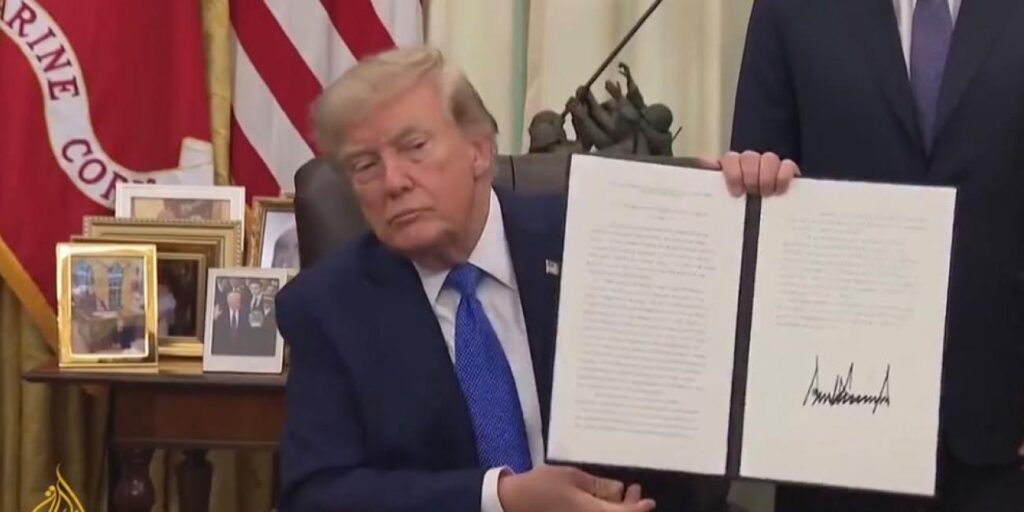
Connecticut Attorney General William Tong has launched a scathing attack on President Donald Trump’s latest executive orders targeting birthright citizenship, accusing the administration of making another unconstitutional attempt to weaken one of the clearest protections guaranteed by the United States Constitution.
Tong’s condemnation came after Trump unveiled fresh directives aimed at narrowing access to automatic U.S. citizenship for some children born on American soil, weeks after the U.S. Supreme Court rejected the president’s earlier effort to dismantle birthright citizenship through executive action.
In a strongly worded statement, Tong accused Trump of refusing to accept the Supreme Court’s ruling and instead attempting to find another route around the constitutional protections surrounding citizenship.
“The U.S. Supreme Court already rejected Trump’s attempt to end birthright citizenship, but rather than accept that decision, he’s back with another scheme to undermine and gut one of our Constitution’s clearest guarantees,” Tong said.
“The Fourteenth Amendment means what it says, and Trump cannot rewrite it or manufacture new exemptions because the Court rejected his blatantly unconstitutional efforts.”
Tong said Connecticut was reviewing the latest orders and considering “all appropriate options,” signalling the possibility of another legal confrontation between the Trump administration and states opposed to its immigration policies.
The attorney general did not immediately disclose what legal action Connecticut could pursue, but his comments underscore the likelihood that the new directives will face significant opposition in federal court.
The latest orders represent a narrower but potentially far-reaching continuation of Trump’s campaign to restrict birthright citizenship. The president has repeatedly argued that the constitutional provision is being exploited by foreign nationals who travel to the United States specifically to give birth and secure American citizenship for their children.
According to ABC Network, the new directives expand the categories of U.S.-born children whose citizenship could be challenged. They also instruct immigration authorities to deny visas to foreign nationals suspected of travelling to the United States primarily for the purpose of giving birth — a practice the administration refers to as “birth tourism.”
Speaking at the signing ceremony, White House Deputy Chief of Staff Stephen Miller defended the policy, saying the administration was moving to prevent the use of U.S. visas for what he described as the “fraudulent purpose” of obtaining citizenship for newborn children.
The executive orders further seek to restrict citizenship rights involving children born in the United States to certain foreign government employees and individuals classified as “alien enemies.”
The measures could also have implications for people born in U.S. territories if Congress ultimately approves proposed legislation seeking to end automatic citizenship there.
Trump has made the rollback of birthright citizenship a major pillar of his immigration agenda. He has argued that the current system encourages abuse of U.S. immigration laws and allows people with no lasting connection to the country to secure American citizenship for their children simply by giving birth on U.S. soil.
Reacting to the Supreme Court’s earlier ruling, Trump said he considered the decision “very unfortunate,” maintaining that his administration had a legitimate interest in addressing what it views as widespread abuse of the citizenship system.
The president’s first executive order, issued in 2025, directed federal agencies to stop recognising the citizenship of certain children born in the United States when neither parent was an American citizen nor a lawful permanent resident.
That attempt was challenged in court and found inconsistent with the Fourteenth Amendment, particularly its Citizenship Clause, which has long been interpreted as guaranteeing citizenship to nearly everyone born on U.S. soil, subject to limited historical exceptions, including children of foreign diplomats and members of an occupying enemy force.
The constitutional battle, however, appears far from over.
Legal experts and civil rights advocates are expected to challenge Trump’s latest directives, arguing that the president cannot use executive orders to create new exceptions to a constitutional guarantee.
The confrontation places the Trump administration once again on a collision course with opponents who contend that the president is attempting to accomplish through narrower executive actions what the courts have already prevented him from doing directly.
At the heart of the dispute is a fundamental constitutional question: Can a president, through executive order, redefine who qualifies as an American citizen when the Constitution itself provides the governing rule?
For Tong and other opponents of Trump’s policy, the answer is unequivocal.
The Fourteenth Amendment, they argue, is not an immigration regulation that can be rewritten by presidential decree — it is a constitutional guarantee that stands above executive power.