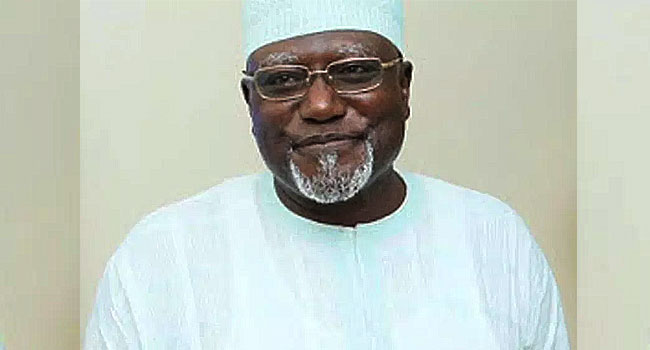
Former Director-General of the Department of State Services (DSS), Lawal Musa Daura, has blamed the politicisation of Nigeria’s security architecture for the country’s worsening insecurity, insisting that security operations remained insulated from political interference throughout his tenure.
In an interview conducted in Hausa with JBC Hausa and monitored by SaharaReporters, Daura argued that Nigeria’s security fortunes began to decline after politics was allowed to dictate security decisions following his departure from office, dismissing suggestions that intelligence failure was primarily responsible for the country’s security crisis.
According to him, no nation can achieve lasting peace when political interests override professional security judgment.
«”Politics entered the security sector. Any country in the world that allows politics to interfere with security will never enjoy lasting peace,” he said.»
The former intelligence chief rejected suggestions that the trend began under the current administration, maintaining that political interference started during the administration of the late former President Muhammadu Buhari after he left office.
«”Even during President Buhari’s administration, especially after I left office, politics found its way into security. But while I was in office, politics was not allowed to interfere,” Daura stated.»
Pressed on whether politicians influenced security operations during his stewardship, Daura was emphatic.
«”None at all.”»
He further asserted that the first three years of the Buhari administration, during which he headed the DSS, recorded greater security stability than the years that followed.
“There is a clear difference between the first three years of the Buhari administration and the five years after I left office. What I did worked. The country became more stable, the security sector had direction, and the records will confirm it,” he said.
Daura noted that the confidential nature of intelligence work often prevented security agencies from publicly explaining the operations behind their successes.
“Our work was highly sensitive. We could not disclose everything publicly. Those who needed to know were adequately briefed, and we carried out our responsibilities with professionalism and expertise,” he said.
Addressing the wave of banditry that later engulfed Nigeria’s North-West, Daura maintained that the crisis had not reached its devastating scale while he remained in office.
According to him, the DSS and other security agencies carried out successful operations that earned Nigeria international recognition and strengthened intelligence cooperation with foreign partners.
“At that time, Nigeria enjoyed greater respect internationally, and there was no serious tension with neighbouring countries arising from security failures,” he said.
He again attributed the subsequent deterioration to political interference in security matters.
“The major reason was politics. Once politics dictates security decisions, peace becomes impossible,” he insisted.
Defends National Assembly Operation
Daura also defended the controversial August 7, 2018 deployment of armed DSS operatives to the National Assembly complex in Abuja, an operation that sparked nationwide outrage and culminated in his dismissal.
Rejecting claims that the operation was politically motivated, he argued that politicians often interpret security actions through a political lens.
“That was not politics. Sometimes security agencies act on intelligence that cannot be fully disclosed. Our actions were intended to protect the country, not to advance any political agenda,” he said.
He denied allegations that the National Assembly was prevented from carrying out its constitutional responsibilities or that the operation was designed to facilitate the removal of legislative leaders.
“There were underground activities that required urgent intervention. The National Assembly was never prevented from performing its duties, and there was never any attempt to remove anyone,” he maintained.
Daura also said that despite years of public criticism, no government authority had formally questioned him over the controversial operation.
“Up till today, no one has ever questioned me, verbally or in writing, about what I allegedly did or why I did it. The allegations simply do not stand,” he said.
The former DSS boss argued that public officials committed to acting in the national interest must be prepared to face criticism.
“If you want to do the right thing in Nigeria, you must be ready to stand firm. Anyone who has taken an oath of office should fear no one except God,” he said.
A Crisis That Shook Nigeria’s Democracy
Daura’s remarks revive memories of one of the most controversial episodes in Nigeria’s democratic history.
On August 7, 2018, heavily armed and masked DSS operatives barricaded the National Assembly complex, denying lawmakers, legislative staff and journalists access to the premises amid heightened political tensions following the defection of then Senate President Bukola Saraki and several lawmakers from the ruling APC to the PDP.
The operation triggered widespread condemnation, with opposition lawmakers accusing the security agency of attempting to pave the way for an unconstitutional change in the leadership of the National Assembly.
Daura defended the action at the time, claiming it was based on intelligence suggesting that weapons and other dangerous items were to be smuggled into the complex.
However, an investigation by the Nigeria Police Force reportedly found no evidence supporting that claim and concluded that the operation was carried out without consultation with the Presidency, the police or other security agencies.
Then Acting President Yemi Osinbajo, who was overseeing the affairs of government while President Muhammadu Buhari was on a private visit to the United Kingdom, described the siege as an unauthorised action inconsistent with constitutional governance and ordered Daura’s immediate removal as DSS Director-General.
Nearly eight years later, Daura insists history will vindicate his stewardship, arguing that Nigeria did not lose the battle against insecurity because of intelligence failure, but because political interests gradually eclipsed professionalism within the country’s security architecture.