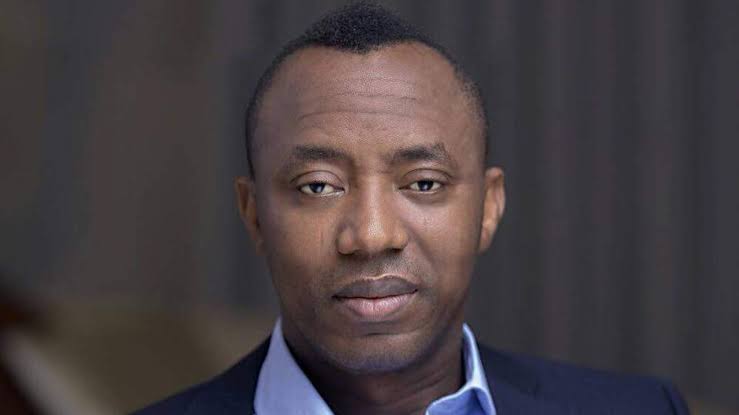
Human rights activist and African Action Congress (AAC) presidential candidate, Omoyele Sowore, has launched a blistering attack on the administration of President Bola Ahmed Tinubu, warning that the Federal Government’s push to establish state police ahead of the 2027 general elections could hand governors a dangerous political weapon capable of undermining democracy, violating human rights and influencing election outcomes.
Speaking during an interview on Channels Television on Tuesday, Sowore accused the government of rushing through one of the most far-reaching constitutional reforms in Nigeria’s history without adequate public consultation, transparency or constitutional safeguards.
While making it clear that he fully supports decentralising Nigeria’s policing system, Sowore insisted that such a fundamental reform must be part of a broader restructuring of Nigeria into a genuine federal system rather than what he described as a selective constitutional amendment driven by political convenience.
He argued that decentralisation should not stop at state police but should extend to local government and community policing, provided every security outfit is professionally trained, effectively regulated and subjected to strict human rights oversight.
According to him, any policing structure that lacks accountability, proper supervision and adequate welfare for officers would only create another layer of insecurity instead of solving Nigeria’s security crisis.
Sowore stressed that police personnel must receive competitive salaries, pensions and welfare benefits to prevent poorly paid officers from becoming part of the very criminality they are expected to combat.
The activist, however, said his greatest concern remains the timing of the proposed state police initiative.
He warned that introducing state-controlled security agencies barely months before the 2027 elections could place enormous coercive powers in the hands of governors, whom he accused of having poor records on democratic accountability and respect for fundamental human rights.
According to him, governors already wield overwhelming political influence across their states, and handing them armed security structures before a crucial national election could create an atmosphere of intimidation, political persecution and electoral manipulation.
Sowore maintained that Nigerians should not allow a constitutional amendment of such national importance to be hurried through the National Assembly within a limited consultation period.
He argued that constitutional reforms affecting the country’s security architecture deserve extensive nationwide debates across all states to allow citizens, civil society organisations, legal experts and stakeholders to make meaningful contributions before any decision is taken.
He therefore called for the entire process to be suspended until after the 2027 general elections, insisting that the politically charged atmosphere surrounding campaigns makes this the wrong time to introduce such a sensitive reform.
Beyond the state police debate, Sowore delivered a scathing assessment of the Tinubu administration, declaring that the government had failed Nigerians across virtually every measurable sector of governance.
He cited worsening insecurity, persistent national grid failures, epileptic electricity supply, rising inflation, deepening poverty, food insecurity, unemployment, declining healthcare services and setbacks in the education sector as evidence that the administration has failed to fulfil the promises it made to Nigerians.
He criticised the government’s student loan policy, arguing that increasing access to loans without adequately funding public education, expanding infrastructure and providing scholarships merely shifts financial burdens onto struggling students.
Sowore also dismissed government claims of improving macroeconomic performance, insisting that international commendations received by the Central Bank of Nigeria have little relevance when millions of Nigerians continue to battle rising living costs, hunger and economic hardship.
According to him, no economic indicator should be celebrated while ordinary citizens face deteriorating standards of living, arguing that the true measure of governance is the quality of life enjoyed by the people rather than statistics presented by government officials.
Using a classroom analogy, the AAC presidential candidate said that if President Tinubu were his student, he would ask him to leave the class because the administration had failed to attain even the minimum standard required to pass.
He also revisited the long-running controversy surrounding the President’s academic records, saying Tinubu should return to school and resolve lingering questions about his educational qualifications, insisting that public office holders must be beyond reproach on matters relating to their credentials.
Rejecting attempts to defend the administration with macroeconomic data and foreign recognitions, Sowore maintained that Nigerians should judge the government solely by the realities confronting citizens daily.
He concluded that despite official narratives of economic reforms and international recognition, ordinary Nigerians remain poorer, hungrier and more insecure than they were three years ago, insisting that no government can claim success while the majority of its citizens continue to experience severe hardship.