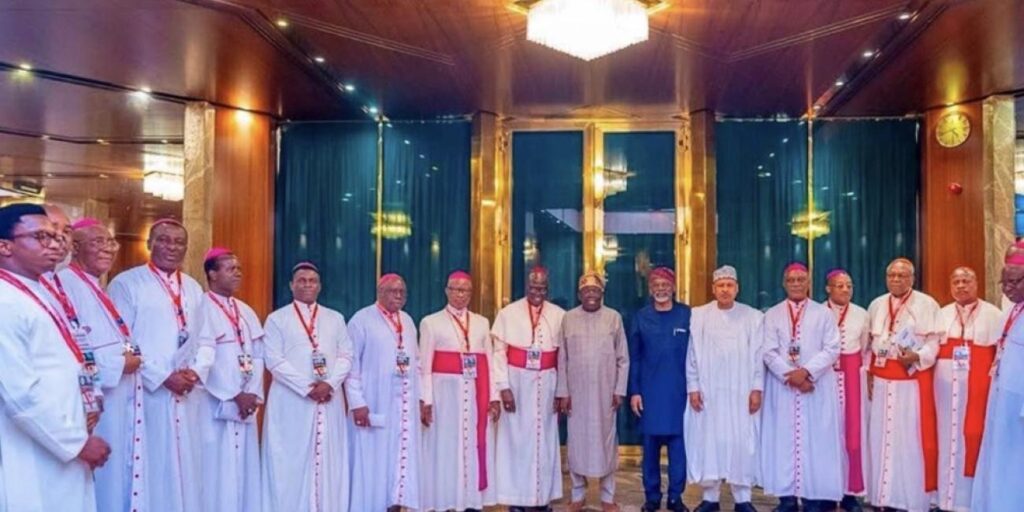
A fresh confrontation has erupted between the Presidency and the Catholic Church following a forceful defence of Cardinal John Onaiyekan by Catholic priest, Fr. Ugochukwu Ugwoke, who dismissed claims that the former Archbishop of Abuja acted improperly by speaking publicly after a meeting with President Bola Tinubu and members of the Catholic Bishops’ Conference of Nigeria (CBCN).
In a detailed response to an opinion article by the Senior Special Assistant to the President on Media and Publicity, Temitope Ajayi, titled “Cardinal Onaiyekan’s Abuse of Clerical Privilege,” Fr. Ugwoke argued that neither the law nor Catholic doctrine forbids bishops from discussing matters of national importance after meeting with government officials.
Ajayi had accused Cardinal Onaiyekan of violating the confidentiality and dignity of the meeting after the respected cleric granted an interview on Arise Television in which he reflected on the discussions held with President Tinubu.
Rejecting the allegation in its entirety, Fr. Ugwoke insisted that the meeting was never classified or bound by any legal, diplomatic or ecclesiastical obligation of secrecy.
“The meeting between President Tinubu and the Catholic Bishops of Nigeria was not a sacramental confession, a diplomatic negotiation conducted under secrecy, or a legally confidential proceeding,” he said, adding that unless participants expressly agreed to confidentiality, there was no legal or moral principle preventing either side from commenting publicly afterward.
He maintained that Catholic bishops have a sacred pastoral responsibility to speak whenever justice, human dignity, security and the common good are at stake, stressing that the Church’s social teachings encourage active engagement with national issues.
“Bishops are not merely private citizens expressing personal opinions. By virtue of their pastoral office, they have a duty to teach on moral and social issues,” he stated.
According to him, explaining one’s understanding of a meeting should not be misconstrued as betraying trust or revealing state secrets.
“Providing one’s understanding of a discussion is entirely different from disclosing confidential government information. In a democracy, explaining issues that affect millions of citizens is both legitimate and necessary,” he argued.
Fr. Ugwoke also challenged the Presidency’s defence of President Tinubu’s economic and security policies, insisting that acknowledging improvements does not prevent religious leaders from highlighting persistent failures.
“Recognising government achievements and identifying shortcomings are not mutually exclusive. One may commend progress while still insisting that much more remains to be done,” he said.
The priest further rejected the argument that the President’s privileged access to intelligence briefings makes external criticism unnecessary, insisting that no government possesses a monopoly on truth.
“Security agencies, economists, religious leaders, civil society organisations, academics, journalists and ordinary citizens all contribute perspectives essential to national development. No single source possesses the whole truth,” he said.
While acknowledging that the President has access to classified information unavailable to the public, Fr. Ugwoke stressed that democratic governance requires leaders to remain accountable to citizens and open to legitimate criticism.
“The President undoubtedly has information unavailable to the public. However, democratic accountability equally demands that government decisions remain subject to public scrutiny,” he added.
On the issue of confidentiality, the cleric argued that if government officials are free to explain their own perspectives after meetings, religious leaders should enjoy the same liberty, provided they speak truthfully, respectfully and without disclosing genuinely confidential matters.
He also dismissed suggestions that bishops should remain silent on national affairs because of their clerical office, noting that history is replete with examples of religious leaders who challenged governments in defence of justice while remaining faithful to both the Gospel and constitutional authority.
“The virtues expected of bishops—prudence, temperance and wisdom—do not require silence in the face of national concerns,” he declared.
Fr. Ugwoke concluded that the controversy should centre not on Cardinal Onaiyekan’s decision to speak publicly, but on the substance and truthfulness of his remarks.
“The real issue is not whether Cardinal Onaiyekan spoke, but whether what he said was truthful, fair and served the common good. In a constitutional democracy, respectful dialogue between religious leaders and civil authorities should continue not only behind closed doors but, where appropriate, in the public square.”
The exchange follows the recent meeting between President Tinubu and the Catholic Bishops’ Conference of Nigeria, during which the bishops raised concerns over worsening economic hardship, insecurity and governance. President Tinubu defended his administration’s reforms, while Ajayi later accused Cardinal Onaiyekan of abusing “clerical privilege” for publicly discussing the meeting—an accusation Fr. Ugwoke has now strongly rejected, setting the stage for an intensifying debate over free expression, religious leadership and democratic accountability.