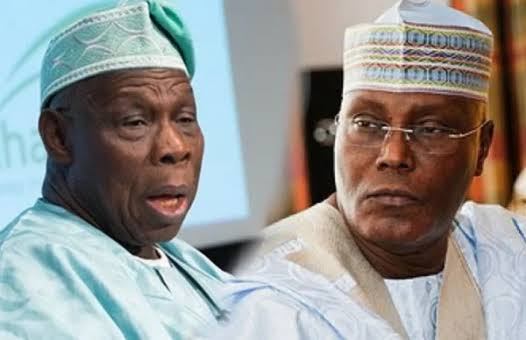
Former Vice President and presidential candidate of the African Democratic Congress (ADC), Atiku Abubakar, has launched a blistering response to former President Olusegun Obasanjo over allegations that he bribed the late Speaker of the House of Representatives, Rt. Hon. Ghali Umar Na’Abba, with ₦5 million to initiate impeachment proceedings against him while they were in office.
Describing the allegation as “reckless, politically motivated and an attempt to rewrite history,” Atiku accused Obasanjo of exploiting the death of Na’Abba to revive claims that could no longer be challenged by one of the principal figures involved.
In a statement issued on Friday by his Senior Special Assistant on Public Communication, Phrank Shaibu, and titled “The Grave Is Not A Witness Box,” Atiku said it was disturbing that Obasanjo chose to make such allegations only after Na’Abba’s death.
He argued that if the alleged bribery had truly taken place, Obasanjo had every opportunity to expose it while Na’Abba was alive or prosecute those involved during his administration.
“If this allegation were true, why was it never raised when Rt. Hon. Na’Abba was alive? Why wait until the only man who could confirm or deny the allegation is no longer here to speak?” Atiku asked.
The former Vice President maintained that no court ruling, investigative report or official finding had ever established that he bribed the former Speaker, insisting that the allegations remain unsupported by evidence.
Atiku further alleged that the timing of Obasanjo’s remarks, coming as political alignments for the 2027 presidential election gather momentum, was calculated to damage his reputation and influence the emerging political landscape.
According to him, Nigerians are intelligent enough to recognise what he described as an attempt to resurrect decades-old political disputes for present-day political advantage.
He also revisited his long-running political battle with Obasanjo, insisting that their strained relationship began after he opposed the controversial third-term agenda during the former President’s administration.
Atiku said he chose to defend constitutional democracy rather than support any attempt to extend presidential tenure beyond constitutional limits, adding that his legal victories against Obasanjo have become part of Nigeria’s democratic history.
He said the former President had never forgiven him for resisting what he described as an unconstitutional project.
The ADC presidential candidate, however, dismissed further engagement on what he called political quarrels from over two decades ago, arguing that Nigerians are more concerned about worsening economic hardship, rising inflation, unemployment, mounting public debt, insecurity and hunger than recycled political accusations.
He urged political leaders to focus on addressing the country’s pressing socio-economic challenges instead of revisiting historical disputes.
Atiku also said Obasanjo was free to endorse any candidate for the 2027 presidential election but challenged the former President to openly declare his preferred choice rather than, in his words, deploying unsubstantiated allegations to weaken political opponents.
The rebuttal followed Obasanjo’s explosive claims on Thursday that Atiku orchestrated an impeachment plot against him during his first term in office.
According to the former President, Atiku secretly met with the late Speaker, Ghali Umar Na’Abba, at the Presidential Villa while he was away from office and allegedly handed him ₦5 million to commence impeachment proceedings.
Obasanjo further alleged that intelligence reports from his then Chief of Staff detailed the meeting and claimed Atiku had begun plotting to succeed him almost immediately after assuming office as Vice President.
He also accused Atiku of working behind the scenes to ensure he served only one term as President.
Despite the alleged plot, Obasanjo said he refused to panic because he believed he had committed no impeachable offence, adding that former President Shehu Shagari later volunteered to intervene after learning about the crisis.
The latest exchange has reopened one of the most bitter rivalries in Nigeria’s Fourth Republic, reviving longstanding accusations between two political heavyweights whose fractured alliance has shaped the country’s democratic history.
With preparations for the 2027 general election already gathering pace, the renewed war of words signals that old political battles are once again taking centre stage in the contest for Nigeria’s highest office.