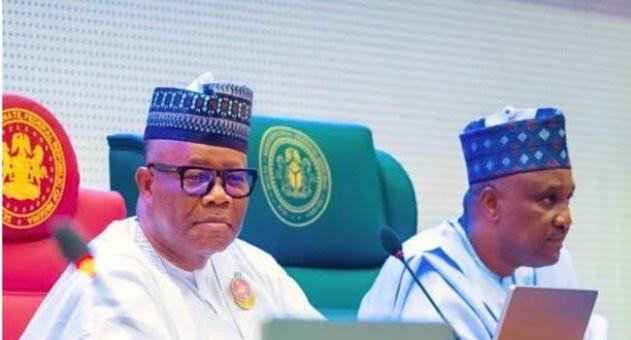
The Socio-Economic Rights and Accountability Project (SERAP) has called on Senate President Godswill Akpabio and Speaker of the House of Representatives Tajudeen Abbas to immediately withdraw the controversial Nigeria Data Protection (Amendment) Bill, 2026, warning that it would drag the National Assembly to court if the proposed legislation is passed in its current form.
SERAP described the bill as a “backdoor attempt” to regulate social media and expand government control over online expression, arguing that it poses a serious threat to freedom of speech, digital rights and Nigeria’s rapidly growing technology ecosystem.
The warning was contained in a letter dated July 18, 2026, signed by the organisation’s Deputy Director, Kolawole Oluwadare, and addressed to Akpabio and Abbas.
Sponsored by Senator Ned Nwoko (APC, Delta North), the proposed amendment seeks to compel social media platforms, data controllers and data processors operating in Nigeria to establish physical offices within the country. It also empowers the Nigeria Data Protection Commission (NDPC) to suspend or prohibit the operations of any platform or entity that fails to comply within 30 days.
SERAP argued that forcing global technology companies to establish local offices would significantly increase government leverage over digital platforms, making it easier for authorities to exert political pressure, demand censorship and expose local employees to intimidation or retaliation.
“The Bill constitutes a backdoor attempt to regulate social media and increase governmental control over online expression through corporate localisation requirements rather than through transparent and constitutionally permissible regulation,” the organisation stated.
It warned that the legislation would hand regulators sweeping powers capable of excluding digital platforms from Nigeria, thereby threatening the constitutional rights of millions of Nigerians who depend on social media for freedom of expression, access to information, business, education and civic engagement.
SERAP also drew parallels with the Federal Government’s 2021 suspension of Twitter, noting that although the proposed amendment differs in structure, it could ultimately produce the same effect by giving regulators the power to force digital platforms out of the country.
The organisation recalled that the ECOWAS Court of Justice had ruled that the Twitter ban violated the right to freedom of expression.
According to SERAP, the bill also lacks critical safeguards against abuse, including prior judicial authorisation before enforcement actions, adequate opportunities for compliance and the consideration of less restrictive alternatives before shutting down digital platforms.
It further argued that there is no credible evidence suggesting that the existing Nigeria Data Protection Act is inadequate or that the proposed amendment satisfies the constitutional requirements of necessity and proportionality.
Beyond its implications for civil liberties, SERAP warned that the bill could undermine Nigeria’s digital economy by imposing heavy compliance costs on startups, artificial intelligence developers, educational institutions and smaller technology firms, making the country less attractive for innovation and investment.
The organisation maintained that the proposed legislation is inconsistent with the Nigerian Constitution and Nigeria’s obligations under the African Charter on Human and Peoples’ Rights and the International Covenant on Civil and Political Rights.
SERAP urged Akpabio and Abbas to ensure the immediate withdrawal of the bill, warning that if it is enacted in its current or substantially similar form, it would promptly institute legal proceedings in the public interest to challenge its constitutionality and safeguard Nigerians’ fundamental rights.