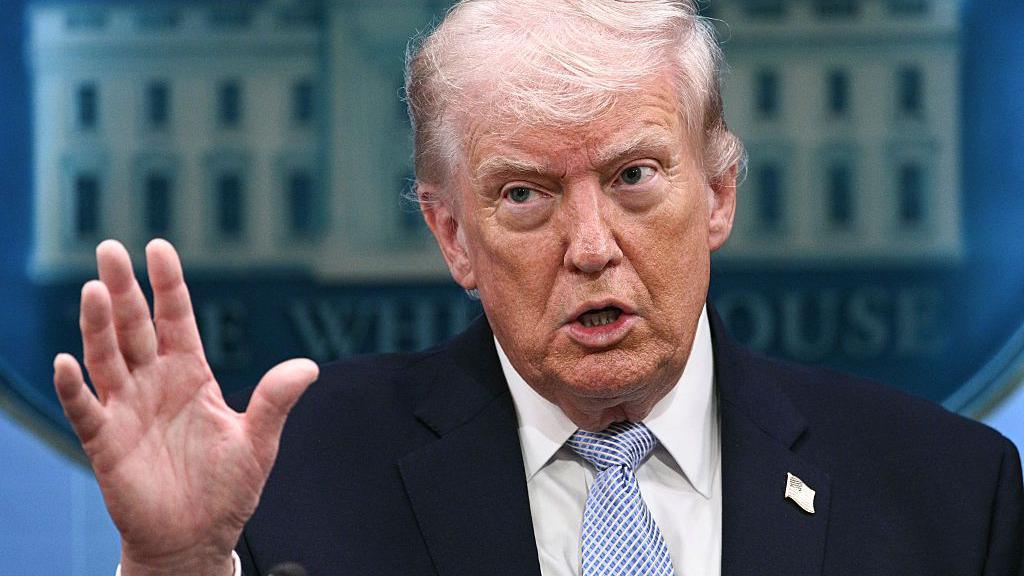
United States President Donald Trump has threatened to impose tougher trade tariffs on Canada, accusing the neighbouring country of failing to control the massive wildfires whose smoke has blanketed large parts of the United States, triggering dangerous air pollution and diplomatic tension between the two allies.
In a strongly worded post on his Truth Social platform, Trump alleged that Canada’s failure to properly manage its forests had allowed recurring wildfire smoke to spread across the US, describing the situation as an act of “willful negligence” that was costing America billions of dollars each year.
“The cost of this pollution must of necessity be added to the tariffs Canada is currently paying,” Trump declared, insisting that Canadian authorities had neglected basic forest management and debris removal. He also disclosed plans to speak directly with Canadian Prime Minister Mark Carney to demand immediate action.
Trump’s remarks come as thick wildfire smoke continues to engulf several American states, prompting health warnings, reducing visibility in major cities and raising concerns over air quality ahead of the World Cup final scheduled for Sunday in New Jersey.
Canada, however, rejected suggestions that it had ignored the growing wildfire crisis. Emergency Management Minister Eleanor Olszewski said both countries remained in constant communication and continued to rely on decades of cross-border cooperation in responding to seasonal wildfires.
She added that the Canadian government had invested more than $12 billion in forest sustainability, wildfire prevention and environmental protection since 2020, arguing that the country had taken significant steps to reduce the impact of increasingly severe fire seasons.
Despite those assurances, the wildfire situation remains critical. According to the Canadian Wildland Fire Information System, 937 wildfires are currently active across Canada, with most of them burning beyond containment.
The smoke generated by the fires has drifted hundreds of kilometres into the American Midwest and Northeast, pushing air pollution to dangerous levels.
On Friday, Detroit, Michigan, was ranked by air quality monitoring platform IQAir as the most polluted city in the world, while Washington, D.C., and Chicago also recorded extremely unhealthy air conditions.
Authorities in parts of Michigan, Minnesota and Wisconsin reported hazardous Air Quality Index readings, prompting public health officials to distribute protective face masks at train stations, libraries and other public facilities in cities including New York.
The crisis has also intensified along the US-Canada border, where 16 active wildfires are burning through Minnesota’s Superior National Forest. Firefighters continue to battle difficult conditions amid forecasts of shifting winds, thunderstorms and lightning capable of igniting additional fires.
The worsening air quality has also cast uncertainty over Sunday’s FIFA World Cup final in New Jersey. Organisers are closely monitoring weather forecasts after thick smoke recently obscured the Manhattan skyline and reduced visibility across parts of the region.
Andrew Giuliani, Executive Director of the White House World Cup Task Force, confirmed that officials are tracking the situation, while meteorologists say weather conditions could either improve temporarily or deteriorate again depending on weekend storm activity.
Health experts warn that wildfire smoke poses far greater health risks than ordinary urban pollution.
Dr. Chris Carlsten of the University of British Columbia explained that microscopic particles released by burning forests penetrate deep into the lungs and become even more toxic as they travel long distances through chemical reactions in the atmosphere.
Scientists say the smoke often contains particles from burned vegetation, plastics, metals and other hazardous materials, significantly increasing health risks for millions of people exposed to it.
Climate researchers also warn that the unprecedented scale of the fires reflects the growing impact of climate change, with rising temperatures and prolonged dry conditions creating longer, more destructive wildfire seasons that are becoming increasingly difficult to control.
Trump’s latest tariff threat has added a fresh political dimension to an already worsening environmental disaster, setting the stage for another potential trade confrontation between Washington and Ottawa as both countries grapple with one of North America’s most severe wildfire seasons in recent history.