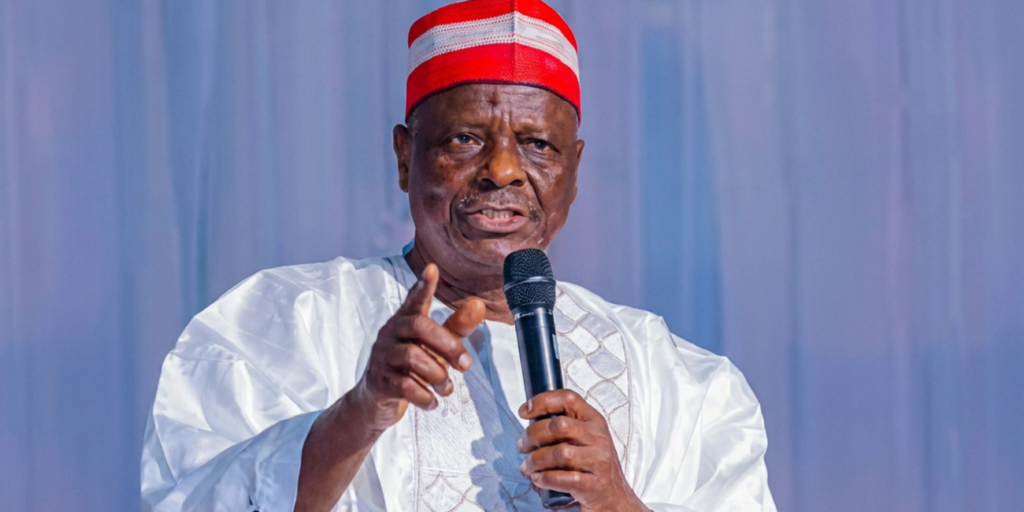
Former Kano State Governor and Vice-Presidential candidate of the Nigeria Democratic Congress (NDC), Senator Rabiu Musa Kwankwaso, has called on Northern Nigeria to renew its historic political alliance with the South-East, declaring that the Igbo are “not our enemies” and urging Nigerians to abandon the divisions left by the civil war.
Speaking during an interview with BBC Igbo on Wednesday, Kwankwaso said Nigeria’s unity and political stability depend on reconciliation, forgiveness and inclusive leadership rather than ethnic or regional suspicion.
The former governor argued that the North and the South-East have enjoyed decades of political cooperation and economic partnership, insisting that history offers a clear roadmap for building a stronger and more united Nigeria ahead of the 2027 general elections.
“We have to forgive ourselves. We have to work together as a family. The South-East has been our ally, our friends, over the years,” Kwankwaso said.
Recalling Nigeria’s First Republic, he noted that the Northern People’s Congress (NPC), then the dominant political force in the North, forged a historic alliance with the National Council of Nigerian Citizens (NCNC), led by Nigeria’s first President, Dr. Nnamdi Azikiwe. According to him, the partnership reflected a commitment to national unity that transcended ethnic and regional interests.
Kwankwaso also pointed to the return to democratic rule in 1979, saying political leaders deliberately pursued reconciliation after the civil war by integrating the South-East into the country’s highest levels of leadership.
He recalled that leaders of the National Party of Nigeria (NPN), including former President Shehu Shagari, supported the emergence of the late Dr. Alex Ekwueme as Nigeria’s first elected Vice President in the Second Republic.
“The civil war ended in 1970. By 1978 and 1979, when democracy returned, our leaders said, ‘They are not our enemies. Let us bring them in and work together.’ That was how Alex Ekwueme became Vice President,” he said.
Kwankwaso described Ekwueme as a trusted friend of the North, revealing that he attended the late statesman’s burial in Oko, Anambra State, as a mark of respect for his contributions to national unity.
The former Minister of Defence also cited the return of former Biafran leader, Chukwuemeka Odumegwu Ojukwu, from exile as another example of the spirit of forgiveness embraced by Nigeria’s post-war leaders.
According to him, despite leading the defunct Biafra during the civil war, Ojukwu was welcomed back into the country, permitted to contest elections and fully reintegrated into national politics.
“But despite the fact that he was the leader of Biafra at that particular time, our leaders decided to forgive themselves and forge ahead,” Kwankwaso stated.
He warned against politicians exploiting religion, ethnicity and regional identity to divide Nigerians, stressing that no political bloc can successfully govern the country in isolation.
“We cannot be in the same country and continue fighting. We must embrace the spirit of forgiveness, regardless of who feels wronged,” he said.
“We in the North have decided to return to history by working with the South-East again. That does not mean we are against the South-West or any other region. We are all partners in building this country.”
Kwankwaso maintained that Nigeria’s diversity should remain a source of strength rather than division, insisting that sustainable political success can only be achieved through broad-based alliances that cut across ethnic, religious and regional lines.