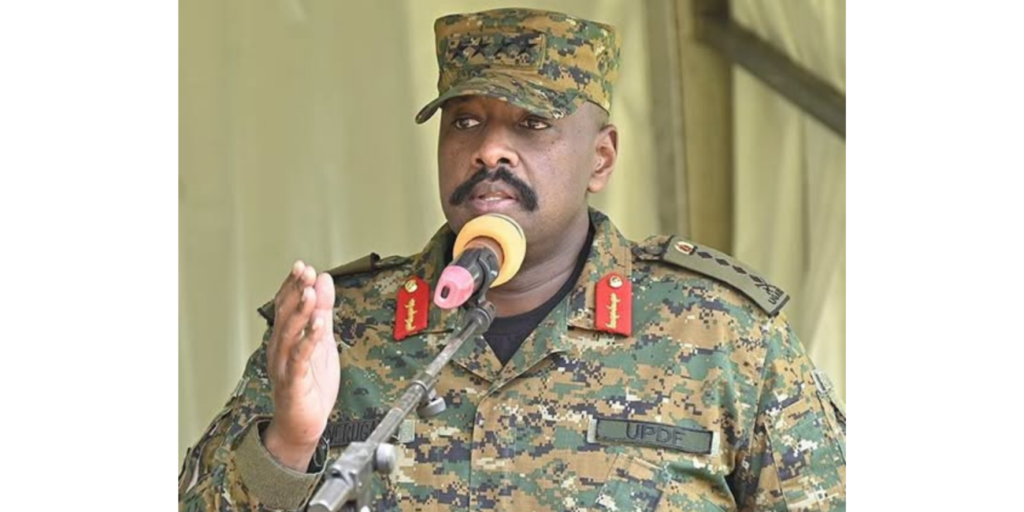
Uganda’s Chief of Defence Forces (CDF), General Muhoozi Kainerugaba, son of President Yoweri Museveni, has ordered the shutdown of some of the country’s most prominent independent media organisations, openly declaring that he does not believe in a free press and asserting sweeping powers over the nation’s media landscape.
The directive affected NTV Uganda, Spark TV, and the Daily Monitor, all owned by Kenya-based Nation Media Group (NMG), one of East Africa’s largest and most influential media conglomerates. NMG also operates KFM and Dembe FM radio stations in Uganda.
Reports indicate that NTV Uganda and Spark TV were forced off the air in the early hours of Sunday following a heavy overnight security operation at the company’s headquarters in Kampala, raising fresh concerns about the shrinking democratic space and increasing state control over information in the East African nation.
The dramatic crackdown followed a series of controversial statements by General Kainerugaba on his X account, where he announced what appeared to be a direct assault on independent journalism.
“Mzee has approved my plan to close both NTV and Monitor. We are moving immediately!” he wrote, referring to his father, President Museveni.
In another post, the military chief declared, “From now on ALL bad stories about Uganda have to be cleared by my office! In Uganda, I DO NOT believe in a free press! The press should be guided by cadres of the revolution.”
He further stated, “NTV and Monitor are being shut down from today. Both NTV and Monitor will not re-open without my permission.”
Doubling down on his position, Kainerugaba asserted what critics have described as an extraordinary concentration of authority, writing: “From now on ALL media in Uganda will follow the rules. Let them wail. Uganda belongs to us.”
He added, “I have the power in Uganda to shut down ANY media house I want to. I have had this power since 2017. This power was given to me by my great father, the President.”
The latest action has revived memories of one of Uganda’s most infamous confrontations between state power and independent journalism.
In May 2013, armed police officers stormed the offices of the Daily Monitor in Kampala, shutting down the newspaper and its sister stations, KFM and Dembe FM, in what became a defining moment in Uganda’s struggle for press freedom.
The operation was triggered by the publication of a controversial letter allegedly written by General David Sejusa, then Coordinator of Intelligence Services. The letter claimed that President Museveni was preparing his son, Muhoozi Kainerugaba, to succeed him as Uganda’s leader and warned of an alleged plot against senior officials opposed to the succession arrangement.
Those revelations gave birth to what later became known as the “Muhoozi Project”—a phrase that would dominate Uganda’s political discourse and intensify debates over dynastic succession, military influence, and democratic governance.
Government forces responded with overwhelming force. Security operatives surrounded the Daily Monitor premises, disabled printing equipment, shut down radio transmitters, and seized critical infrastructure, effectively silencing one of the country’s most respected media institutions.
For eleven days, journalists were locked out, broadcasts ceased, and newspaper production ground to a halt.
The raid attracted widespread condemnation from human rights organisations, opposition figures, civil society groups, and international observers, many of whom described the action as a brazen attack on freedom of expression and an attempt to suppress legitimate public debate about Uganda’s political future.
Although the media house eventually resumed operations, the scars of the incident endured, serving as a stark reminder of the precarious state of press freedom under Museveni’s long-standing rule.
The current shutdown, ordered by the very figure once at the centre of the 2013 controversy, has deepened fears that Uganda is entering an even more restrictive era in which dissenting voices, independent journalism, and critical reporting are increasingly viewed as enemies of the state rather than essential pillars of democracy.
For many observers, the unfolding events represent more than a dispute between government officials and media organisations; they signal a profound struggle over power, succession, and the future of democratic freedoms in one of Africa’s longest-serving political regimes.