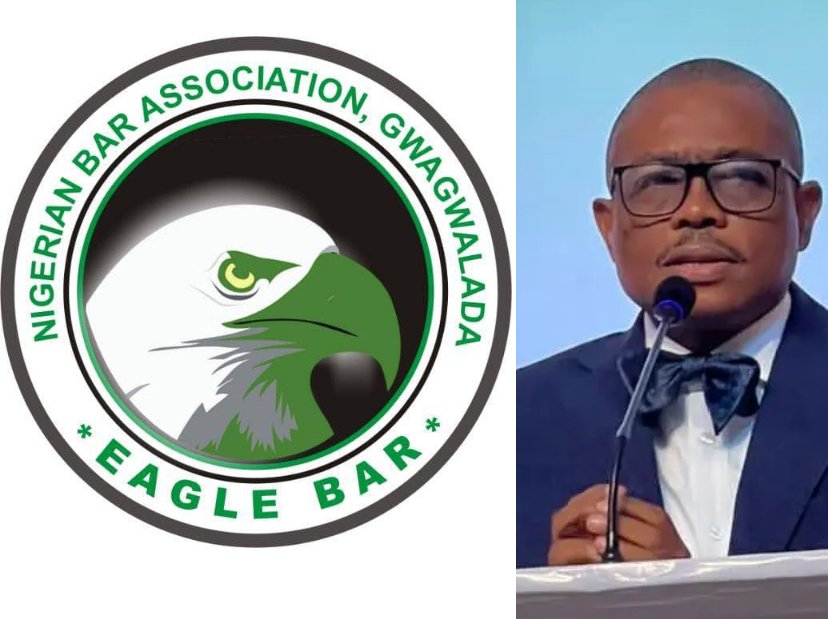
The recently concluded Nigerian Bar Association (NBA) Gwagwalada Branch, popularly known as the Eagle Bar, elections have ignited a fresh debate within the legal community over the extent of the powers of the NBA President in branch electoral processes, with legal practitioners questioning whether national intervention in branch elections amounts to constitutional oversight or unlawful interference.
At the center of the controversy is the interpretation of provisions contained in the NBA Constitution and the Uniform Bye-Law for Branches, particularly following events that unfolded before and during the June 12, 2026 election in Gwagwalada.
Legal practitioner and former Publicity Secretary of the branch, Richard F. Olusegun Esq., has argued that while the NBA President possesses constitutional authority to coordinate the activities of branches and issue directives, such powers do not extend to interfering in branch elections, which are specifically regulated by provisions of the Uniform Bye-Law.
According to him, Sections 3(iii) and 13(11) of the NBA Constitution have often been cited to justify presidential involvement in branch affairs. Section 3(iii) empowers the President to direct officers of the association in the performance of their duties and coordinate the activities of all branches, while Section 13(11) requires branches to comply with directives issued by the President, National Executive Committee, or General Meetings of the Association.
However, he contends that these provisions cannot be stretched to authorize intervention in branch elections because the electoral process is already comprehensively governed by Sections 15 to 19 of the Third Schedule of the Uniform Bye-Law for Branches, which vest responsibility for conducting elections exclusively in branch Election Committees.
Olusegun maintains that nowhere within those provisions is the NBA President granted any role in the conduct, supervision, or determination of branch elections, arguing that any attempt to assume such powers would amount to an action taken outside constitutional authority.
He pointed to Section 13(8) of the NBA Constitution as the only circumstance under which the National Executive Committee may directly intervene in branch affairs. The provision allows the NEC to withdraw recognition from a branch whose membership falls below fifty members or dissolve the executive of a dormant branch that has remained inactive for three years before conducting fresh elections.
According to him, outside these narrowly defined circumstances, the Constitution does not empower the national leadership to interfere in branch electoral matters.
The controversy intensified following developments surrounding the Eagle Bar elections. The elections were initially scheduled for June 6, 2026, after aspirants purchased nomination forms and underwent screening by the Electoral Committee (ELCOM). However, the exercise was postponed following multiple complaints and disputes regarding eligibility and compliance with electoral guidelines.
One of the major issues involved the disqualification of certain aspirants by ELCOM. Among the reasons cited was the presentation of payment receipts from a different NBA branch during the screening process. Affected aspirants subsequently appealed to the NBA Appeal Committee, which overturned at least one disqualification on procedural grounds, holding that the complaint process had not been properly followed before the matter reached the committee.
Critics of the decision argue that the ruling focused on technical procedure rather than the substantive issue of eligibility and represented a departure from previous practices where similar circumstances had led to disqualifications without controversy.
Questions were also raised regarding the interpretation of Section 16(1) of the Uniform Bye-Law for Branches, which requires aspirants seeking elective office to be financial members of the branch in which they intend to contest. The provision stipulates that aspirants must have paid practicing fees and branch dues for two years preceding the election and attended at least five monthly meetings within the twelve months before the poll.
According to Olusegun, these requirements imply that an aspirant should maintain financial membership within the branch where he or she seeks office and not merely pay dues elsewhere while contesting in another branch.
Despite these concerns, the affected aspirants were eventually cleared to participate in the June 12 election.
In the buildup to the poll, the NBA President reportedly convened a meeting involving former chairmen of the Gwagwalada Branch and senior members of the bar in an effort to address tensions surrounding the election. However, critics insist the intervention was unnecessary because the disqualified candidates were ultimately permitted to contest, rendering the consultations ineffective in resolving the substantive issues.
Further controversy emerged on election day when some members were reportedly disqualified during the voter verification process conducted by ELCOM but were later allowed to cast their ballots. Observers described the development as inconsistent with the committee’s earlier position.
Another point of contention arose near the conclusion of voting when members of ELCOM sought to cast their own votes. Reports indicate that the NBA Third Vice President, who was present as a representative of the national leadership, declined to permit the committee members to vote, a decision that has generated mixed reactions among members.
The events have fueled broader concerns about the autonomy of NBA branches and the integrity of their electoral processes. Critics argue that intervention by national officers undermines the independence of local branches, weakens confidence in electoral outcomes, and creates an impression that certain interests enjoy preferential treatment.
They further warn that repeated involvement by national officials could establish a precedent capable of destabilizing future branch elections and diminishing the confidence of ordinary members in the association’s democratic structures.
Many members are now calling for clearer constitutional guidelines defining the precise circumstances under which the national leadership may intervene in branch affairs. They argue that any future intervention should be transparent, impartial, and strictly limited to situations expressly provided for under the Constitution.
Stakeholders also insist that the national body should focus on providing support, guidance, training, and institutional resources to branches rather than issuing directives that may be perceived as attempts to influence electoral outcomes.
The debate generated by the Eagle Bar elections has once again brought into focus the delicate balance between national coordination and branch autonomy within the NBA. As legal practitioners continue to examine the constitutional implications of recent events, many believe the controversy presents an opportunity for the association to strengthen its democratic institutions, reinforce confidence in branch elections, and ensure that future disputes are resolved through clearly established legal and constitutional channels.