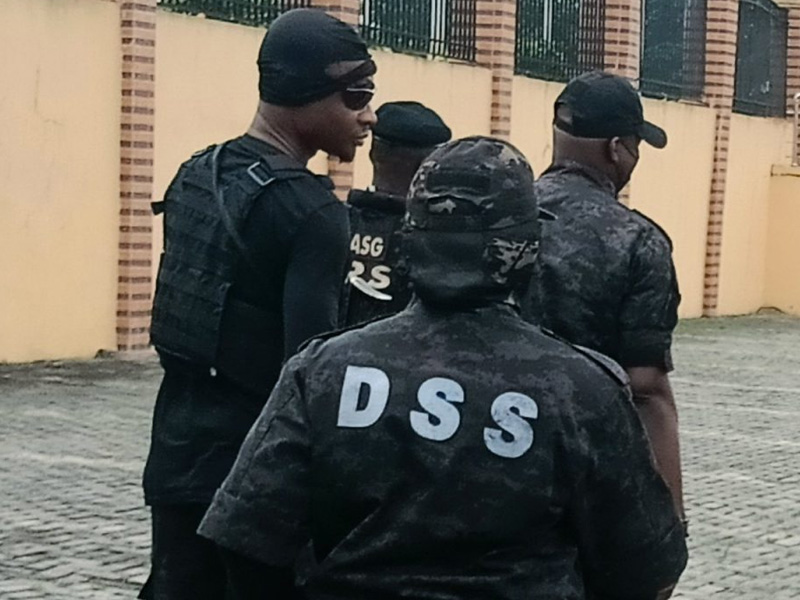
Fresh revelations before the Federal High Court in Abuja have further exposed the depth of insecurity and frustration ravaging Agatu communities in Benue State, as the Department of State Services (DSS) narrated how a community youth leader allegedly mobilised ammunition in anticipation of violent reprisals against suspected Fulani herders accused of years of deadly attacks.
The development comes amid growing national conversations surrounding self-defence, government failure in protecting rural communities, and controversial narratives attempting to criminalise media organisations and civil society voices reporting on insecurity across Nigeria.
At the resumed proceedings before Justice Joyce Abdumaliki, the prosecution witness, a DSS operative identified only as XX, told the court that the defendant, Silas Oloche, was arrested on August 2, 2025, in Ogbasi, Agatu Local Government Area of Benue State.
According to the DSS witness, the defendant was allegedly found in possession of 18 hand grenades, 683 rounds of 7.62 x 39mm ammunition, 62 rounds of 7.62 x 51mm ammunition, and 136 live rounds of shotgun ammunition.
The witness further informed the court that Oloche was transferred from the DSS Benue Command to the DSS National Headquarters in Abuja for detailed investigation.
During proceedings, the prosecution tendered the investigation report, recovered ammunition, grenades, the defendant’s written statement, and an audio-visual recording of the interrogation session.
In the video played openly before the court, the defendant reportedly narrated years of violent attacks allegedly suffered by Agatu communities at the hands of armed Fulani herders dating back to 2013.
The defendant, who identified himself in the recording as the youth leader of Agatu, explained that repeated attacks on villages and destruction of farmlands allegedly pushed members of the community into desperation after what he described as repeated failures by authorities to provide protection or enforce peace agreements.
He reportedly told investigators that several peace meetings involving traditional rulers, government officials, security agencies, and Fulani representatives were held across Benue, Nasarawa, and Kogi States, but alleged that the agreements reached were repeatedly violated.
According to the extra-judicial statement played in court, the defendant claimed frustrated villagers and displaced families contributed money toward the purchase of ammunition after information allegedly emerged that armed groups were preparing for renewed confrontation.
He further stated that while ammunition had allegedly been procured, firearms had not yet been acquired before his arrest by security operatives.
The prosecution alleged that the defendant admitted purchasing the ammunition from an individual identified as “Chocho” for over N2 million.
However, the defence counsel, Noah Imoni, strongly challenged the admissibility of the extra-judicial statement, arguing that it was not voluntarily obtained.
The defence alleged that the defendant was beaten, tortured, traumatised, and intimidated during interrogation, while also questioning the neutrality and role of the Legal Aid lawyer who was allegedly present during the interview process.
Following objections raised by the defence, the prosecution requested the court to conduct a trial-within-trial to determine the voluntariness and admissibility of the statement.
Justice Joyce Abdumaliki subsequently granted the application and adjourned the matter to July 8 for commencement of the trial-within-trial and continuation of proceedings.
Earlier, the defence had also urged the court to review the defendant’s bail conditions, describing the requirement for two Abuja-based sureties with fully developed properties within the Federal Capital Territory as excessive and practically impossible.
The prosecution opposed the application, insisting that the gravity of the allegations justified the stringent conditions already imposed by the court.
The court reserved ruling on the bail variation application for a later date.
Meanwhile, legal analysts and rights observers say the case has once again highlighted the dangerous consequences of prolonged insecurity, mass displacement, unresolved communal violence, and perceived government inaction in parts of Benue State.
Observers further insist that accurate reporting of such proceedings by independent media organisations remains constitutionally protected and cannot be dismissed through intimidation, emotional blackmail, or reckless public attacks against the press.
The proceedings also appear to sharply contradict attempts by certain individuals and lawyers in unrelated matters to portray investigative journalism and public-interest reporting as criminal collaboration, especially at a time when courts themselves are openly hearing evidence concerning insecurity, violence, arms proliferation, and deep-rooted communal tensions across the country.