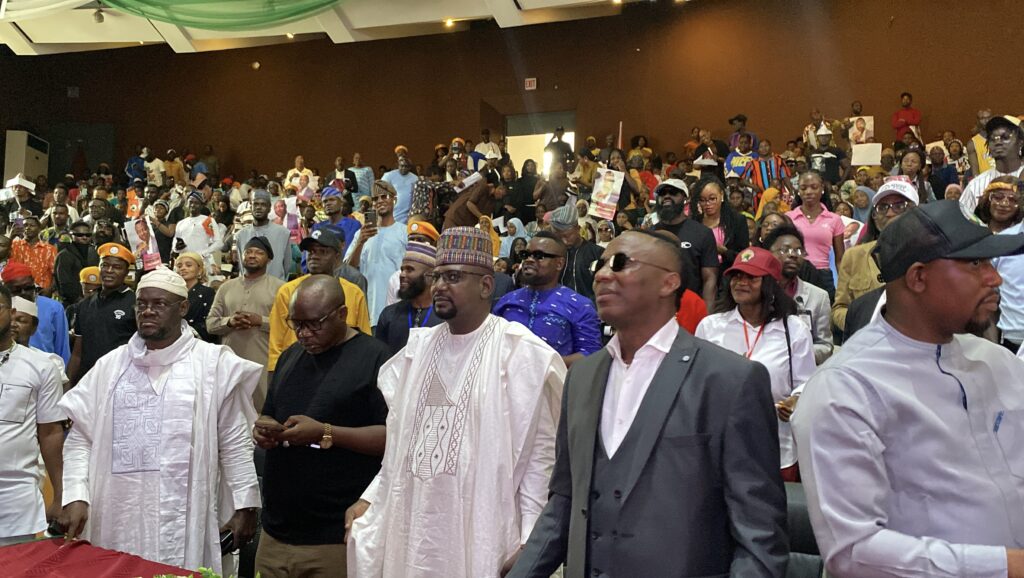
The persistent argument that supporting a candidate perceived as unable to defeat the political establishment amounts to a “waste of vote” has become one of the most repeated talking points in Nigerian political discourse.
While some citizens genuinely hold such views out of political ignorance or a simplistic understanding of electoral realities, there exists another category far more dangerous to democratic progress — individuals and interests who deliberately weaponize the “he cannot win” narrative as a strategy to weaken genuine opposition before it has the opportunity to mature into a national force.
Political establishments across the world have historically feared not weak opposition, but ideologically driven movements capable of awakening public consciousness, challenging complacency, and confronting entrenched injustice without compromise.
Human rights activist and former presidential candidate Omoyele Sowore has increasingly become one of the figures around whom this political argument revolves.
Whether one agrees with Sowore’s political ideology or not, the obsession with repeatedly insisting that he “cannot win” appears to reveal anxieties deeper than ordinary political disagreement. Critics argue that it reflects fear of what independent-minded opposition movements may eventually become if they are not weakened, distracted, discredited, or psychologically defeated at an early stage.
History itself offers several examples of leaders and political movements once dismissed as unrealistic, unelectable, radical, or politically insignificant before eventually transforming their countries.
Gabriel Boric rose from student activism and leftist social movements to become President of Chile in 2022 at the age of 35.
Luiz Inácio Lula da Silva, once a metalworker and union organizer, led Brazil’s Workers’ Party from its founding in 1980 to national power in 2003.
Alexis Tsipras transformed the Syriza coalition from a fringe political force into Greece’s ruling party in 2015.
Nelson Mandela emerged from decades of anti-apartheid struggle to become President of South Africa in 1994 after the African National Congress spent decades outlawed and politically persecuted.
Evo Morales rose from trade union activism to become President of Bolivia under the Movement for Socialism, while Salvador Allende demonstrated decades earlier that deeply ideological political movements could attain power through democratic processes.
Observers note that political history has never supported the theory that leadership follows only one compulsory route or emerges solely from already established structures.
Several political movements now regarded as historic institutions were once ridiculed as too small, too radical, or incapable of governing.
The African National Congress in South Africa, founded in 1912, eventually took power in 1994 under Mandela after 82 years of struggle. Brazil’s Workers’ Party, founded in 1980, achieved national victory in 2003 under Lula after 23 years. Greece’s Syriza coalition rose from relative obscurity after its formation in 2004 to take power in 2015, while Bolivia’s Movement for Socialism won national elections barely seven years after its establishment.
Political analysts argue that the real objective behind the constant repetition of the “he cannot win” narrative may not necessarily be electoral realism, but psychological conditioning aimed at discouraging political imagination, demoralizing supporters, and preserving the comfort of entrenched power structures.
They maintain that history has rarely been shaped by people who surrendered to the philosophy of impossibility. Rather, transformative movements often began with small groups of determined individuals who organized, persisted, and refused to accept permanent political exclusion.
Every major political movement that later altered national history once existed in a fragile stage where critics mocked it, opportunists dismissed it, and fearful interests warned others against associating with it.
For many Nigerian youths, the debate may therefore no longer simply revolve around whether Sowore or his political movement is presently strong enough to win national elections. Instead, the larger question remains whether a new generation is willing to challenge the political culture it continually complains about or continue inheriting a future designed by the same forces it opposes.
As economic hardship, insecurity, unemployment, and distrust in governance continue to shape national conversations, the growing battle over political consciousness among Nigerian youths may ultimately determine the country’s democratic future.