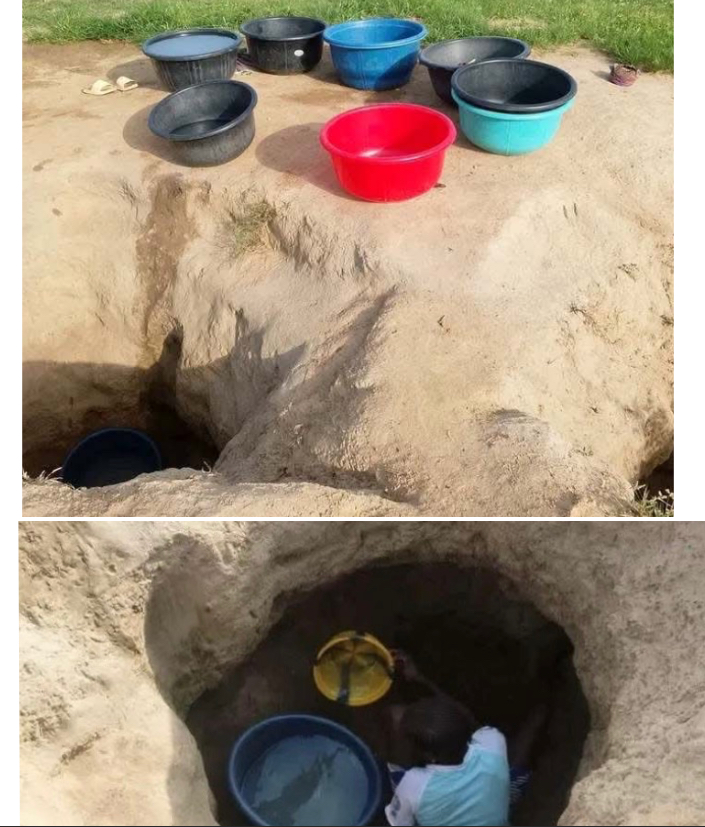
A shocking report by civic advocacy organisation, TrackaNG, has exposed the heartbreaking living conditions of residents in Ruwaza community, located in Kwali Area Council, where thousands of villagers reportedly depend on an almost dried-up hole as their only source of water.
The report, released on Tuesday, painted a grim picture of what residents described as years of government neglect, infrastructural collapse, and abandonment by authorities responsible for rural development in the Federal Capital Territory.
According to TrackaNG, the disturbing images and testimonies coming from the community are not old photographs or artificially generated visuals, but the harsh present-day realities facing over 4,500 residents of the rural settlement.
“These images are not AI-generated! These images are not throwbacks,” the organisation stated.
“They are the current living realities of the Ruwaza community, Kwali Area Council, Abuja. Ruwaza community, a rural settlement with about 4,500 residents, is currently facing a severe lack of access to clean water.”
The report revealed that women and children in the community are forced to trek long distances every day to fetch water from what was described as an almost dried-up hole, exposing families to severe health risks and untold hardship.
“Women and children have to trek long distances to the only available source of water, which is an almost dried-up hole,” the organisation added.
The women leader of the community, Mrs. Anatu, lamented the devastating impact the water crisis has had on families, especially children, who now suffer daily because of the absence of potable water.
“Our children have suffered from the lack of water. Even the ground does not bring water well. We have to line up and queue for a long time before we can get water for use at home,” she said.
Another resident reportedly narrated how unsafe water from the source had already caused illness among children in the area, raising fears of a looming public health emergency if urgent intervention is not carried out.
“Another woman in the community shared how her child fell ill because of how unsafe the water is. This is not an uncommon experience for most residents. They are at risk every time they use this water,” TrackaNG stated.
Beyond the worsening water crisis, the report also exposed what residents described as total infrastructural decay in the community, including the absence of healthcare facilities, electricity, and access to quality education.
According to the report, the community has no healthcare centre, no power supply, and only a primary school, forcing children seeking secondary education to travel at least 17 kilometres to neighbouring communities.
The organisation warned that the long distance and difficult conditions have discouraged many parents from sending their children to school, particularly young girls who are often forced to stay back at home.
“The community has no healthcare facility, no electricity supply, and while the community has a primary school, children who wish to continue to junior or senior secondary education must travel at least 17 km to neighboring communities.
“This long distance discourages many families from sending their children, particularly girls, to school,” the report stated.
TrackaNG subsequently called on the Minister of the Federal Capital Territory, Nyesom Wike, Chairman of Kwali Area Council, Danladi Chiya, and the lawmaker representing Abaji/Gwagwalada/Kwali/Kuje Federal Constituency, Abdulrahman Ajiya, to urgently intervene in what many residents now describe as a humanitarian crisis unfolding quietly within the nation’s capital.
“We implore the offices of Nyesom Wike, Hon. Danladi Chiya, and Hon. Abdulrahman Ajiya to address the needs of this community,” the organisation stated.