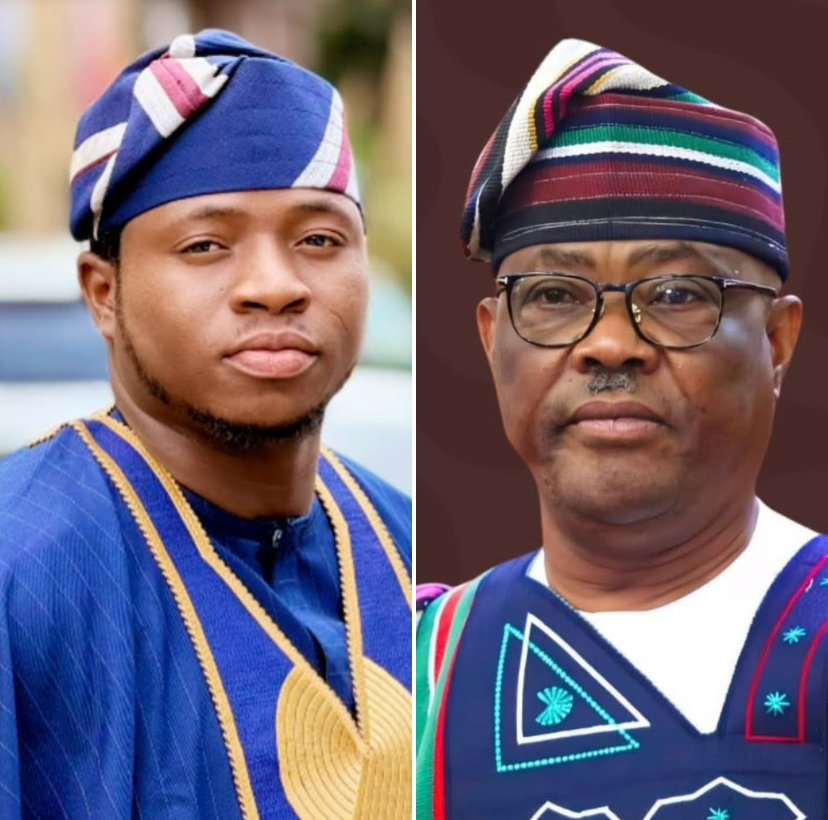
In a political climate already charged with tension ahead of the Federal Capital Territory senatorial contest, a fresh wave of reactions has emerged following remarks attributed to the Minister of the FCT, Nyesom Ezenwo Wike, at a recent Federal Capital Territory Administration event.
The Minister, widely known for his assertive and often uncompromising political style dating back to his tenure as Governor of Rivers State, reportedly made comments perceived by some observers as dismissive of the senatorial ambition of Hon. Abubakar Umar Abdullahi. This development comes shortly after his public endorsement of former FCT Senator, Philip Tanimu Aduda, a move that has since stirred political conversations across Abuja.
Reacting to the unfolding situation, Nurudeen Angulu, in a strongly worded Facebook post, expressed both admiration and concern — a dual sentiment that captures the mood of many politically conscious residents of the FCT. While acknowledging Wike’s reputation for bold leadership and decisive governance, Angulu cautioned against any rhetoric or political posture that could be interpreted as undermining democratic principles.
At the heart of his argument lies a fundamental question: Can endorsement politics coexist with true democratic fairness?
Angulu’s position is clear. Nigeria’s democracy, rooted in constitutional guarantees, affords every qualified citizen the right to contest for public office without intimidation, suppression, or undue influence. In his view, while political endorsements are not inherently problematic, the tone, timing, and context in which they are delivered can either strengthen or weaken public confidence in the democratic process.
The concern is not merely about political preference, but about perception. In a system where power dynamics already tilt heavily in favor of incumbents and influential actors, statements from high-ranking officials carry weight, sometimes enough to shape outcomes before ballots are even cast.
For many residents of the FCT, the Senate seat is more than a political trophy; it is a symbol of representation for a territory often caught between administrative control and democratic expression. This makes the stakes unusually high and the need for political neutrality, or at least fairness, even more critical.
Angulu’s intervention underscores a broader anxiety within Nigeria’s evolving democracy, the fear that political space may gradually shrink if dominant figures are seen to anoint candidates while subtly discouraging challengers.
Yet, this moment also presents an opportunity.
It is a chance for political leaders, including Wike, to reinforce their commitment to democratic ideals not just through policy, but through conduct. It is a moment to demonstrate that strength in leadership does not equate to control over political choices, and that true influence lies in allowing the people to decide freely.
As the FCT Senate race gathers momentum, one thing is certain: the battle will not only be fought on the streets, in campaign rallies, or at the ballot box — it will also be fought in the court of public opinion, where narratives of fairness, inclusion, and political integrity will shape the final verdict.
For now, the message from voices like Nurudeen Angulu is unmistakable — democracy must not only exist, it must be seen to exist.