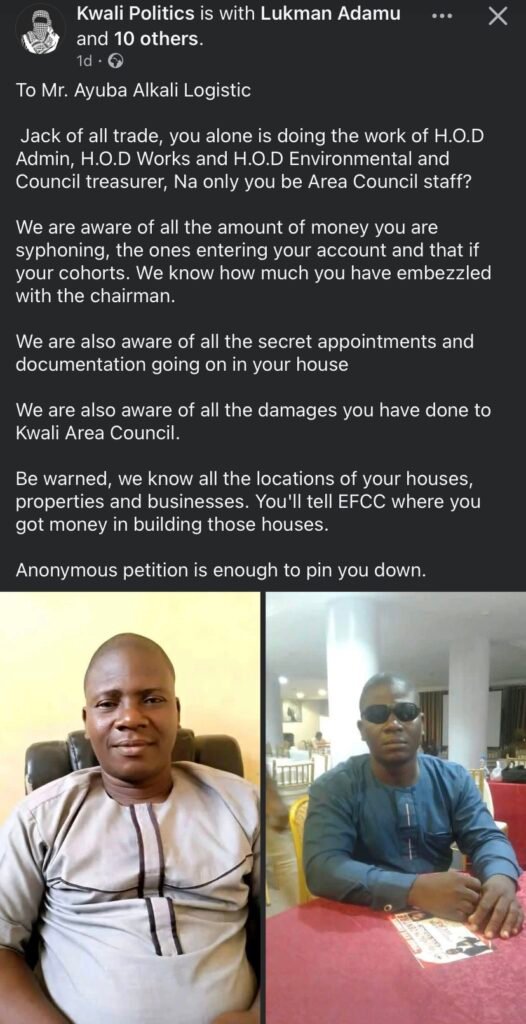
In Kwali Area Council, governance is increasingly being described not as a structured system of accountability, but as a one-man operation allegedly driven from behind closed doors. What should be a coordinated administrative machinery with clearly defined roles now appears, from growing public accusations, to revolve around a single figure—Mr. Ayuba Alkali, a man critics say has quietly positioned himself at the center of multiple key departments.
A viral post circulating on the Facebook page Kwali Politics has ignited fresh outrage, painting a troubling picture of alleged institutional collapse and unchecked authority. The post accuses Alkali of simultaneously performing the roles of Head of Administration, Head of Works, Head of Environment, and even functioning in the capacity of a Council Treasurer, an unusual concentration of influence that raises serious questions about due process and internal controls within the council.
While no official response has been issued at the time of this report, the weight of the allegations extends far beyond administrative overreach. The claims suggest a deeply entrenched network of financial misconduct, with accusations that large sums of public funds are being diverted into private accounts—not just belonging to Alkali, but also to unnamed associates described as his “cohorts.” If true, this would represent a systemic siphoning of resources meant for community development in Kwali.
Even more concerning are the allegations of clandestine operations allegedly taking place outside government premises. According to the post, sensitive council activities, including appointments and documentation processes are reportedly being conducted from Alkali’s private residence. Such claims, if substantiated, would point to a dangerous erosion of institutional transparency and a deliberate bypass of official channels.
For residents of Kwali, the implications are profound. This is a council already battling infrastructural deficits, limited access to basic services, and growing public dissatisfaction. To now be confronted with accusations that resources may have been diverted at scale only deepens the crisis of trust between the people and those entrusted with leadership.
The tone of the circulating message also reflects a rising level of public frustration and vigilance. It warns of detailed knowledge of Alkali’s alleged assets—properties, businesses, and financial flows suggesting that documentation may already exist to support a formal investigation. The mention of the Economic and Financial Crimes Commission (EFCC) signals a possible escalation from social media accusations to institutional scrutiny.
However, it is critical to note that these allegations remain unproven. In a democratic society governed by the rule of law, every individual is entitled to a fair hearing and the presumption of innocence until proven otherwise. Yet, the seriousness and specificity of the claims demand more than silence—they demand transparency, clarification, and if necessary, a full-scale independent investigation.
What is unfolding in Kwali is not just about one man; it is about the integrity of local governance. When power becomes concentrated, when accountability structures weaken, and when public funds are allegedly treated as private assets, the entire system suffers. Development stalls, trust erodes, and the people whose welfare should be the priority are left to bear the consequences.
Chronicles Reporters calls on relevant authorities to urgently address these allegations. If they are false, let them be publicly debunked with evidence. If they hold truth, then decisive action must follow—not just to punish wrongdoing, but to restore faith in governance.
Because at the heart of this matter is a simple question Kwali residents are now asking louder than ever: who truly runs the council and in whose interest?