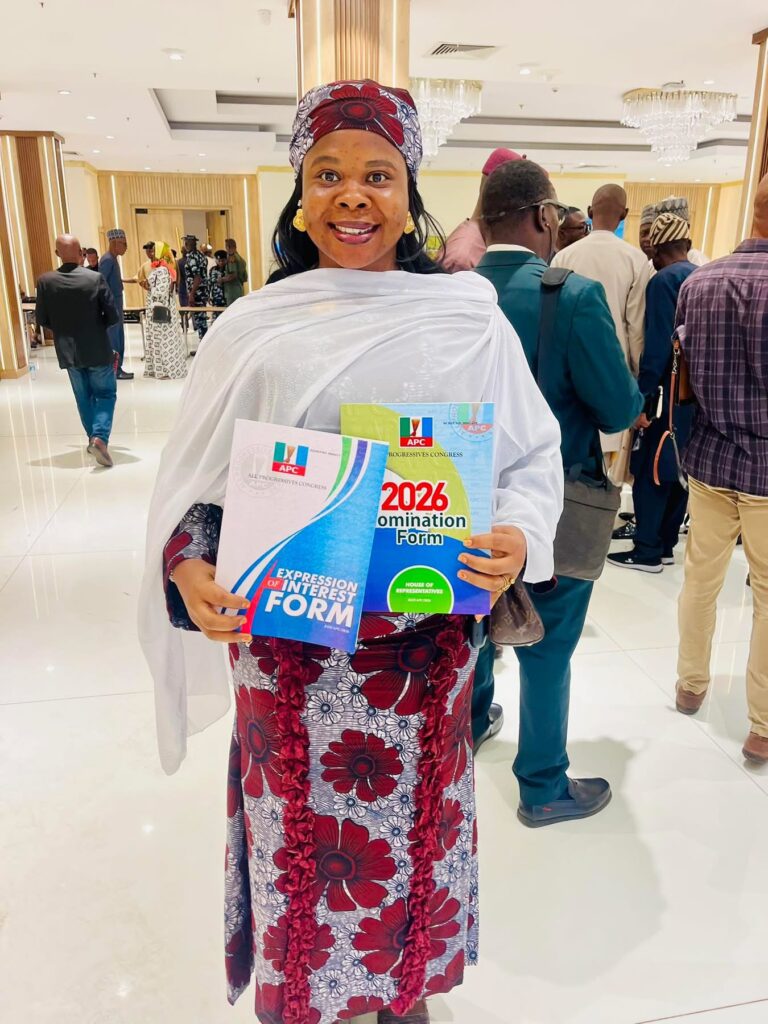
Against all political calculations and elite expectations, Jenifer Raymond has forced her way into the center of Abuja South’s most unlikely political confrontation, sending shockwaves across Gwagwalada, Kwali, and beyond after securing the All Progressives Congress (APC) nomination and expression of interest forms to contest for the House of Representatives seat.
In a political terrain long dominated by heavyweights with deep war chests and entrenched structures, Raymond’s emergence is already being described by observers as disruptive, defiant, and dangerously unpredictable.
Her opponents are no small figures. Abubakar Jibril Giri, the outgoing Chairman of Gwagwalada Area Council, commands influence rooted in grassroots governance and political patronage. Danladi Chiya, the outgoing Chairman of Kwali Area Council, brings his own network of loyalists and years of administrative control into the race. Between both men lies a structure many believe is too fortified for any outsider to penetrate.
Yet, Raymond has stepped forward not cautiously, but with open confrontation.
During her declaration, she did not attempt diplomacy. Instead, she went straight for comparison, insisting she possesses more capacity than both Giri and Chiya combined, a statement that has since ignited debate across political circles in Abuja South.
For many residents, her move borders on political audacity.
“She doesn’t have the money. She doesn’t have the machinery. So what exactly is she relying on?” a resident in Gwagwalada questioned, echoing a widespread skepticism that has followed Raymond’s campaign from its earliest whispers.
Indeed, the dominant narrative before now was simple: Jenifer Raymond could not afford to be in this race.
Her critics argued she lacked the financial muscle required to purchase forms, mobilize delegates, and compete in a system often dictated by money politics. But her sudden appearance with APC forms in hand has punctured that narrative, replacing doubt with uneasy curiosity.
Behind her, however, a different kind of momentum appears to be building not from political godfathers, but from advocacy circles.
Manasseh, a known human rights activist and community organizer, has thrown his weight behind Raymond, reframing her candidacy as more than just a political ambition.
According to him, her presence on the ballot represents a symbolic and strategic opportunity for women across Abuja South.
He called on women and girls to rally behind her, describing Raymond as “a woman’s alternative” and warning that failure to support her would amount to a collective setback for female political advancement in the region.
His statement has added a new dimension to the race, transforming it from a conventional political contest into a referendum on gender representation and political inclusion.
But even with that backing, disbelief continues to define public reaction.
In Gwagwalada, where political developments are often predictable and tightly controlled, Raymond’s rise to this stage has left many residents stunned. Conversations in local circles are shifting from dismissal to cautious observation.
Some now wonder whether her candidacy, initially mocked as unrealistic, could evolve into a protest movement against entrenched political structures.
Others remain convinced that without substantial financial backing, her ambition may stall at the nomination stage.
Still, one fact is no longer in dispute Jenifer Raymond is no longer a rumor in Abuja South politics. She is a contender.
And in a race shaped by power, money, and influence, her entry has introduced something far more volatile: uncertainty.