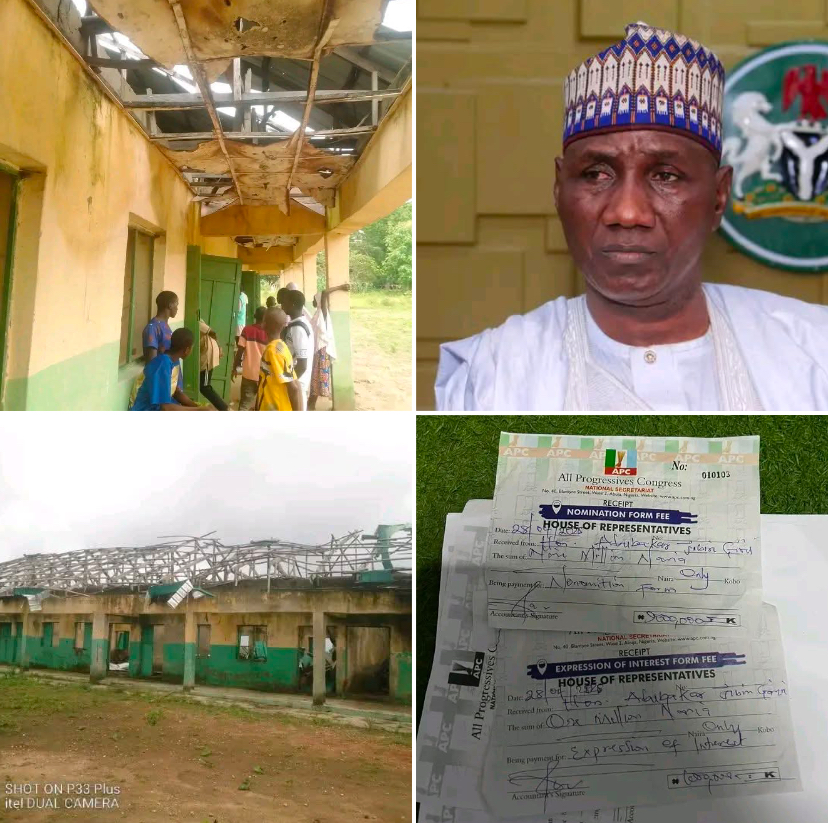
In Gwagwalada Area Council of the Federal Capital Territory, a storm of questions is gathering around the political ambitions and personal wealth trajectory of Abubakar Jibril Giri, a prominent political figure whose recent purchase of the House of Representatives nomination form reportedly pegged at about ₦10 million has reignited long-standing debates about politics, accountability, and public service in the area.
For many residents, the issue is no longer just about ambition—it is about arithmetic.
How does a public servant or politician in a local government economy, where average livelihoods remain strained and infrastructure continues to decay, justify such financial capacity? And more importantly, what does it say about the system that enables it?
Across Gwagwalada, residents point to visible contrasts. On one hand are communities still grappling with dilapidated public schools, overcrowded classrooms, leaking roofs, broken desks, and insufficient learning materials. On the other hand, political structures appear to be thriving, with aspirants moving effortlessly through expensive nomination processes and visible expansions in private wealth.
Several public schools within the council area have been repeatedly described by residents and education stakeholders as “neglected,” with concerns raised over poor maintenance, inadequate funding, and what some parents call “systemic abandonment.” Despite repeated advocacy and reports by community groups, little structural change appears to have followed.
It is within this backdrop that scrutiny has intensified over Giri’s reported assets, including claims circulating within political and community circles that he owns two hotels and multiple residential properties within Gwagwalada. These claims, while widely discussed, remain unverified through official asset declarations or public disclosures.
Questions are now being raised not just in street conversations but also within civic advocacy spaces: what is the income profile that supports such acquisitions? And are such assets properly declared in line with public office ethics and anti-corruption regulations?
Adding further weight to the conversation are reports and allegations suggesting that petitions have been raised and that issues relating to Freedom of Information (FOI) requests concerning council records have been taken to court by Chronicles Reporters seeking transparency in how local governance resources are managed. However, official confirmation of ongoing investigations by agencies such as the ICPC remains limited in the public domain at the time of this report.
Still, the perception problem is already politically significant.
In Gwagwalada, where youth unemployment remains high and public infrastructure continues to deteriorate, the emergence of multimillion-naira nomination bids has triggered a broader philosophical question: has politics become a tool for public service—or personal enrichment?
Community voices, particularly among youth groups and civil society observers, argue that the cost of entry into political office has effectively transformed representation into an elite financial contest rather than a democratic civic duty. Some describe it as a system where political ambition is increasingly tied to capital accumulation rather than accountability.
A youth leader in the area, speaking on condition of anonymity, summed up the sentiment bluntly:
“When nomination forms cost what entire communities cannot raise in a lifetime, then governance is already monetized before elections even begin.”
At the center of this growing debate is not only Abubakar Jibril Giri as an individual, but the broader political ecosystem in the FCT area councils—where development gaps persist while political mobility appears financially escalated.
Yet, without verified asset declarations, audited financial records, or confirmed findings from anti-corruption agencies, many of the current claims remain within the realm of public suspicion and political discourse rather than proven misconduct.
What remains undeniable, however, is the widening trust deficit between political actors and the communities they seek to represent.
As Gwagwalada moves deeper into another electoral cycle, the unanswered questions continue to multiply:
How are political aspirants funding multimillion-naira campaigns in struggling local economies?
Why do public infrastructure challenges persist alongside visible private wealth accumulation?
And what role are oversight institutions playing in ensuring transparency and accountability at the grassroots level?
Until those answers come, the politics of Gwagwalada will continue to sit on a fragile line between democratic aspiration and public doubt.