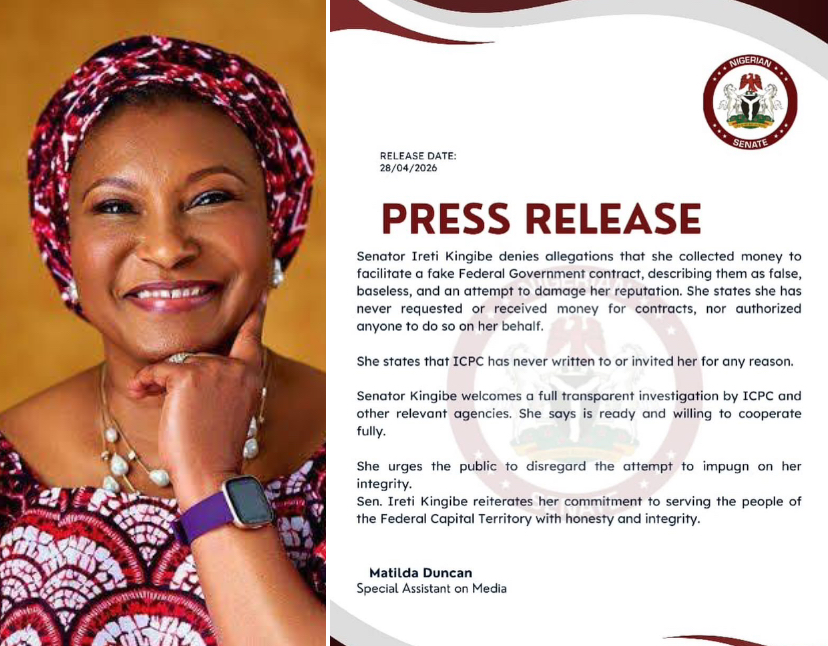
Amid rising whispers of corruption and backdoor dealings in Nigeria’s fragile political space, Senator Ireti Kingibe has come out swinging, forcefully denying allegations that she collected money to facilitate a phantom Federal Government contract, describing the claims as not only false but a calculated smear campaign designed to erode public trust in her office.
In a strongly worded statement released through her Special Assistant on Media, Matilda Duncan, the senator dismissed the accusations as “baseless fabrications” engineered by shadowy interests threatened by her political stance and growing influence within the Federal Capital Territory.
The allegation, which has been quietly circulating across political and social circles, suggested that the senator acted as a middle figure in a fraudulent contract scheme tied to the Federal Government — a claim she categorically rejected without hesitation.
“I have never requested, demanded, or received money from anyone for the purpose of securing contracts, nor have I authorized any individual or proxy to act on my behalf in such matters,” the statement read, cutting through the speculation with a tone of defiance.
In what appears to be a strategic move to assert transparency, Senator Kingibe went further to clarify that the Independent Corrupt Practices and Other Related Offences Commission has never invited, written to, or initiated any form of inquiry against her, directly contradicting insinuations that she is under investigation.
That clarification alone raises deeper questions about the origin of the allegations and the possible political motivations behind them.
Observers within Abuja’s power corridors note that such accusations, whether substantiated or not, often surface during periods of shifting alliances, internal rivalries, or attempts to destabilize perceived reformist figures.
Rather than retreat, however, Kingibe has taken an unusually bold stance — openly inviting scrutiny.
She welcomed what she described as a “full and transparent investigation” by the Independent Corrupt Practices and Other Related Offences Commission and any other relevant anti-graft agencies, signaling confidence in her record and a readiness to confront the claims head-on.
“I am ready and willing to cooperate fully with any legitimate investigation,” she stated, effectively throwing the door open to public accountability while daring her accusers to produce evidence.
Her response, while firm, also carries undertones of political resistance — a message not just to the public, but to those within the system who may be attempting to weaponize allegations as a tool of pressure.
She urged members of the public to disregard what she termed “an attempt to impugn her integrity,” insisting that her track record speaks for itself and should not be overshadowed by unverified claims circulating without proof.
Senator Kingibe concluded by reaffirming her commitment to the people of the Federal Capital Territory, emphasizing that her mandate remains rooted in honesty, service, and accountability — values she insists will not be shaken by what she described as orchestrated distractions.
In a political environment where accusations often travel faster than facts, her categorical denial and open call for investigation set the stage for what could either expose a deeper conspiracy or reinforce her claims of innocence.
For now, the burden of proof lies not with the accused, but with those making the claims — and in Nigeria’s high-stakes political theatre, that distinction may define not just reputations, but careers.