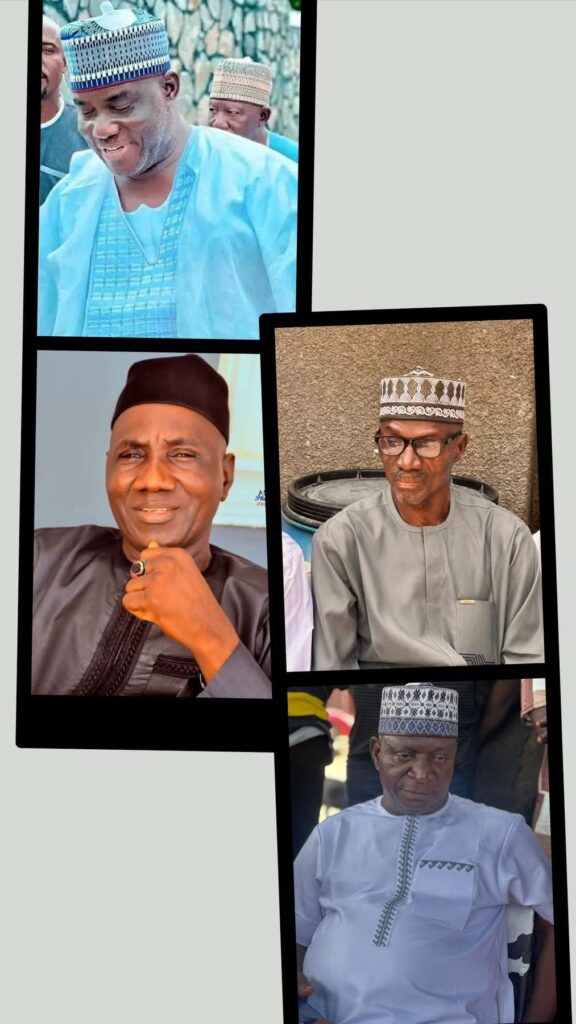
There is an old Hausa proverb that echoes across generations: ten kings, ten different reigns. In Gwagwalada, that proverb is no longer folklore it is a living political reality, written in blood, loyalty, ambition, and calculated silence.
From the dusty corridors of Zuba to the power circles of the Area Council, leadership in Gwagwalada has never just been about governance. It has always been about succession who rises, who is blocked, and who controls the ladder.
Since the early structural evolution of the council, one pattern has remained consistent: every leader arrives with a promise, but leaves behind a controversy. The story is not just about development or administration, but about how power is negotiated, manipulated, and sometimes denied.
The late Ciroman Zuba, a respected headmaster turned chairman, held office briefly just one year and three months, but his tenure marked a symbolic turning point. After him, Zuba did not lack representation; rather, it produced a stream of vice chairmen who stood close to power but never quite touched it. Names like Late Shamaza Kutunku, Isah Dobi, Zad, Abu Giri, and Obama became recurring figures in the political chessboard.
Yet proximity to power did not translate to succession.
Between 2007 and 2013, as Zad consolidated his authority, the internal struggle within Zuba intensified. What should have been a transition became a battlefield. Strong contenders like Late Rabilu Zuba and Late Alhassan Ikwa were gradually neutralized not through open confrontation, but through a more strategic design.
Zad’s political method was subtle but effective. By rotating multiple vice chairmen across different tenures, he prevented the emergence of any single dominant successor. No one individual was allowed to gain enough influence, financial strength, or grassroots control to challenge his authority or inherit his structure.
The consequences were severe.
Communities within the Koro bloc witnessed rising tensions that spilled beyond political debate into physical confrontations. Early morning clashes, injuries, and deep-seated divisions became part of daily reality. Supporters turned against supporters, brothers against brothers, all in the name of a succession that never came.
It was a period many now describe not just as politically turbulent, but socially damaging.
Even within his circle of loyalists, the pattern of controlled loyalty persisted. Today, one of his closest political products the current vice chairman serving a third tenure, stands as a testament to longevity without upward transition. Yet, despite this long-standing relationship, there has been no clear, public endorsement from Zad for Hon. Said Abdullahi Zuba’s chairmanship ambition.
Instead, what observers see is a familiar strategy quiet alignment behind the scenes, paired with public neutrality. A balancing act that allows influence without accountability.
This stands in contrast to the more direct political style seen in figures like Abu Giri, who, despite his own controversies, has shown a willingness to openly identify and support preferred candidates, particularly during the 2025 APC primaries.
But perhaps the most defining contrast comes from Obama.
In a political environment often shaped by tribal lines and zoning calculations, Obama’s approach has taken a different direction. Since 2022, his consistent backing of Kasim Mohammed, a fellow Koro son from Zuba Chiefdom has been framed not as tribal favoritism, but as a statement of belief in competence and inclusion.
Where others saw boundaries, he projected possibility.
Where others calculated risk, he chose clarity.
This distinction has elevated his image among supporters who view him as a bridge-builder in a historically fragmented political landscape. His allies argue that leadership in Gwagwalada must evolve beyond micro-identities and embrace a broader, more inclusive vision if the council is to progress.
Still, history does not forget contradictions.
Zad’s past opposition to Abu Giri in 2016, alongside his assertion that Gwako and Zuba share the same Koro identity, remains a point of reference in current debates. For many, it raises a fundamental question: if unity was acknowledged then, why has succession remained so exclusive?
The silence around that question continues to define the present.
Gwagwalada’s political archives are not empty. They are filled with decisions that shaped destinies some made in daylight, others in shadows. Each leader has left behind a signature, not just in policy, but in the opportunities they created or denied.
Today, as conversations around succession resurface once again, the past is no longer distant. It is active, influencing alliances, fueling suspicions, and guiding strategies.
Because in Gwagwalada, power is never just handed over.
It is negotiated, resisted, and sometimes quietly withheld.
And as the proverb reminds us ten kings, ten reigns—no two stories are ever the same.