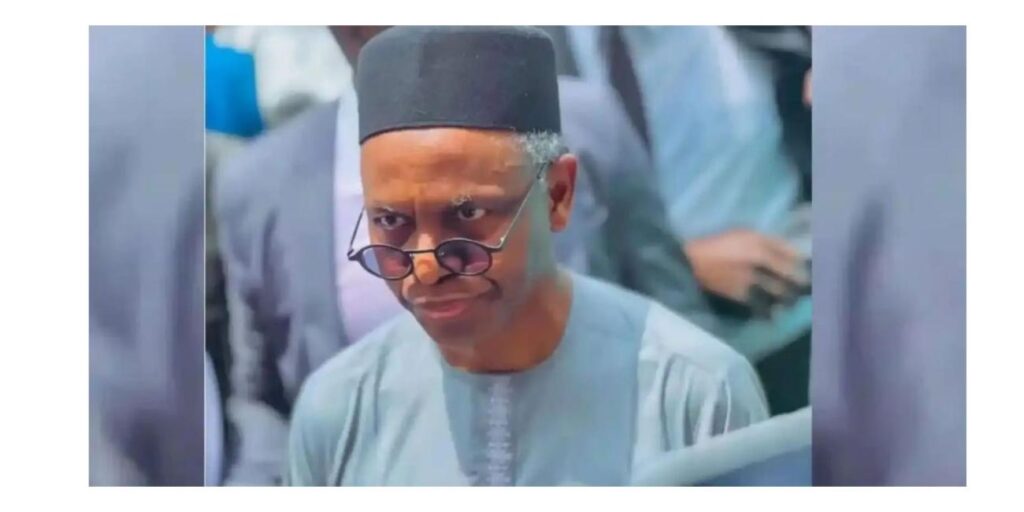
Fresh controversy has erupted around the ongoing trial of former Nasir El‑Rufai after journalists were barred from the courtroom during his bail application hearing at the Federal High Court Kaduna on Wednesday, raising serious concerns about transparency in one of Nigeria’s most closely watched corruption trials.
Reporters who arrived early at the court premises were denied access as security operatives enforced tight restrictions around the venue, allowing only a limited number of individuals into the courtroom. The unusual level of secrecy meant that media coverage of the proceedings relied largely on information from lawyers and a few insiders permitted within the restricted environment.
According to reports earlier published by SaharaReporters, the former Kaduna State governor arrived at the court premises at about 9:00am and stepped out of the vehicle conveying him at exactly 9:05am, drawing attention from security operatives and a handful of observers allowed within the court vicinity.
Proceedings resumed following Tuesday’s session, which had stalled after the defence team introduced fresh legal manoeuvres that altered the direction of the case. The court subsequently adjourned the hearing of the bail application to Wednesday under continued heavy security presence.
Counsel to the former governor, Ukpong Akpan, confirmed the adjournment on Tuesday but declined to disclose details of the proceedings.
“I’m sorry, I can’t talk now, we are in the middle of work. I have to go and file responses. The hearing of the bail application has been adjourned till tomorrow,” he reportedly said.
Following Tuesday’s proceedings, El-Rufai was escorted out of the court premises by operatives of the Independent Corrupt Practices and Other Related Offences Commission in a white Hilux vehicle, further reinforcing the tense atmosphere that has surrounded the case since his arraignment.
The former governor is currently standing trial before Justice Rilwan M. Aikawa on a 10-count charge bordering on alleged conversion and possession of public property, as well as money laundering, allegations that have drawn widespread national attention.
El-Rufai was brought before the court after spending over a month in detention, a development that has intensified public scrutiny and political reactions across the country.
The court had initially fixed March 31, 2026, for the hearing of all pending applications, including his bail request. However, the anti-graft agency had earlier released him on compassionate grounds on March 27, 2026, following the death of his mother, Hajiya Ummar El‑Rufai, who passed away in Cairo.
Despite his temporary release, Wednesday’s proceedings marked a continuation of the high-stakes legal battle that has kept political observers, legal experts, and the public on edge.
The decision to bar journalists from the courtroom has now sparked renewed debate over openness in judicial proceedings, particularly in high-profile corruption cases involving politically exposed persons.
As the trial continues under tight security and growing public interest, many observers warn that restricting media access risks undermining public confidence in the judicial process, especially in a case already surrounded by tension, speculation, and national attention.