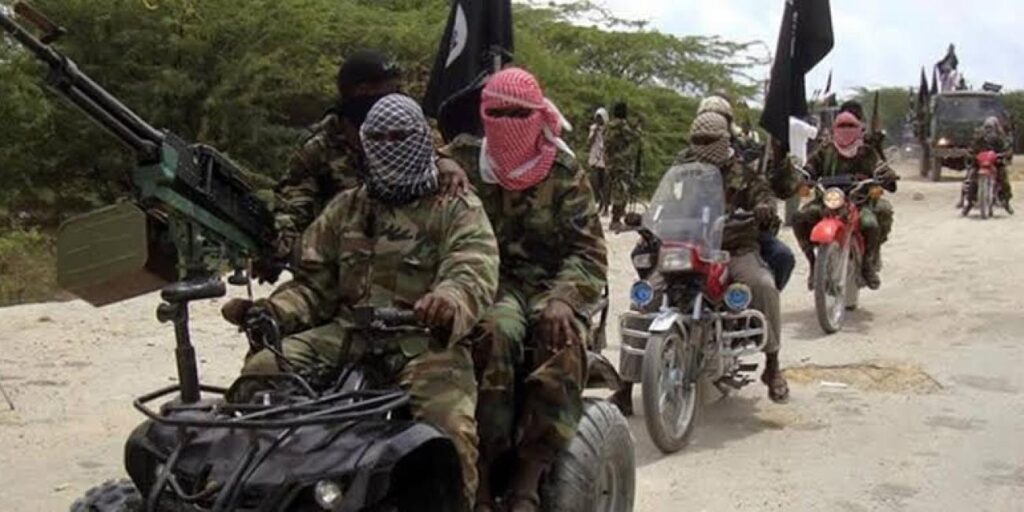
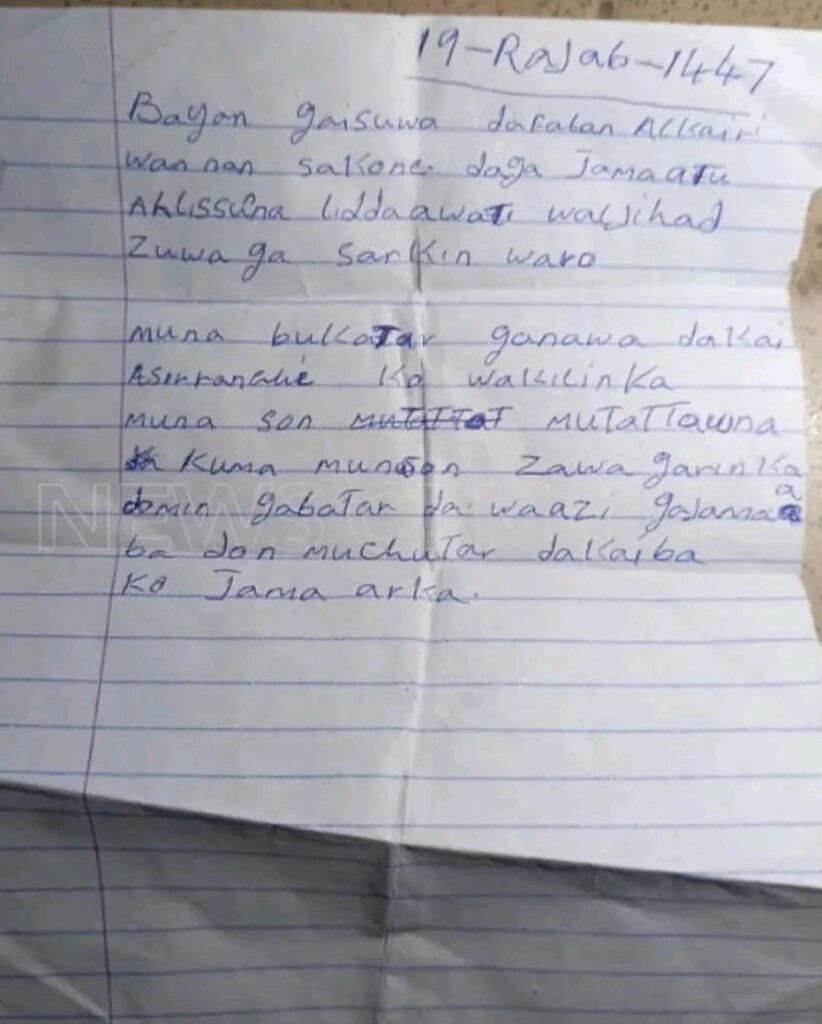
A handwritten letter sent by Boko Haram terrorists formally known as Jama’atu Ahlis Sunna Lidda’awati wal-Jihad, to the Sarkin Woro, the traditional ruler of Woro community in Kaiama Local Government Area of Kwara State, has surfaced days after a coordinated massacre that claimed the lives of over 170 people.
The letter, dated January 8, 2026 (19 Rajab 1447 AH), was written in Hausa and requested a personal meeting with the traditional ruler or, alternatively, his representative. The terrorists deceptively framed the request as a peaceful engagement for “preaching and guidance,” deliberately masking their violent intentions.
In the message obtained by SaharaReporters, the terrorists wrote in part:
“After greetings and good wishes, this message is from Jama’atu Ahlis Sunna Lidda’awati wal-Jihad to the Sarkin Woro. We are requesting a meeting with you personally, or alternatively with your representative.
We wish to discuss matters with you and remind you, particularly concerning preaching and guidance among your people. This is not a threat or a declaration of war against you or your people.”
Days later, the same community was thrown into mourning as armed terrorists stormed Woro, Nuku, and surrounding villages in a brutal, well-coordinated attack that wiped out entire families, razed homes, and forced survivors to flee into nearby bushes.
Residents of Kaiama have accused the Kwara State Government under Governor AbdulRahman AbdulRazaq of ignoring repeated distress calls and security warnings months before the massacre.
Multiple community members who spoke to Chronicles Reporters confirmed that youths had raised alarms several times after noticing strange, heavily armed men camping in forests surrounding their villages.
“Before these attacks happened, our youths went to the traditional ruler many times to report that strange people were gathering inside the forest close to our villages,” one resident said.
“They also informed the local government council and the state government. Everybody knew, but nobody came to protect us.”
Another resident corroborated the claims, stating that intelligence reports were escalated to both local and state authorities.
“We reported to the state government and local government authorities that terrorists were around us. We begged them to deploy security operatives to clear the forests,” the resident said.
“They kept assuring us that something would be done, but nothing happened.”
According to residents, the situation became more alarming around July–August 2025, when the movement of armed men in the forests intensified.
“There was a time the governor even promised that soldiers would be deployed to our area because of what we reported,” a source disclosed.
“He told some of our leaders that the Army would be sent, but till today, no soldier came. We were abandoned.”
Survivors described a prolonged attack that lasted several hours, with no immediate intervention from security forces.
“They came in large numbers with guns, shouting and shooting. People were running in all directions,” a survivor recounted.
“Our houses were burned. Many families were wiped out. We are still counting the dead.”
Community members insist the massacre did not happen overnight but was the result of months of unchecked terrorist presence.
“These people were around us for months. We warned the authorities. If they had listened, this massacre would not have happened,” a resident said.
On Wednesday evening, Governor AbdulRahman AbdulRazaq disclosed that no fewer than 75 peoplewere killed, stating that the victims were murdered after refusing to submit to what he described as a “strange and misguided doctrine” preached by the terrorists.
The governor made the statement after arriving in Kaiama alongside top service chiefs and members of his cabinet to commiserate with the Emir of Kaiama, His Royal Highness Alhaji Omar Mu’azu (Bagidi Kiyaru IV), and affected communities.
However, residents have strongly disputed the official death toll.
“It is so sad; the governor came after people died and even lied that it was only 75 people,” one resident said.
“Anybody who believes the dead are not up to 100 should come here and count the corpses themselves. This is just eye-service to the media.”
Community members maintain that the massacre was preventable and blame what they describe as gross government negligence and failure to act on credible intelligence.
“The government failed us,” a resident said.
“We did our part by reporting early. If they had deployed soldiers when we raised alarm, these terrorists would not have stayed here to plan and kill our people.”
As mass burials continue and survivors grapple with trauma, the emergence of the terrorists’ handwritten letter raises disturbing questions about intelligence failures, delayed response, and accountability at the highest levels of government.
Chronicles Reporters will continue to investigate the warning signs ignored, the true casualty figures, and the chain of responsibility behind one of the deadliest terror attacks in Kwara State’s history.