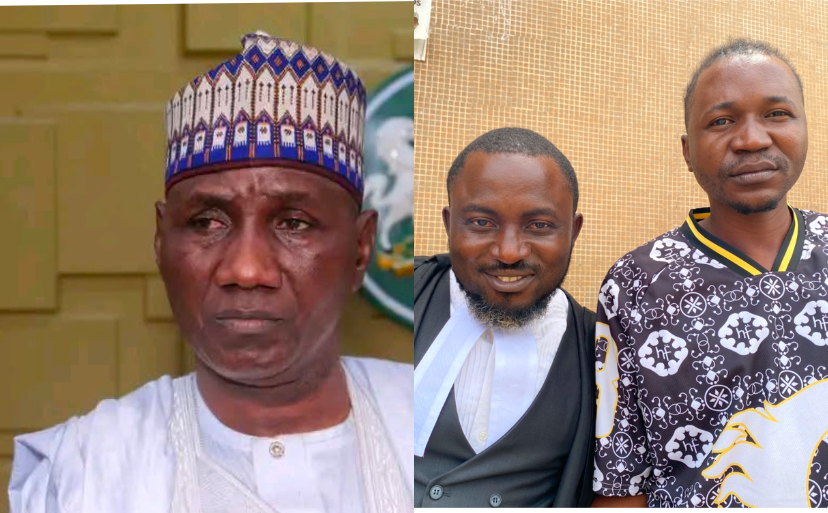
The tension that has long brewed in Gwagwalada Area Council took a dramatic turn today following the high-profile court session of Sowore vs. Ned Nwoko. The sidelines of the case became a stage for another explosive revelation: Manasseh B.P., widely known as the Revolutionary Chief Priest and a former face of the #BuhariMustGo and #RevolutionNow campaigns, vowed to drag the Gwagwalada Area Council Chairman, Abubakar Jubril Giri, before the law for alleged misappropriation of public funds and abuse of office.
Flanked by his legal counsel, Barrister Marshal Abubakar of Falana & Falana Chambers, Manasseh did not mince words. He accused the council chairman of “recklessly looting Gwagwalada’s lifeblood” while abandoning the masses to worsening conditions of poverty and infrastructural decay. According to his lawyer, Marshal, “the fate that befell the FCT Minister Wike will befall Giri, and the courts will reveal the truth about the mansions, hotels, and questionable assets he has amassed with council allocations.”
The fiery lawyer also took a personal jab at the chairman’s alleged political mentorship, quipping that Giri’s choice of a “drunken master” as his role model was both misguided and symbolic of the failures of his administration.
For months, whispers of financial recklessness have echoed through Gwagwalada, but Manasseh’s public declaration marks the most direct challenge yet to the council’s leadership. He alleged that council allocations, which run into billions of naira annually, are being diverted into lavish lifestyles, exotic cars for loyalists, and private business ventures, while ordinary residents face a collapse of basic services.
• Schools in Crisis: Classrooms across several wards are reportedly in deplorable condition, with leaking roofs, broken furniture, and unpaid teachers.
• Workers Unpaid: Civil servants claim they are owed months of salaries and allowances despite steady inflows from federal allocation.
• Healthcare Neglect: Local health centers, meant to serve thousands, are underfunded and understaffed, forcing residents to travel long distances for basic medical attention.
• Infrastructural Blackout: Roads linking communities within Gwagwalada remain riddled with potholes, while town hall projects and rural electrification schemes are either abandoned or non-functional.
“This is not governance; it is brazen exploitation,” Manasseh thundered. “Our chairman has chosen to feed his friends while starving his people.”
In a move that could set the stage for a landmark confrontation, Manasseh revealed that a Freedom of Information (FOI) request will be sent to the chairman’s office, demanding an official breakdown of all council expenditures within the last two years. The request, he emphasized, will seek clarity on the alleged diversion of funds into real estate, hotels, and luxury cars.
The FOI gives the chairman seven working days to respond. Failure to do so, Manasseh warned, will trigger escalated actions including:
• Filing a suit in the Federal High Court
• Petitioning anti-graft bodies such as the EFCC and ICPC
• Taking the case to national and international media platforms
• Mobilizing the people of Gwagwalada to “reclaim what is rightfully theirs”
The accusations against Chairman Giri, if substantiated, could deepen the crisis of confidence between leadership and the people in Gwagwalada. While residents have long murmured about neglect, this is the first time a prominent activist, backed by legal muscle, has threatened to haul the council before Nigeria’s anti-corruption agencies.
“This is about accountability and justice,” Barrister Abubakar assured reporters. “The same way the people exposed the excesses of the FCT Minister, the law will also strip the Gwagwalada chairman of the façade he hides behind. The houses, the hotels, the unexplained wealth – everything will be laid bare before Nigerians.”
The unfolding drama speaks to a wider national crisis: the endemic corruption and impunity within Nigeria’s local governance system. Area councils, designed to be the closest tier of government to the grassroots, have increasingly become hotbeds of mismanagement, where allocations meant for roads, schools, and hospitals allegedly vanish into private accounts.
For Gwagwalada, a council that hosts the University of Abuja and serves as a vital hub in the Federal Capital Territory, the stakes are even higher. Neglecting its infrastructure and people while flaunting unexplained wealth not only deepens inequality but also fuels the anger that activists like Manasseh are now channeling into legal confrontation.
As the crowd dispersed from the court premises, one line from Manasseh lingered in the air:
“The time is now. The people of Gwagwalada will no longer be spectators in their own story. We will demand answers, and this chairman will account for every naira and kobo.”
The days ahead may determine whether this is just another activist’s outburst or the beginning of a watershed legal battle that could reshape governance at the grassroots level of the FCT.